
This guide explains how gold commodity trading works on MCX: the gold and silver contracts, what a lot is worth and the margin it needs, expiry and delivery, what moves the price, the trading day in Indian time, four rule-based strategies with model numbers, a worked week, the duty-day gap of May 2026, sizing, costs, options, backtesting, and how to run the rules as an algo in QuantPower.
Gold commodity trading at a glance
| Feature | Gold and silver on MCX |
|---|---|
| Exchange | Multi Commodity Exchange of India (MCX) |
| Gold contracts | Gold (1 kg), Gold Mini (100 g), Gold Ten (10 g), Gold Guinea (8 g) and Gold Petal (1 g) |
| Silver contracts | Silver (30 kg), Silver Mini (5 kg), Silver Micro (1 kg) and Silver 100 (100 g) |
| Price | Rupees per 10 grams for gold (Gold Guinea per 8 grams, Gold Petal per gram) and per kilogram for silver, including import duty |
| Tick | ₹1: ₹100 per Gold lot, ₹10 per Gold Mini lot, ₹5 per Silver Mini lot, ₹1 per Silver Micro lot |
| Trading hours | 9:00 am to 11:30 pm while the US is on daylight saving time, 11:55 pm for the rest of the year |
| Expiry | Gold and Gold Mini on the 5th; Gold Ten, Guinea and Petal on the last trading day of the month; Silver on the 5th; Silver Mini and Micro on the last day of the month |
| Settlement | Compulsory delivery; most brokers close retail positions before the tender period |
| Margin | About 9.5% of contract value for gold and 13.5% for silver in this guide, based on September 2026 broker figures |
| Busiest hours | The evening, when US markets are open |
| Main risks | Overnight gaps, changes to import duty, US data and Fed decisions, delivery deadlines and leverage |
Key takeaways
- Each ₹1 change in the price per 10 grams moves a Gold Mini lot by ₹10, a Gold Ten lot by ₹1 and a standard Gold lot by ₹100. At a model volatility of 18% a year, a typical day's move is about ₹1,680 per 10 grams: ₹16,780 per Gold Mini lot.
- The MCX price is the international price in rupees plus 15% import duty. At $4,140 an ounce and ₹96.70 to the dollar that is about ₹1,48,000 per 10 grams; $10 an ounce adds ₹358, and a rupee ₹1 weaker adds ₹1,531.
- Silver moves almost twice as much as gold in percentage terms: about 2% on a typical day in our model, against 1.1% for gold. Stops, sizes and ratio trades have to allow for it.
- Margin is about 9.5% of contract value for gold, or ₹1.41 lakh per Gold Mini lot, and 13.5% for silver. With 1% risk per trade, the breakout in this guide uses about 28% of capital as margin, and a 6% gap would cost about 18% of capital.
- A round trip costs about ₹302 on a Gold Mini lot and ₹73 on a single Gold Ten lot. Per 10 grams, one Gold Ten lot costs more than twice as much, which matters for small targets.
- Bullion contracts are delivery contracts. Exits and rolls have to happen before the broker's cut-off, which can be a week before expiry.
How gold commodity trading works on MCX
Gold and silver trade on MCX as futures and options, with lot sizes from a kilogram of gold down to a gram. The futures price is quoted in rupees and includes the import duty, so it moves with the international price, the rupee and Indian duty together. Unlike crude oil, which settles in cash, bullion contracts are delivery contracts: positions still open at expiry are settled in metal through MCX's vaults. Retail traders almost always exit or roll before that point. For MCX as a whole, including the other commodities and how to activate the segment, see our guide to commodity trading.
The gold and silver contracts
| Contract | Lot size | Price quoted per | ₹1 move per lot | Value at model price | Margin | Typical day's move |
|---|---|---|---|---|---|---|
| Gold | 1 kg | 10 grams | ₹100 | ₹1.48 crore | ₹14.06 lakh | ₹1,67,820 |
| Gold Mini | 100 grams | 10 grams | ₹10 | ₹14.8 lakh | ₹1,40,600 | ₹16,780 |
| Gold Ten | 10 grams | 10 grams | ₹1 | ₹1,48,000 | ₹14,060 | ₹1,680 |
| Gold Guinea | 8 grams | 8 grams | ₹1 | ₹1,18,400 | ₹11,250 | ₹1,340 |
| Gold Petal | 1 gram | 1 gram | ₹1 | ₹14,800 | ₹1,410 | ₹170 |
| Silver | 30 kg | Kilogram | ₹30 | ₹65.4 lakh | ₹8.83 lakh | ₹1,31,830 |
| Silver Mini | 5 kg | Kilogram | ₹5 | ₹10.9 lakh | ₹1,47,150 | ₹21,970 |
| Silver Micro | 1 kg | Kilogram | ₹1 | ₹2,18,000 | ₹29,430 | ₹4,390 |
The model prices are gold at ₹1,48,000 per 10 grams and silver at ₹2,18,000 per kilogram, round figures close to mid-October 2026 levels. Margins use 9.5% of value for gold and 13.5% for silver, and the typical day's move uses a model volatility of 18% a year for gold and 32% for silver. MCX added a fourth silver size, Silver 100 (100 grams), in June 2026.
The rules in this guide work the same on every size; what changes is the money per tick and the cost per unit. Gold Mini is the contract most retail traders use, and its cost per 10 grams is close to the standard lot's. Gold Ten and Silver Micro let a smaller account run the same rules. Gold Guinea and Gold Petal are small enough to test a rule with real orders, but their costs per gram are high and their order books thinner.
Expiry, the tender period and delivery
MCX bullion futures are compulsory-delivery contracts. In the last few trading days before expiry, the staggered delivery or tender period, open positions can be marked for delivery, and anything still open at expiry must be settled in metal. Exchange margins can also rise in this period.
| Contract | Expiry | Tender period | Example of a broker cut-off |
|---|---|---|---|
| Gold | 5th of the contract month, a contract every two months | Last 3 trading days | |
| Gold Mini | 5th of every month | Last 3 trading days | Zerodha: 10:30 pm on 31 December 2025 for the 5 January 2026 contract |
| Gold Ten, Gold Guinea, Gold Petal | Last trading day of the month | Last 3 trading days | Fyers: 9:00 pm on 25 September 2026 for the 30 September 2026 contracts |
| Silver | 5th of the contract month | Last 5 trading days | |
| Silver Mini | Last calendar day of the contract month | Last 5 trading days | Zerodha: 10:30 pm on 20 February 2026 for the 27 February 2026 contract |
| Silver Micro | Last calendar day of the contract month | Last 3 trading days | Zerodha applied the Silver Mini cut-off above |
If the expiry day is a holiday, the contract expires on the working day before. For an algo, three rules follow:
- Set the last entry date and the exit or roll date from your broker's cut-off, not from the expiry date.
- Pick the contract month with the most volume and open interest, and switch to the next month the same way each time.
- Check whether your broker squares off positions automatically, and at what time.
Our pages on physical settlement and rollover explain the general mechanics.
MCX gold margin required per lot
MCX sets bullion margins from its risk model and adds margin in volatile periods and in the tender period. Broker figures for September 2026 put the margin at about ₹14.10 lakh for a standard gold lot, ₹8.80 lakh for a standard silver lot and 9.25% of contract value for Gold Ten. This guide uses 9.5% for gold and 13.5% for silver.
At 9.5%, the MCX gold margin required for one Gold Mini lot is about ₹1.41 lakh against a contract worth ₹14.8 lakh. That is leverage of about 10.5 times, so a 1% move in gold is about 10.5% of the margin. The MCX silver margin requirement is higher as a share of value because silver moves more: about ₹1.47 lakh for a Silver Mini lot and ₹29,430 for Silver Micro. Margins can change within a day, so check the current figure in your broker's F&O margin calculator and keep capital in reserve. Leverage works the same way in every futures market.
What moves the MCX gold price
The international price, the rupee and import duty
MCX gold is quoted in rupees per 10 grams, including the import duty. Its price is roughly the international dollar price per troy ounce (31.1035 grams) converted to 10 grams, multiplied by the rupee-dollar rate, plus 15% duty: a 10% basic customs duty and a 5% Agriculture Infrastructure and Development Cess (AIDC).

| Step | Per 10 grams |
|---|---|
| Gold at $4,140 an ounce, converted to 10 grams | $1,331.04 |
| In rupees at ₹96.70 to the dollar | ₹1,28,712 |
| Basic customs duty, 10% | +₹12,871 |
| AIDC, 5% | +₹6,436 |
| MCX price before any local premium or discount | ₹1,48,018 |
The traded price differs a little from this sum. Futures include the cost of carry to the expiry month, and Indian bullion trades at a premium or a discount to the import price depending on local demand. The rate of ₹96.70 is close to the ₹96.78 at which the rupee closed on 7 October 2026.
| Change | Per 10 grams | Per Gold Mini lot | Per Gold Ten lot |
|---|---|---|---|
| Gold up $10 an ounce, rupee unchanged | +₹358 | +₹3,575 | +₹358 |
| Gold up 1% | +₹1,480 | +₹14,800 | +₹1,480 |
| Rupee weakens by ₹1, gold unchanged | +₹1,531 | +₹15,307 | +₹1,531 |
| Rupee weakens by 50 paise | +₹765 | +₹7,653 | +₹765 |
| Duty back at 6% | −₹11,584 | −₹1,15,840 | −₹11,584 |
A strategy that reads only the COMEX chart misses the rupee and the duty. Rules built on the MCX price capture all three.
The duty increase of 13 May 2026
India raised the import duty on gold and silver from 6% to 15% with effect from 13 May 2026, lifting the basic customs duty from 5% to 10% and the AIDC from 1% to 5%. At unchanged world prices, that raises the landed cost by 8.5% (1.15 ÷ 1.06). MCX gold opened about 6% higher that morning, up about ₹9,200 at ₹1,62,648 per 10 grams, and silver opened about ₹16,700 higher at ₹2,95,805 per kilogram. Both opened at their 6% daily price limit. The opposite happened in July 2024, when the Budget cut the duty from 15% to 6% and MCX gold fell the same day.
Duty changes usually arrive in the Union Budget on 1 February or by an overnight notification, as in May 2026, when MCX is closed. No stop loss can act on them; only position size and holding rules can.
Rates, the dollar and demand
- US interest rates. Gold pays no interest, so higher real yields tend to weigh on it and falling rates support it.
- The US dollar. A stronger dollar usually lowers the dollar price of gold, but a weaker rupee can offset that for Indian traders.
- Central banks. Central banks have bought gold in large amounts since 2022, which has supported prices through periods of high rates.
- Risk events. Wars, financial stress and elections can lift gold as a haven, often outside Indian hours.
- Indian demand. Festivals and the wedding season mainly change the local premium or discount, not the futures trend.
- Indian policy. Import duty, GST and rules on gold imports.
Silver commodity trading: what changes from gold
Silver trades the same way on MCX, in rupees per kilogram with the same 15% duty, but it behaves differently.
- It moves more. At a model volatility of 32% a year, a typical day is about ₹4,390 a kilogram, or 2.0%, against 1.1% for gold.
- Industry matters. More than half of silver demand comes from industry, including solar panels and electronics, so silver also follows the economic cycle.
- The sizes differ. Silver (30 kg), Silver Mini (5 kg), Silver Micro (1 kg) and Silver 100 (100 g). On Silver Micro a ₹1 move is worth ₹1, which suits testing.
- The calendar differs. Silver Mini and Silver Micro expire at the end of their contract months, and Silver Mini's tender period is five trading days.
- The sensitivities differ. At $61 an ounce and ₹96.70, silver up $1 an ounce adds ₹3,575 a kilogram (₹17,876 per Silver Mini lot), and a rupee ₹1 weaker adds ₹2,255 a kilogram.
The practical consequence is in the stops. A stop of ₹400 per 10 grams on gold is about 0.27% of the price. The same share on silver is about ₹590 a kilogram, and a typical silver day covers that more than seven times. Base stops on the average true range (ATR) so that each metal gets a stop that fits its own movement.
The gold trading day in Indian time
| Time in India, US summer | In winter | What happens | What it means for a strategy |
|---|---|---|---|
| 9:00 am | 9:00 am | MCX opens; overnight moves show up as a gap | Check the gap against open stops before new entries |
| 9:00 am to 12:30 pm | 9:00 am to 1:30 pm | Asian hours, thinner trading in India | Fewer clean signals |
| 12:30 pm | 1:30 pm | London opens | Volume picks up |
| 5:00 pm | 5:00 pm | MCX's evening session begins | The breakout window opens |
| 5:50 pm | 6:50 pm | The main US trading hours begin | The busiest part of the day |
| 6:00 pm | 7:00 pm | US inflation (CPI) and jobs data | No new entries from 10 minutes before to 15 minutes after |
| 11:30 pm | 12:30 am | US Federal Reserve decisions, eight a year | In summer the decision lands at MCX's close; in winter, after it |
| 11:30 pm | 11:55 pm | MCX closes | Intraday positions are closed by 11:00 pm in the strategies here |
US daylight saving time ends on 1 November 2026, after which MCX closes at 11:55 pm and the US times above move an hour later in India until March.
How far gold and silver move
Model values at ₹1,48,000 per 10 grams with 18% annual volatility for gold, and ₹2,18,000 per kilogram with 32% for silver:
| Period | Gold per 10 grams | Per Gold Mini lot | Silver per kilogram | Per Silver Mini lot | Per Silver Micro lot |
|---|---|---|---|---|---|
| One day | ₹1,678 (1.1%) | ₹16,780 | ₹4,394 (2.0%) | ₹21,970 | ₹4,394 |
| One week | ₹3,752 (2.5%) | ₹37,520 | ₹9,826 (4.5%) | ₹49,130 | ₹9,826 |
| One month | ₹7,690 (5.2%) | ₹76,900 | ₹20,138 (9.2%) | ₹1,00,690 | ₹20,138 |
These are one standard deviation: about a third of the time the move is larger. The examples below assume an hourly ATR(14) of ₹360 per 10 grams on gold, which is ₹3,600 per Gold Mini lot.
Gold trading strategies for each market
| Market | Strategy | Timeframe | Main risk |
|---|---|---|---|
| Trending, driven by rates or central-bank buying | Hourly trend following | Days to weeks | Many small losses between trends, and overnight gaps |
| Quiet by day, active in the evening | Previous-day breakout | Intraday | False breaks and event spikes |
| Gold and silver out of line with each other | The gold-silver ratio | Weeks | The ratio drifting for months |
| Data and policy days | The event and policy filter | Applies to all | Gaps that no stop can cover |
Strategy 1: Trend following on the hourly chart
| Rule | Setting |
|---|---|
| Chart | 1-hour candles of Gold Mini futures |
| Entry | Buy when the 20-period EMA crosses above the 50-period EMA; sell on the reverse cross |
| Filter | Trade only in the direction of the 200-period EMA |
| Initial stop | 2 × ATR(14) from entry |
| Trailing stop | 2 × ATR from the best close since entry |
| Exit | The opposite cross or the trailing stop |
| Roll | Exit or roll at least one trading day before the broker's cut-off |
Example. Gold has been above its 200-hour EMA for two weeks. At 7:00 pm the 20-period EMA crosses above the 50 and the strategy buys one Gold Mini lot at ₹1,46,610. The ATR is ₹360, so the stop is ₹720 lower at ₹1,45,890: ₹7,200 at risk per lot. Over nine trading days gold climbs, the trailing stop follows it, and the trade exits on the opposite cross at ₹1,50,320. That is +₹3,710 per 10 grams, ₹37,100 per lot before costs and ₹36,796 after ₹304 of charges.
One trade like that usually carries the others. In the model month, the three signals before it lost ₹7,200, ₹4,800 and ₹6,100. After about ₹1,200 of charges for the four trades, the month made about ₹17,800; without the trend it would have lost about ₹19,000. Bullion trends can last weeks, driven by interest rates, the dollar and central-bank buying, but a rule set like this has to be judged over years. The trade also holds overnight, and the 13 May 2026 open moved gold by about 25 times the model's hourly ATR.
Strategy 2: Previous-day breakout in the evening
| Rule | Setting |
|---|---|
| Levels | The previous day's high and low, and their midpoint |
| Entry window | 5:00 pm to 9:30 pm |
| Entry | A stop order one tick above the previous high or below the previous low |
| Filter | Skip if the previous day's range was more than 1.5 times its 20-day average |
| Stop loss | The midpoint of the previous day's range |
| Target | 1.5 × the stop distance |
| Time exit | 11:00 pm |
| Limit | One trade a day |
Example. Friday's range was ₹1,47,800 to ₹1,48,600, so the midpoint is ₹1,48,200. On Monday at 6:20 pm gold trades through ₹1,48,600 and the buy stop fills at ₹1,48,602. The stop is ₹402 away at the midpoint, ₹4,020 per Gold Mini lot, and the target is 1.5 times that distance higher, at ₹1,49,205, worth ₹6,030. After charges of about ₹302 per round trip, a win makes ₹5,727. A loss, with the stop filling two ticks late at ₹1,48,198, costs ₹4,342.
With these numbers the rule breaks even at a win rate of about 43%, against 40% before costs. Starting at 5:00 pm keeps it out of the quieter daytime hours, when moves through the previous day's levels have less volume behind them. On Silver Mini the same rules, with a typical midpoint stop of about ₹2,000 a kilogram, risk about ₹10,000 per lot; on Silver Micro, about ₹2,000.
Strategy 3: The gold-silver ratio
The gold-silver ratio is the price of a gram of gold divided by the price of a gram of silver. On MCX:
In dollars per ounce the ratio is the same, $4,140 ÷ $61 = 67.9, because both metals carry the same 15% duty. It moves a lot. On MCX it was about 55 at the open on 13 May 2026, with gold at ₹1,62,648 and silver at ₹2,95,805, and about 68 in mid-October 2026: a 24% move in five months. Over longer periods it has ranged from about 32 in April 2011 to above 120 in March 2020.
A ratio strategy bets that the ratio returns to its recent average:
| Rule | Setting |
|---|---|
| Signal | The z-score of the ratio against its 60-day mean and standard deviation |
| Entry | Above +2: sell gold, buy silver. Below −2: buy gold, sell silver |
| Sizing | Balance the typical daily move of the two legs, not only their value |
| Exit | When the z-score returns to 0 |
| Stop | A z-score of ±3.5 |
| Time stop | Exit after 20 trading days if neither level is reached |
| Expiry | Roll both legs on the same day, before the earlier cut-off |
Sizing. Silver moves about 1.8 times as much as gold, so equal rupee amounts leave the trade mostly a bet on silver. Five Gold Ten lots (₹7.40 lakh) against two Silver Micro lots (₹4.36 lakh) balance the typical daily moves: about ₹8,390 on the gold leg and ₹8,790 on the silver leg. Margin for both legs is about ₹1.29 lakh.
Example. The ratio's 60-day mean is 64.0 and its standard deviation 1.9. At 67.9 the z-score is +2.05, so the strategy sells five Gold Ten lots at ₹1,48,000 and buys two Silver Micro lots at ₹2,18,000.
- The exit. Gold falls 2% to ₹1,45,040 and silver rises to ₹2,26,625, which brings the ratio back to 64.0. The gold leg makes ₹14,800 and the silver leg ₹17,250. After ₹534 of charges on seven lots, the trade makes ₹31,516.
- The stop. Gold rises 2% to ₹1,50,960 while silver falls to ₹2,13,673, so the ratio reaches 70.65, a z-score of +3.5. Both legs lose, ₹14,800 on gold and ₹8,654 on silver: ₹23,986 with charges.
Ratio trades carry two sets of margin and costs, their legs expire on different dates, and the ratio can drift for months when silver's industrial demand changes. A 60-day mean also moves: after a 24% swing like the one from May to October 2026, the average itself has shifted.
Strategy 4: The event and policy filter
Gold and silver react sharply to US data, Fed decisions and Indian policy. These rules sit on top of the strategies above.
| Event | Time in India, US summer | In winter | Rule |
|---|---|---|---|
| US inflation (CPI) | 6:00 pm | 7:00 pm | No new entries from 10 minutes before to 15 minutes after |
| US jobs report, usually the first Friday | 6:00 pm | 7:00 pm | Same |
| US Federal Reserve decision | 11:30 pm | 12:30 am | Close intraday positions; halve swing positions or hedge them with options |
| RBI policy | Morning | Morning | No new entries in the 15 minutes after the statement |
| Union Budget, 1 February | 11:00 am | Flat or hedged before the speech, which is where duty changes usually come | |
| Overnight, every day | Size so that a 6% gap is a loss you can accept |
Existing positions keep their stops. The filter blocks new entries while spreads widen and prices jump, and it caps size on nights when the risk cannot be stopped.
A worked week on one Gold Mini lot
Here is the previous-day breakout over one week on one Gold Mini lot. Prices are model prices, entries fill one tick beyond the stop order, and stops fill two ticks beyond the trigger. It illustrates the mechanics and is not a record of results.
- Monday, 5:00 pmFriday's range was ₹1,47,800 to ₹1,48,600, a normal width. Midpoint ₹1,48,200.
- Monday, 6:20 pmBuy at ₹1,48,602. Stop ₹1,48,200, target ₹1,49,205.
- Monday, 9:10 pmThe target fills: +₹603 per 10 grams, ₹5,727 after ₹303 of charges.
- Tuesday, 6:01 pmUS inflation data. Gold drops through Monday's low of ₹1,48,150 inside the blocked window and is back in the range by 6:15 pm. No trade.
- Wednesday, 7:05 pmTuesday's range was ₹1,47,900 to ₹1,48,900, midpoint ₹1,48,400. Gold breaks below ₹1,47,900 and the sell stop fills at ₹1,47,898. Stop ₹1,48,400, target ₹1,47,145.
- Wednesday, 8:30 pmGold turns back up through the stop, which fills at ₹1,48,402: −₹504 per 10 grams, −₹5,342 after charges.
- Thursday, 6:40 pmWednesday's range was ₹1,47,600 to ₹1,48,500, midpoint ₹1,48,050. Buy at ₹1,48,502. Stop ₹1,48,050, target ₹1,49,180.
- Thursday, 11:00 pmGold has risen but not reached the target. The time exit sells at ₹1,48,890: +₹388 per 10 grams, ₹3,577 after charges.
- Friday, 9:30 pmUS jobs data at 6:00 pm, and gold stays inside Thursday's range of ₹1,48,300 to ₹1,49,100 all evening. No trade.
| Monday | Tuesday | Wednesday | Thursday | Friday | The week | |
|---|---|---|---|---|---|---|
| Exit | Target | No trade | Stop | Time exit | No trade | |
| Per 10 grams | +603 | −504 | +388 | +487 | ||
| P&L before charges | +₹6,030 | −₹5,040 | +₹3,880 | +₹4,870 | ||
| Charges | ₹303 | ₹302 | ₹303 | ₹908 | ||
| Net P&L | +₹5,727 | −₹5,342 | +₹3,577 | +₹3,962 |
Costs took ₹908 of the ₹4,870, about a fifth. The two days without a trade were the filters working: the inflation release on Tuesday and a quiet jobs-day evening on Friday. And each trade put ₹4,000 to ₹5,000 at risk against ₹1.41 lakh of margin, which under the sizing rules below suits an account of about ₹5 lakh.
Gaps, price limits and the duty-day open
Gaps at the open
MCX is shut from the late-evening close until 9:00 am, while gold keeps trading in other markets almost around the clock. Fed decisions in winter, other central banks' statements, Asian trading and any Indian policy notification can all arrive while MCX is closed. After a gap a stop does not fill at its price; it fills at the first price available.
The open on 13 May 2026
The duty increase took effect before MCX opened. Gold opened about ₹9,200 higher per 10 grams and silver about ₹16,700 higher per kilogram, both at the 6% daily limit. A short Gold Mini lot lost about ₹92,000 at the open, nearly two-thirds of its margin; a short Silver Mini lot lost about ₹83,000. The move implied by the duty change, 8.5%, was larger than the limit, and with the price at the limit, buy orders to close shorts may not fill until trading resumes below it.
Price limits
MCX sets a daily price limit for each contract and can relax it after a cooling-off period. While a contract is locked at its limit, stops on the wrong side cannot fill, so the loss can run past the stop.
What gaps mean for sizing
Size for the gap as well as the stop. The breakout risks 1% of capital per trade at its stop, but a 6% gap against two Gold Mini lots on a ₹10 lakh account costs ₹1.78 lakh, nearly 18% of the account. Strategies that hold overnight should cap the number of lots so that a 6% gap stays within the loss you can accept.
Sizing a gold position
Size from the loss at the stop, then check margin and the gap. For the breakout, the risk per Gold Mini lot is the ₹4,020 stop plus ₹302 of charges, about ₹4,320; per Gold Ten lot it is about ₹475.
| Capital | Risk at 1% | Gold Mini lots | Margin used | Loss on a 6% gap | Or Gold Ten lots |
|---|---|---|---|---|---|
| ₹2 lakh | ₹2,000 | 0 | 4 (₹56,240 margin) | ||
| ₹5 lakh | ₹5,000 | 1 | ₹1.41 lakh (28%) | ₹88,800 (18%) | 10 |
| ₹10 lakh | ₹10,000 | 2 | ₹2.81 lakh (28%) | ₹1.78 lakh (18%) | 21 |
| ₹25 lakh | ₹25,000 | 5 | ₹7.03 lakh (28%) | ₹4.44 lakh (18%) | 52 |
With 1% risk and a stop of about 0.27% of the price, margin takes about 28% of capital at every size and a 6% gap about 18%. If 18% is more than you would accept on one night, trade fewer lots, keep to the intraday time exit, or move to Gold Ten and size down. The position size calculator does the arithmetic, and Kelly criterion position sizing explains why most traders stay well below the size the maths allows.
Costs per round trip
At ₹1,48,000 per 10 grams and ₹2,18,000 per kilogram, with brokerage of ₹20 per order:
| Contract | Brokerage | CTT | Exchange, SEBI and stamp | GST | Total | Per 10 grams or per kg |
|---|---|---|---|---|---|---|
| Gold Mini | ₹40 | ₹148 | ₹95 | ₹19 | ₹302 | ₹30.2 |
| Gold Ten | ₹40 | ₹14.80 | ₹9.50 | ₹8.40 | ₹73 | ₹72.6 |
| Gold (1 kg) | ₹40 | ₹1,480 | ₹947 | ₹124 | ₹2,592 | ₹25.9 |
| Silver Mini | ₹40 | ₹109 | ₹70 | ₹16 | ₹235 | ₹46.9 |
| Silver Micro | ₹40 | ₹21.80 | ₹14 | ₹8.90 | ₹85 | ₹84.7 |
CTT is 0.01% of the sell value of commodity futures. Exchange charges use MCX's rate of about ₹2.10 per lakh of turnover, the SEBI fee is ₹10 per crore, stamp duty is 0.002% of the buy value, and GST is 18% of brokerage, exchange charges and the SEBI fee.
On Gold Mini, costs of about ₹30 per 10 grams are 2% of a typical day's move; on a single Gold Ten lot they are 4%. For a rule aiming at a ₹100 move, one Gold Ten lot would give up most of each win and one Gold Mini lot about a third. Brokerage is charged per order, so ten Gold Ten lots in one order cost about the same as one Gold Mini lot. The brokerage calculator shows the charges for your own sizes.
Trading gold and silver options
MCX lists options on gold and silver. Some are options on futures: when exercised they become futures positions, which then follow the futures' delivery rules. Others, such as Gold Mini options, are options in goods with the metal itself as the underlying, so an option in the money at expiry can end in delivery. Check which kind a contract is, its expiry date and your broker's cut-off before trading it.
- Buyers pay the premium and can lose all of it. CTT on commodity options is 0.05% of the premium on the sell side.
- A bought put can hedge a long futures position over a Budget day or a Fed night, the kind of event a stop cannot cover.
- Liquidity is thinner than in the futures, especially away from the nearest expiry and the strikes near the current price.
Time decay and strike choice work the same way on commodity options as on index options.
Backtesting a gold strategy
- Use MCX prices, not COMEX. The rupee and the duty change the result, and a test on dollar prices misses both, including the May 2026 step.
- Include the duty changes. July 2024 and May 2026 produced large one-day moves. A test period without them understates gap risk.
- Use the right session times. MCX's close and the US events in Indian time shift twice a year.
- Roll on the dates you would use. Build the test from the contracts you would trade, rolled before the broker's cut-off, not from a series that rolls at expiry.
- Include costs and slippage, with wider fills on event days.
- Test several years, including sideways and falling years for gold, because trend rules depend on them.
- Paper trade through at least one US inflation release and one Fed decision before going live.
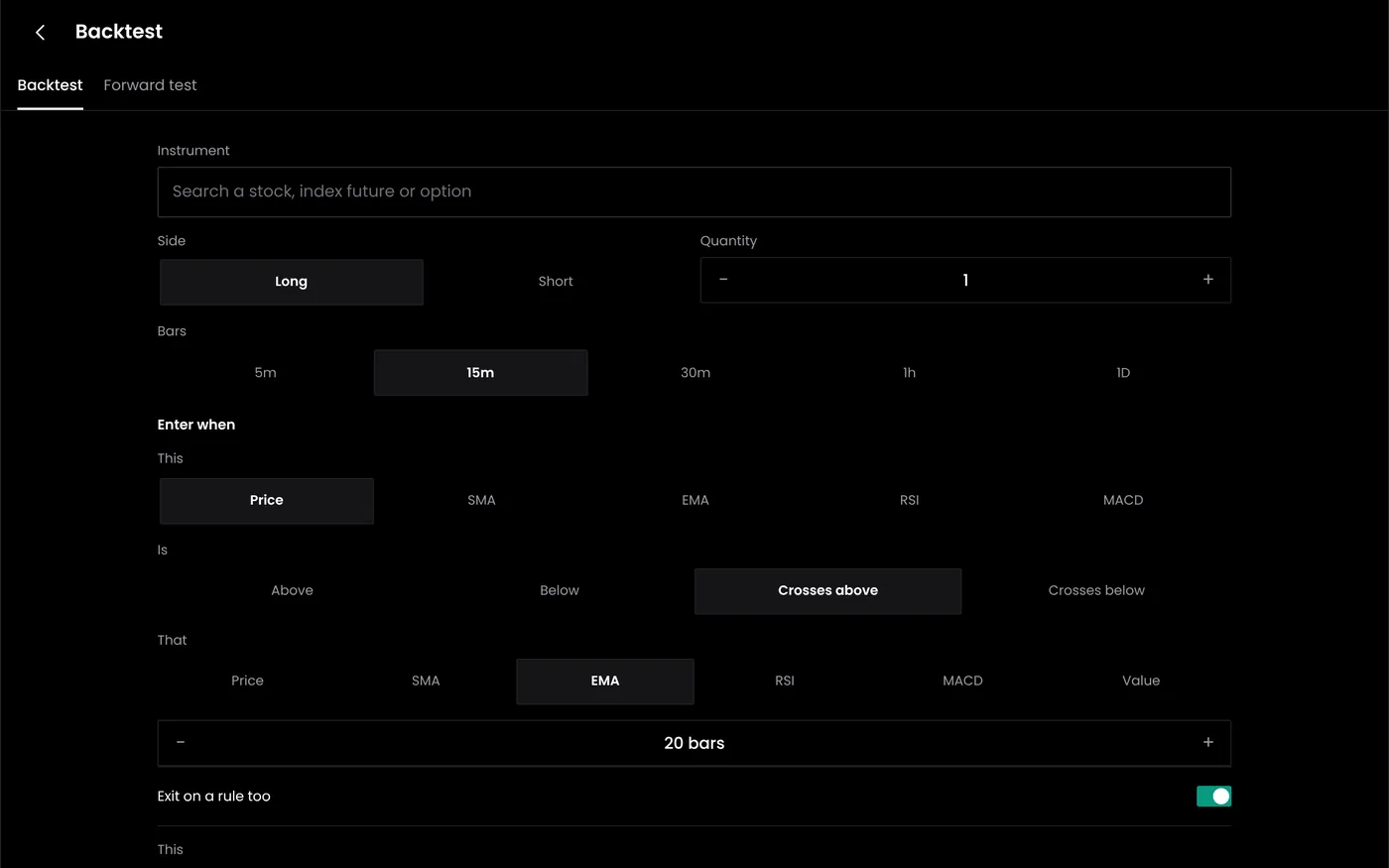
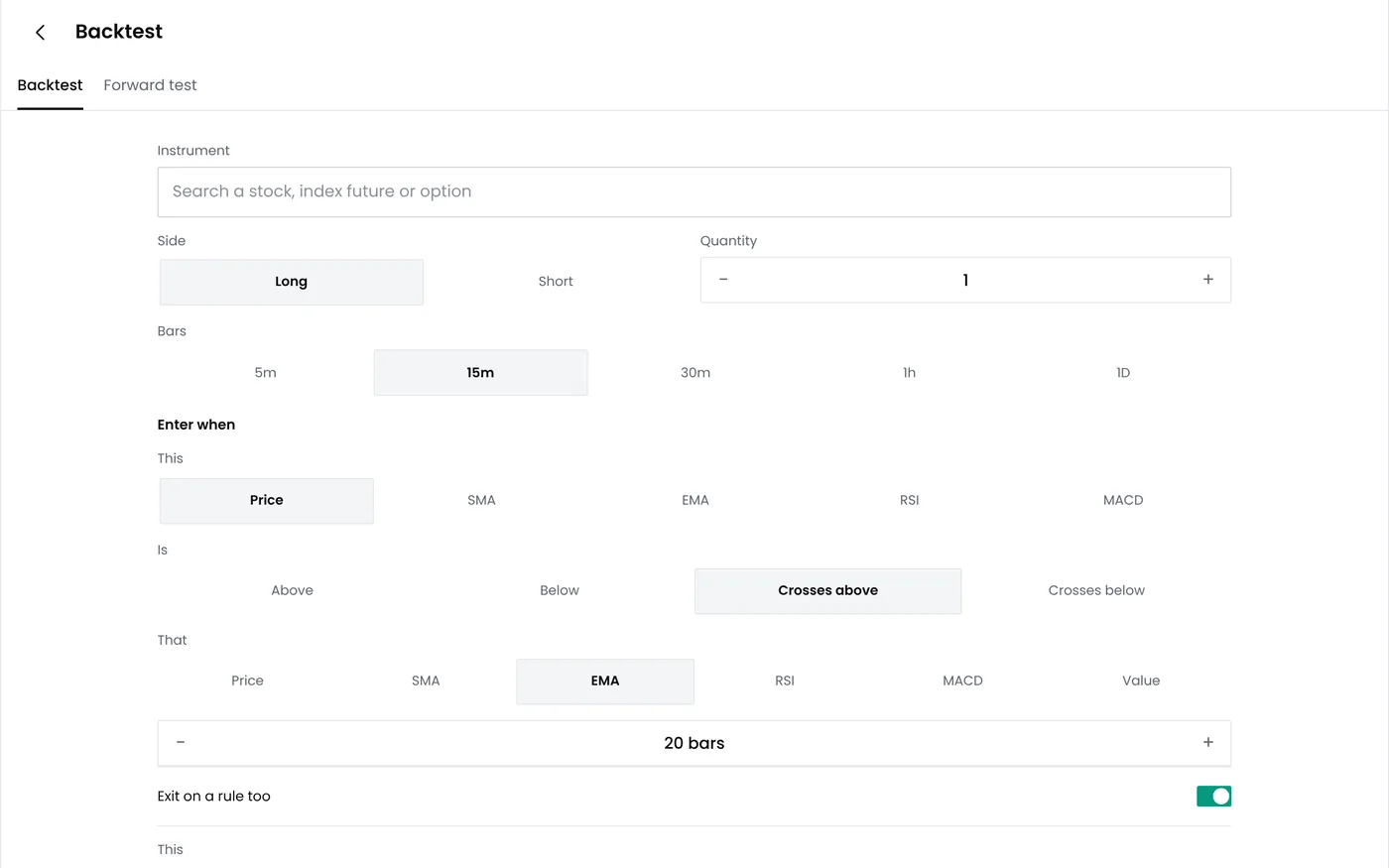
Our guides on how to backtest trading strategies and avoiding overfitting cover the method, and backtesting in QuantPower runs the tests on past MCX contracts.
Setting up a gold algo strategy in QuantPower
The previous-day breakout runs in the evening and depends on exact times, which suits automation. Here is a sample setup for this rule:
| Rule | Example setting |
|---|---|
| Instrument | Gold Mini futures, the active month |
| Session | 9:00 am to 11:30 pm, or 11:55 pm in winter |
| Levels | The previous day's high, low and midpoint |
| Range filter | Skip if the previous day's range was more than 1.5 times its 20-day average |
| Entry | Stop orders one tick beyond the levels, live from 5:00 to 9:30 pm |
| Stop loss | The midpoint of the previous day's range |
| Target | 1.5 × the stop distance |
| Event windows | No entries from 5:50 to 6:15 pm on US inflation and jobs days |
| Time exit | 11:00 pm |
| Trades per day | One |
| Roll | One trading day before the broker's cut-off |
| Account limit | Daily MTM loss limit |
Step 1. Build the rules
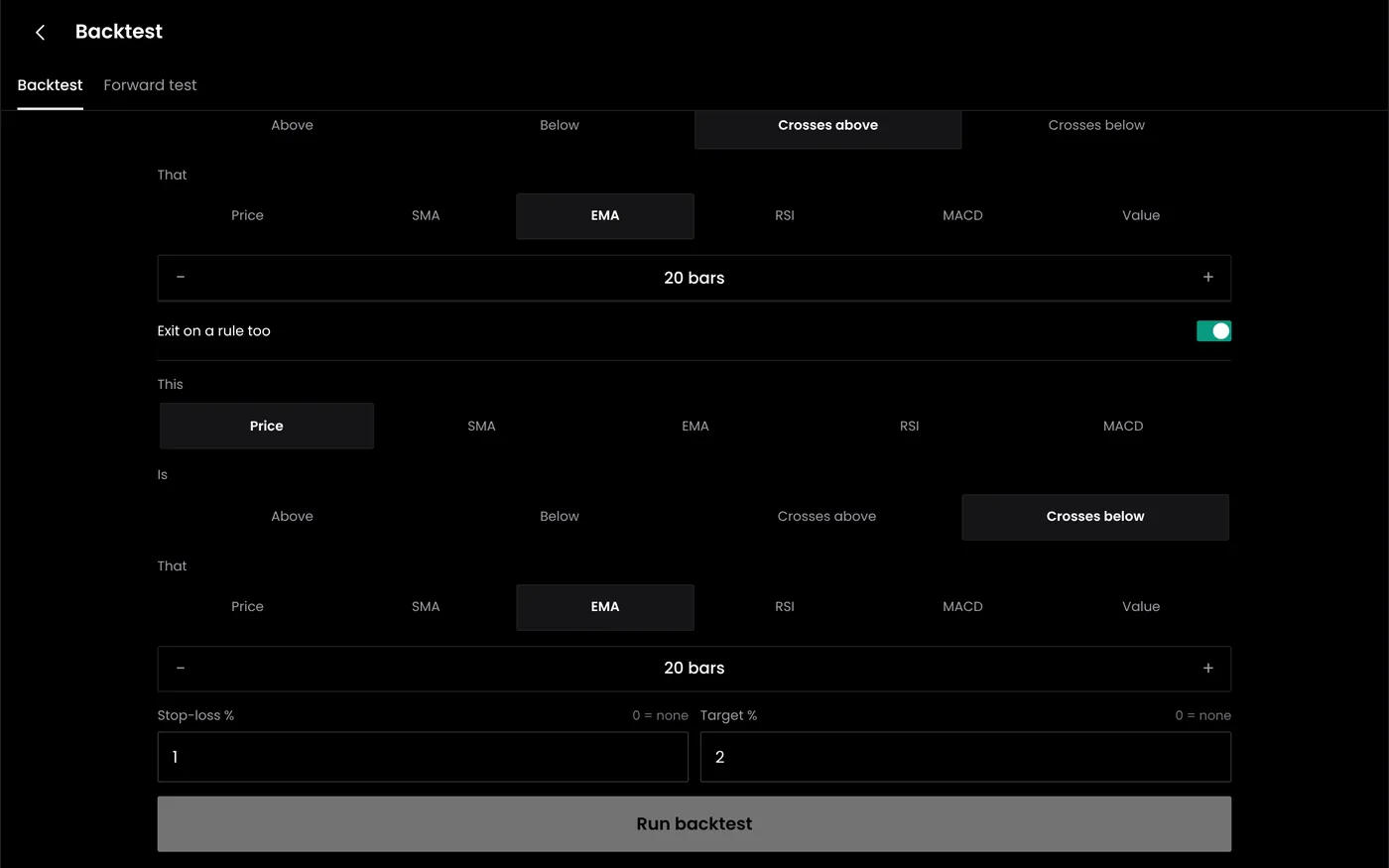
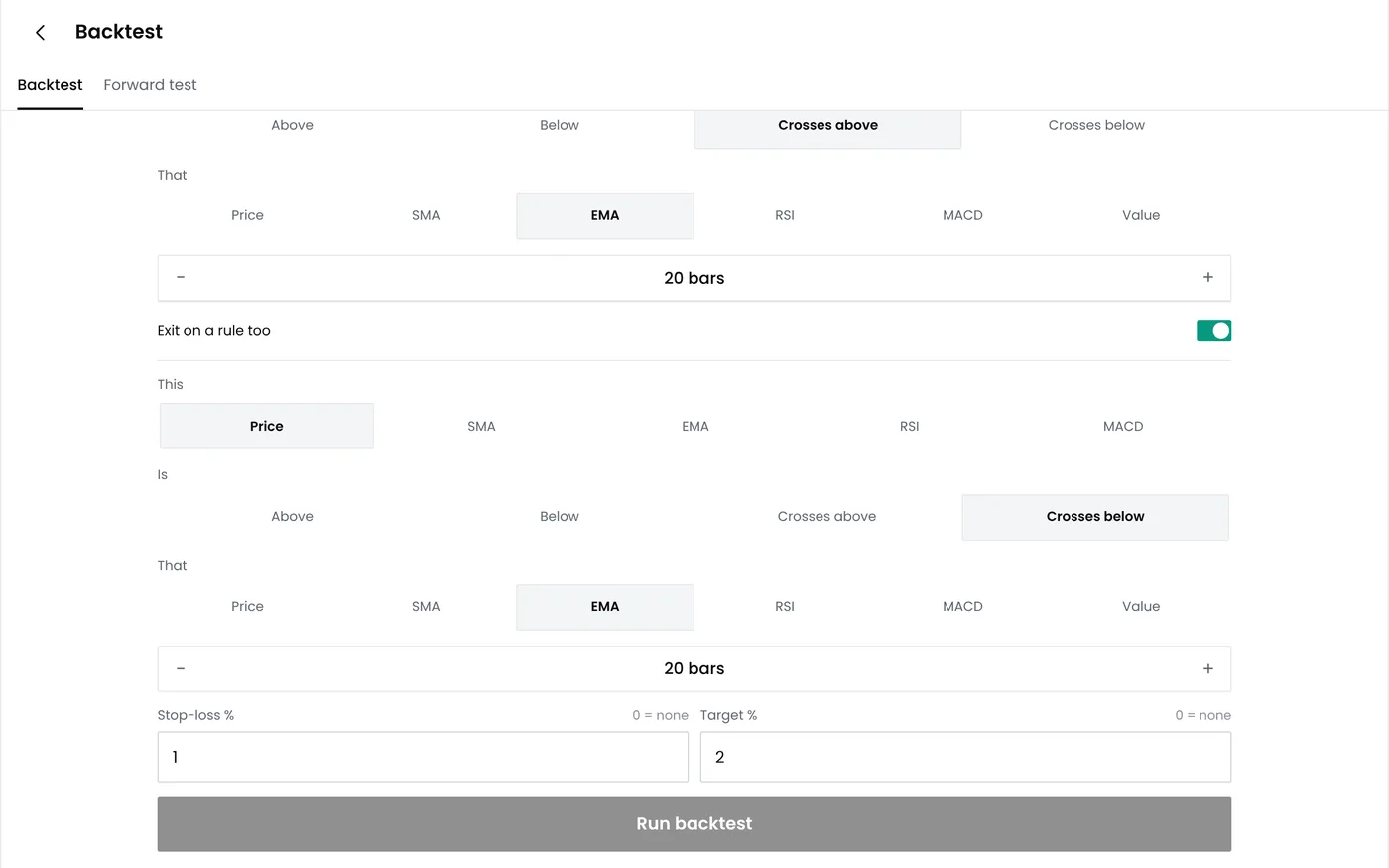
In the option strategy builder, choose Gold Mini futures, set the session times, then add the previous day's levels, the range filter and the entry orders.
Step 2. Set the exits, event windows and limits
Add the stop at the midpoint, the target, the 11:00 pm exit, the event windows and the one-trade limit. In winter, move the event windows an hour later.
Step 3. Backtest it
Run the rules over past Gold Mini contracts with costs and slippage on, rolled on the dates you would use, with summer and winter times set correctly. Change one setting at a time, such as the range filter or the target, and check how many trades each change affects.
Step 4. Paper trade it
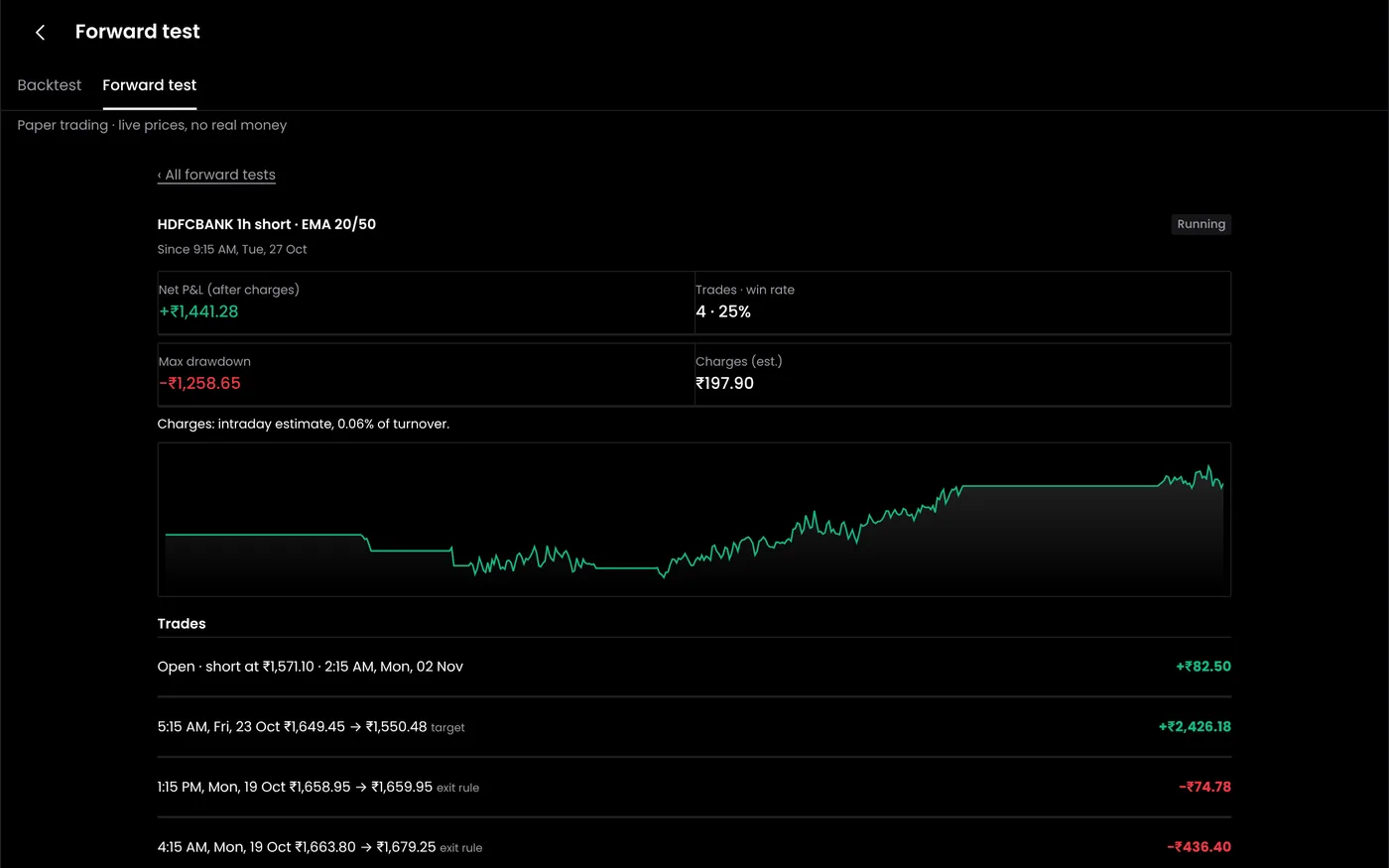
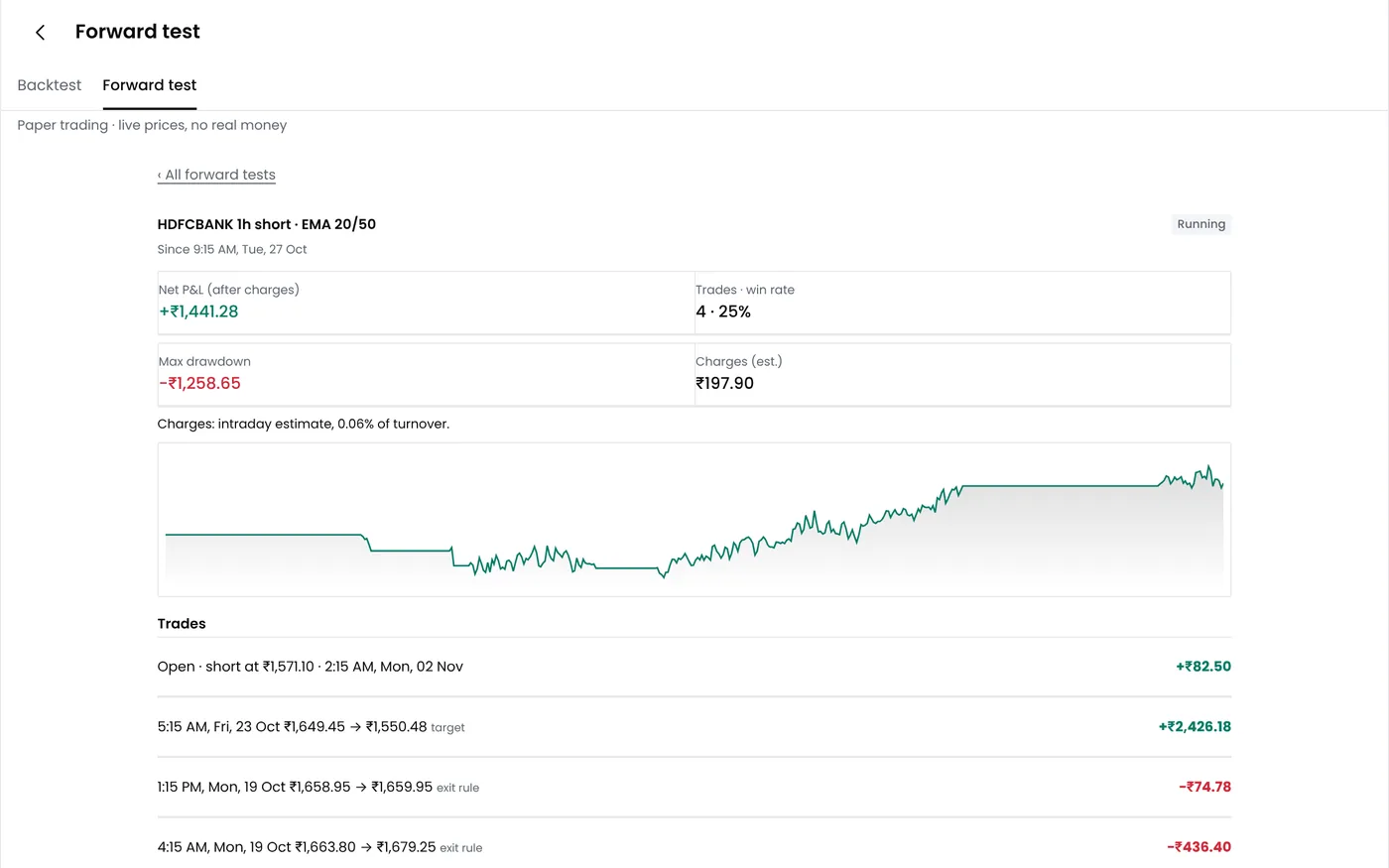
Run the strategy on live prices with virtual money for a few weeks, including a US inflation release, and compare each fill with the backtest's assumption. See the paper trading platform for options, which also runs commodity strategies.
Step 5. Set the account limit
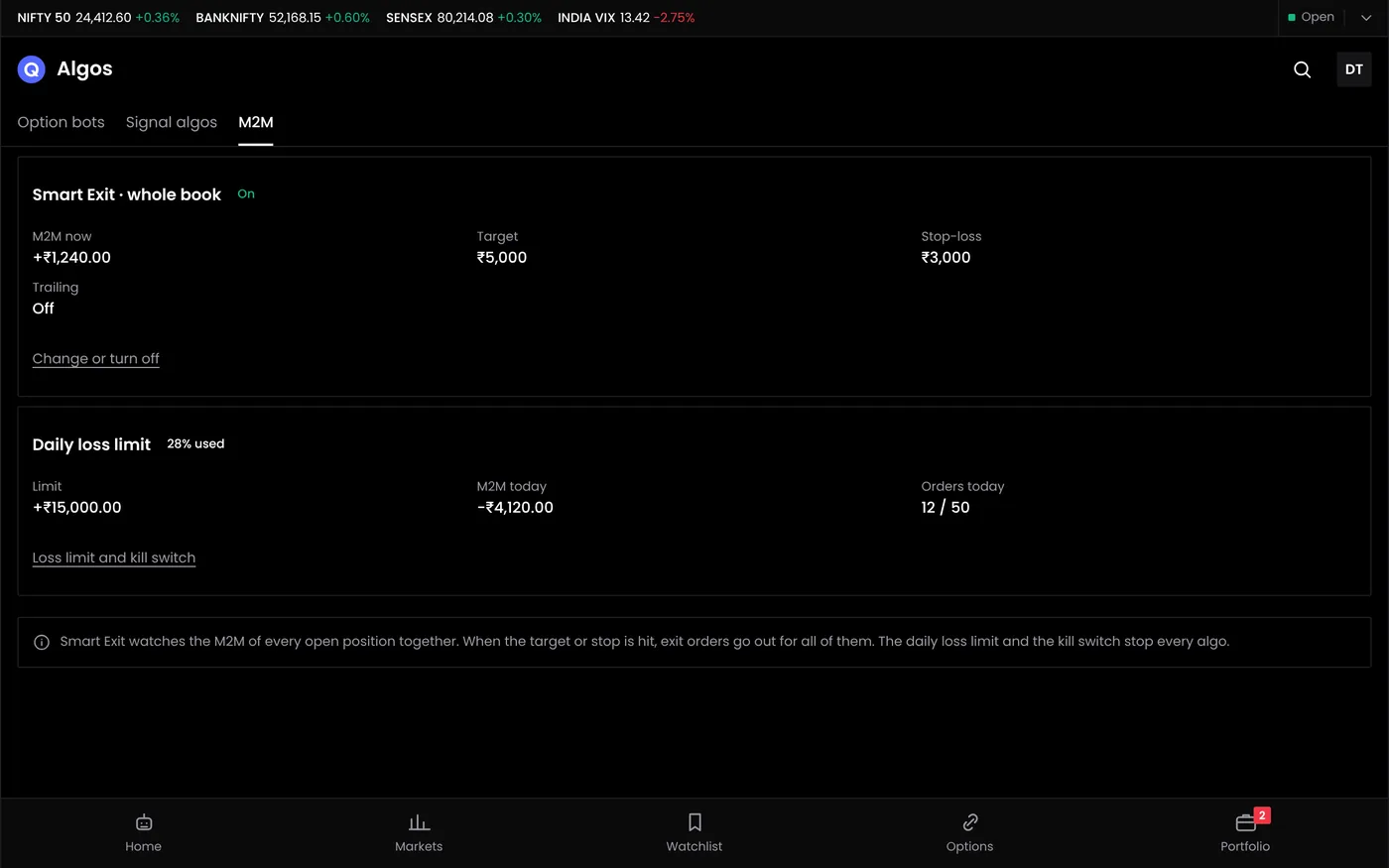
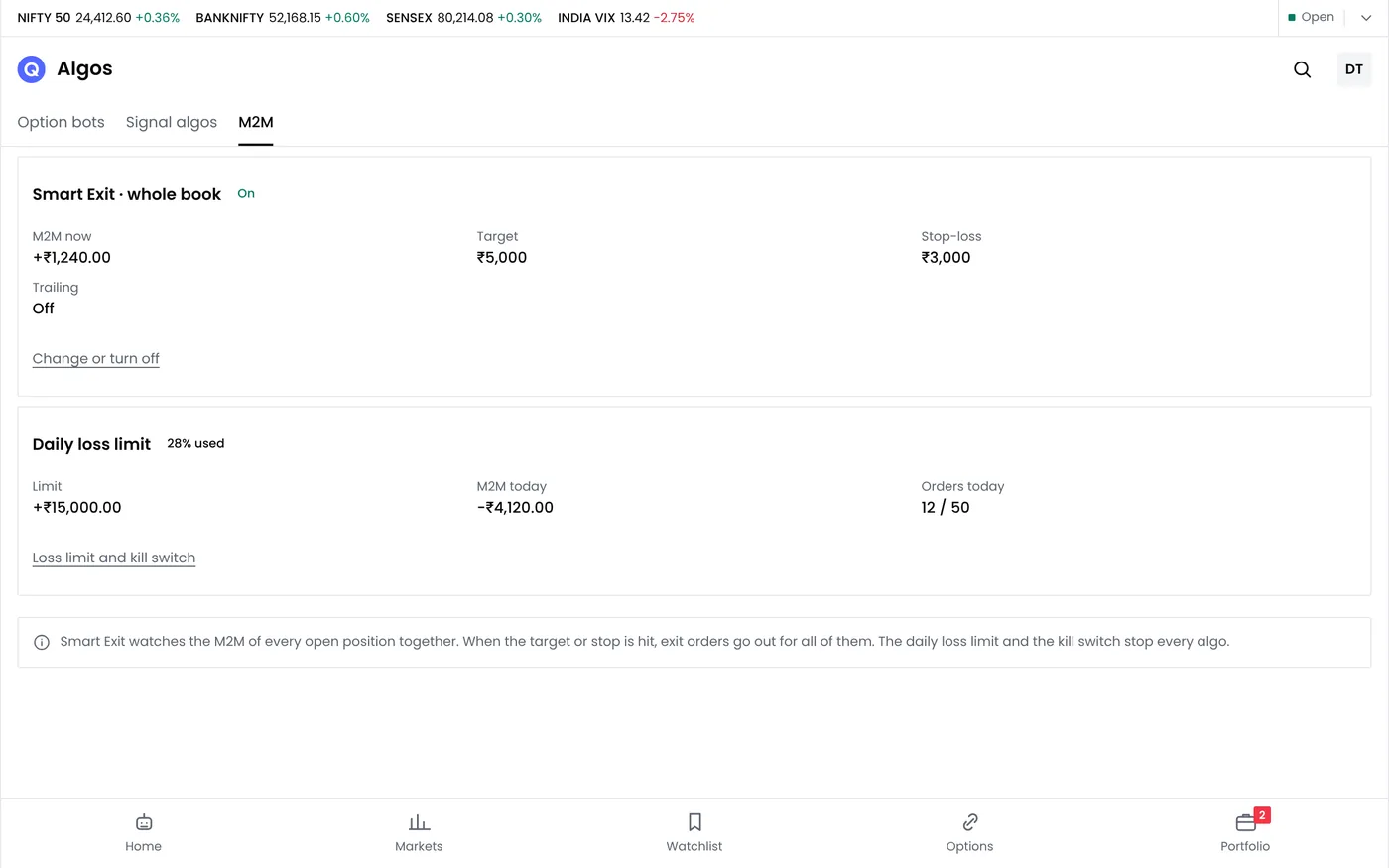
Set the daily MTM loss limit in the risk settings before going live. It closes every position when it is hit, including those from other strategies.
Step 6. Deploy and monitor
Connect your broker, check that the commodity segment is active on your account, choose the strategy and the number of lots, confirm the limits and deploy. The bot places the stop and the target as soon as the entry fills. A market alert can remind you of the roll date, and if your signals come from TradingView charts, signal trading turns the alerts into MCX orders. Orders go through your connected broker under the requirements applicable to your strategy and account; a named example is not a claim of strategy approval.
Measuring a gold strategy
| Measure | What to look for |
|---|---|
| Net result per trade | Positive after costs and slippage, over at least a hundred trades |
| Costs as a share of gross profit | Under a quarter on Gold Mini; check single Gold Ten lots separately |
| Largest gap against the stop | For rules that hold overnight, compared with the planned risk |
| Results on event days | US data days, Fed nights and Budget days against the rest |
| Results by metal | Gold and silver separately, because silver's wider stops change the trade count |
| Margin used | The peak share of capital, with room for a higher rate in volatile weeks |
| Roll costs | The price difference paid at each roll, for trend and ratio rules |
A trade journal helps track these week by week.
Common gold trading mistakes
- Holding into the tender period and having the broker square off the position at a poor price.
- Reading only the COMEX chart and ignoring the rupee and the duty.
- Sizing silver like gold, with the same stop in rupees or the same number of kilograms.
- Carrying full size into a Fed night or the Budget, when no stop can act.
- Trading the minutes around US data without a rule for them.
- Using summer times in winter for the session and the event windows.
- Treating the gold-silver ratio as hedged when it can drift for months.
- Trading single Gold Ten or Gold Petal lots with small targets, where the cost per gram is high.
Pre-trade checklist
- The event calendar is checked: US data, Fed decisions, RBI and any Budget or duty news.
- Session times and event windows match the current season.
- The contract month is chosen, and the exit or roll date is set before the broker's cut-off.
- The stop, target and time exit are set before the entry order.
- Lots follow from the risk per trade, and a 6% gap on the position is a loss you can accept.
- Margin uses no more than about a third of capital.
- The daily MTM limit is set for the account.
- The rules have been backtested on MCX prices with costs and paper traded through a US data day.
Start your free trial
Connect your broker, build a strategy and test it on paper before a single live order goes out.
Frequently asked questions
How do I start gold commodity trading?
Open a trading account with a broker that offers MCX and activate the commodity segment. Start with Gold Mini, or Gold Ten if your account is small, learn how the evening session, US data and the import duty affect the price, and paper trade a written rule set for a few weeks before risking money. Keep enough capital for margin and a buffer for gaps.
What is the lot size of gold on MCX?
1 kilogram for Gold, 100 grams for Gold Mini, 10 grams for Gold Ten, 8 grams for Gold Guinea and 1 gram for Gold Petal. Gold, Gold Mini and Gold Ten are quoted per 10 grams, so a ₹1 change moves a lot by ₹100, ₹10 and ₹1.
How much margin is required for MCX gold?
About 9.5% of contract value in September 2026 broker figures: roughly ₹14 lakh for a 1 kg Gold lot, ₹1.4 lakh for Gold Mini and ₹14,000 for Gold Ten at ₹1,48,000 per 10 grams. MCX raises margins in volatile periods and in the tender period, so check your broker's margin calculator before each trade.
What is the margin requirement for MCX silver?
About 13.5% of contract value at the prices in this guide: around ₹8.8 lakh for a 30 kg Silver lot, ₹1.47 lakh for Silver Mini and ₹29,000 for Silver Micro. The rate is higher than gold's because silver moves more.
Why is MCX gold priced above the international price?
Because the MCX price is in rupees and includes India's import duty, which has been 15% since 13 May 2026. At $4,140 an ounce and ₹96.70 to the dollar, gold worth ₹1,28,712 per 10 grams abroad trades at about ₹1,48,000 on MCX. Local premiums or discounts and the cost of carry to expiry add a little either way.
When do gold and silver contracts expire on MCX?
Gold and Gold Mini on the 5th of the month; Gold Ten, Gold Guinea and Gold Petal on the last trading day of the month; Silver on the 5th; Silver Mini and Silver Micro on the last day of their contract months. The tender period, when delivery can be triggered, covers the last three or five trading days, and most brokers close positions before it starts.
Can I take delivery of gold through MCX?
MCX bullion futures are delivery contracts, settled through the exchange's approved vaults. Most retail brokers do not offer delivery and close positions before the tender period, so futures are a trading tool rather than a way to buy physical gold.
Can I automate gold commodity trading?
Yes. A strategy built in QuantPower runs as a bot on your own broker account, provided the commodity segment is active. Orders go through your connected broker under the requirements applicable to your strategy and account; a named example is not a claim of strategy approval. Set the session times, event windows and roll dates before deploying.
Related guides and terms
- Commodity trading, MCX algo trading and MCX market timings
- Crude oil trading India
- Moving average crossover strategy, pairs trading statistical arbitrage and ATR volatility strategy
- Physical settlement meaning, rollover meaning and lot size meaning
- Trailing stop loss, how to place stop loss order and position size calculator
- F&O margin calculator, brokerage calculator and slippage calculator
Sources
- MCX, contract specifications for Gold, Gold Mini, Gold Ten, Gold Guinea, Gold Petal, Silver, Silver Mini and Silver Micro, and circular MCX/TRD/456/2025 of 11 September 2025 on the launch calendar of Gold Mini, Gold Ten, Gold Guinea and Gold Petal (mcxindia.com)
- CBIC, Customs Notifications No. 15/2026 to 18/2026 of 12 May 2026, raising the import duty on gold and silver to 15% from 13 May 2026
- Market reports of 13 May 2026 on MCX gold and silver opening at their 6% limits (Udaipur Kiran, Sahi, Invezz)
- Business Standard, 7 October 2026: rupee closes at 96.78 per dollar
- Broker expiry notices: Zerodha (December 2025 and February 2026 precious metals expiries) and Fyers (30 September 2026 staggered delivery contracts); ICICI Direct notes on gold and silver tender periods and the Silver 100 contract
- Broker margin data for September 2026 contracts, and broker charge schedules for CTT and MCX transaction charges
- Finance Act, 2013, Chapter VII: commodities transaction tax
- US Bureau of Labor Statistics release schedules for CPI and employment data (bls.gov), and the Federal Reserve's FOMC meeting calendar (federalreserve.gov)
- SEBI circular on safer participation of retail investors in algorithmic trading, 4 February 2025, and MCX's implementation circulars