
This guide explains each Greek with Nifty examples, shows how they change by strike and as expiry approaches, puts the Greeks of the common strategies side by side, breaks a day's profit or loss into its parts, and covers how traders use the Greeks to size positions, choose strikes, manage risk and write rules that software can run. The glossary entries on delta meaning, gamma meaning, theta and vega have the one-paragraph definitions; the strategy guides cover how each structure is traded.
Option Greeks at a glance
| Greek | Measures | Long call | Long put | Short call | Short put | When it matters most |
|---|---|---|---|---|---|---|
| Delta | Price change for a 1-point move in the underlying | + | − | − | + | Direction and sizing |
| Gamma | Change in delta for a 1-point move | + | + | − | − | Near expiry, at the money |
| Theta | Change for one day passing | − | − | + | + | Every day, fastest near expiry |
| Vega | Change for a 1-point change in IV | + | + | − | − | Before and after events |
| Rho | Change for a 1% change in interest rates | + | − | − | + | Long-dated options only |
Buyers own gamma and vega and pay theta; sellers collect theta and carry gamma and vega. Delta's sign depends on direction, not on whether the option is bought or sold.
Key takeaways
- Delta is three things at once: the rupees per point a position makes or loses, its equivalent futures exposure, and a rough chance of finishing in the money.
- Gamma is why a non-directional position does not stay non-directional. A short straddle's delta at entry is about −₹5 a point; after a 200-point rise it is about −₹21 a point.
- Theta decay in options is not steady. The at-the-money straddle loses about 300 points of value between 30 and 12 days to expiry, 180 in the next seven days and 120 in the three after that.
- Vega matters most around events. With Nifty unchanged, a fall in IV from 14% to 12% adds about ₹4,677 to a short straddle; a rise to 17% costs about ₹7,024.
- Wings shrink every Greek. An iron fly has about a tenth of a short straddle's theta and a tenth of its gamma, in exchange for a capped loss.
- The Greeks are model estimates. They assume one IV for every strike and smooth price moves; real markets have skew and gaps, so recheck them during the day and use the full payoff for large moves.
How to read the examples in this guide
All the numbers here come from the Black-Scholes model with these inputs:
- Nifty at 25,000
- 12 days to expiry
- Implied volatility (IV) of 14%
- An interest rate of 6.5%
- A lot size of 65 units, the Nifty lot from the January 2026 series
Each Greek is shown per unit, the way option chains display it, and per lot, which is what changes your P&L. Real Greeks differ slightly from these because each strike trades at its own IV, but the patterns hold. You can reproduce any of them with the Black Scholes option pricing calculator, which takes the same five inputs and returns the price and all five Greeks.
The five Greeks on one option
| Greek | What it measures | ATM Nifty call, per unit | Per lot of 65 |
|---|---|---|---|
| Delta | Change in option price for a 1-point move in Nifty | 0.54 | ₹35 per point |
| Gamma | Change in delta for a 1-point move in Nifty | 0.00063 | 0.041 per point |
| Theta | Change in option price for one day passing | −₹13.08 | −₹850 a day |
| Vega | Change in option price for a 1-point change in IV | ₹18.00 | ₹1,170 |
| Rho | Change in option price for a 1% change in interest rates | ₹4.35 | ₹283 |
The at-the-money (ATM) 25,000 call is worth about ₹280.48 in this model. The Greeks say that if Nifty rises one point, the call gains about 54 paise; if a day passes with nothing else changing, it loses about ₹13; if IV rises from 14% to 15%, it gains about ₹18. This guide covers how that price moves.
Delta
Delta is the change in an option's price for a one-point move in the underlying. Calls have deltas between 0 and 1, and puts have deltas between −1 and 0.
In our example the ATM call has a delta of 0.54 and the ATM put a delta of −0.46. They are not exactly 0.5 because interest rates put the forward price of Nifty slightly above spot, which nudges calls up and puts down.
Delta by strike
Delta depends on how far the strike is from the current price.
| Strike | Call price | Call delta | Put price | Put delta |
|---|---|---|---|---|
| 24,500 | ₹617.66 | 0.81 | ₹65.36 | −0.19 |
| 24,750 | ₹431.51 | 0.69 | ₹128.67 | −0.31 |
| 25,000 | ₹280.48 | 0.54 | ₹227.11 | −0.46 |
| 25,250 | ₹168.06 | 0.38 | ₹364.16 | −0.62 |
| 25,500 | ₹92.11 | 0.25 | ₹537.67 | −0.75 |
In-the-money options have deltas close to 1 or −1 and move almost one for one with the index. Out-of-the-money options have small deltas and barely react to small moves. The curve below shows the whole range, and how it steepens near the strike.

Three ways to use delta
Delta in option trading does three jobs.
As price sensitivity. A delta of 0.54 on one lot of 65 means the position gains about ₹35 for each point Nifty rises. A 100-point rally adds roughly ₹3,500, before gamma changes the delta along the way.
As a hedge ratio. One lot of Nifty futures has a delta of 65 rupees per point. One lot of the ATM call has a delta of about 35, so it behaves like roughly 0.54 lots of futures. To offset the delta of two lots of ATM calls, you would sell about one lot of futures.
As a rough probability. Many traders read a call's delta as an approximate chance of expiring in the money. It is a useful shortcut, but it slightly overstates the probability for calls: the 25,500 call has a delta of 0.25 and a model chance of about 25% of finishing in the money, but only about 18% of finishing above its break-even.
Position delta
The delta of a position is the sum of the deltas of its legs, multiplied by quantity and lot size. A short straddle sells one ATM call and one ATM put. Its delta at entry is the sum of −0.54 and +0.46, times 65, which comes to about −₹5 per point. That is close to neutral, which is why a straddle is described as non-directional. As the next section shows, it does not stay neutral for long.
Gamma
Gamma is the change in delta for a one-point move in the underlying. It tells you how quickly your directional exposure shifts as the market moves.
Gamma is highest for at-the-money options and rises sharply as expiry approaches:
| Days to expiry | ATM call gamma per unit | Change in delta for a 100-point move |
|---|---|---|
| 30 | 0.00039 | about 0.04 |
| 12 | 0.00063 | about 0.06 |
| 5 | 0.00097 | about 0.10 |
| 2 | 0.00154 | about 0.15 |
| 1 | 0.00218 | about 0.22 |
With a month to go, a 100-point move barely changes the delta of an ATM option. With a day to go, the same move can turn a 0.5-delta option into a 0.7-delta option. This is why options near expiry can swing from nearly worthless to valuable within an hour.
Long gamma and short gamma
When you buy options, you are long gamma. Your delta moves in your favour as the market moves: it rises when the market rallies and falls when it drops. Your gains speed up and your losses slow down.
When you sell options, you are short gamma, and the reverse happens. Our short straddle shows it clearly:
| Nifty level | Short straddle delta per lot |
|---|---|
| 24,800 | +₹11.3 per point |
| 25,000 | −₹5.0 per point |
| 25,100 | −₹13.0 per point |
| 25,200 | −₹20.7 per point |
As Nifty rises, the position becomes more and more short. As Nifty falls, it becomes more and more long. Either way, the position ends up leaning against the move, and losses grow faster the further the market travels. Gamma in options trading is the Greek sellers most often underestimate, because it is small on a quiet day and decisive on a busy one, and it is strongest on expiry day.
Exchanges recognise this risk. Since November 2024, SEBI's measures for index derivatives have included an additional 2% extreme loss margin on short index options on expiry day, which raises the cost of holding short gamma into the final session.
Theta
Theta is the change in an option's value for one day passing, with everything else unchanged. Buyers usually have negative theta and lose value each day. Sellers have positive theta and gain it.
Theta is not constant. It grows as expiry approaches, especially for at-the-money options:
| Days to expiry | ATM call price | ATM call theta per day | ATM straddle value |
|---|---|---|---|
| 30 | ₹469.35 | −₹9.06 | ₹805.49 |
| 12 | ₹280.48 | −₹13.08 | ₹507.59 |
| 5 | ₹174.72 | −₹19.52 | ₹327.18 |
| 2 | ₹107.85 | −₹32.53 | ₹206.80 |
| 1 | ₹75.33 | all remaining time value | ₹146.20 |
The straddle loses about ₹300 per unit between 30 and 12 days, then another ₹180 in the next seven days, then another ₹120 in the following three. The last days carry the fastest decay.

Out-of-the-money options decay differently
The 25,300 call shows another pattern. It is worth ₹324.40 with 30 days left, ₹150.11 with 12, ₹61.52 with five, ₹17.30 with two and ₹4.25 with one. In rupees it loses less each day than the ATM call, but in percentage terms it loses value much faster near the end. A buyer of cheap out-of-the-money options in the final days is fighting decay that can take most of the premium in a single session.
Theta is the price of gamma
Theta and gamma are two sides of the same trade. The seller collects theta and carries gamma risk; the buyer pays theta and owns gamma.
Our short straddle earns about ₹1,411 a day in theta. At 14% IV, a one-standard-deviation daily move in Nifty is about 183 points. Using gamma, the loss from a 183-point move is roughly half of gamma times the move squared: 0.5 × 0.081 × 183 × 183, or about ₹1,356. In other words, an ordinary one-standard-deviation day costs the seller about the same as a day of theta earns. The seller profits on days quieter than that and loses on days busier than that.

Repricing the straddle exactly rather than through the Greeks gives the curve above. The day's result is +₹1,411 if Nifty is unchanged, about +₹509 after a 100-point rise and about −₹1,213 after a 200-point rise; the break-evens for the day sit at about +135 and −247 points. The asymmetry comes from the position's small negative delta at entry, which makes a rise cost more than a fall of the same size. In the model, about 46% of trading days move further than one of those break-evens, so the seller's edge, if any, comes from IV being priced above the moves that actually occur, not from theta alone.
Vega
Vega is the change in an option's value for a one-point change in implied volatility. If IV rises from 14% to 15%, an option with a vega of ₹18 gains about ₹18 per unit.
Vega is larger for longer-dated options and for options near the money:
| Days to expiry | ATM call vega per unit | Per lot |
|---|---|---|
| 30 | ₹28.28 | ₹1,838 |
| 12 | ₹18.00 | ₹1,170 |
| 5 | ₹11.65 | ₹757 |
| 2 | ₹7.38 | ₹480 |
| 1 | ₹5.22 | ₹339 |
Buyers are long vega and gain when IV rises. Sellers are short vega and gain when IV falls. Our short straddle has a vega of about −₹2,340 per lot. With the index unchanged, a fall in IV from 14% to 12% would add about ₹4,677 to the seller's P&L. A rise from 14% to 17% would cost about ₹7,024. The effect is not perfectly linear, which is why the three-point rise costs more than one and a half times the two-point fall.
Vega, India VIX and events
India VIX measures the volatility the market expects for Nifty over the next 30 days, based on Nifty option prices. It is a good guide to the general level of IV, though each strike and expiry has its own IV.
IV usually rises before scheduled events, such as RBI policy announcements, the Union Budget or election results, and falls after them. That fall is why option buyers can be right about direction and still lose money, and why sellers often target the days after an event. Our page on implied volatility option trading shows whether the current IV is high or low against its recent range.

Rho
Rho is the change in an option's value for a one percentage point change in interest rates. Calls have positive rho and puts negative rho.
The ATM call in our example has a rho of about ₹4.35 per unit, or ₹283 per lot. RBI usually moves rates in steps of 25 basis points, which would change this call's value by about ₹71 per lot. For short-dated index options, rho is the least important Greek. It matters more for long-dated options and for strategies that hold large positions for months.
Greeks of common strategies
Position Greeks let you compare strategies on the same scale. The figures below are per lot at Nifty 25,000 with 12 days to expiry.
| Strategy | Delta (₹ per point) | Gamma | Theta (₹ a day) | Vega (₹ per IV point) |
|---|---|---|---|---|
| Long ATM call | +35.0 | +0.041 | −850 | +1,170 |
| Short straddle, 25,000 | −5.0 | −0.081 | +1,411 | −2,340 |
| Short strangle, 25,300 and 24,700 | −4.6 | −0.073 | +1,259 | −2,110 |
| Iron condor, 24,500/24,750/25,250/25,500 | −0.8 | −0.016 | +278 | −422 |
| Iron fly, 24,700/25,000/25,300 | −0.4 | −0.009 | +152 | −230 |
| Bull put spread, 24,750/24,500 | +8.1 | −0.009 | +117 | −239 |
| Bear call spread, 25,250/25,500 | −8.9 | −0.007 | +160 | −183 |
A few patterns stand out:
- Naked short options carry the most of everything. The short straddle earns the most theta and carries the most gamma and vega risk.
- Wings shrink every Greek. The iron fly strategy is a short straddle with protective wings. Its theta is about a tenth of the straddle's, and so is its gamma. You give up most of the decay in exchange for a capped loss; the iron condor strategy makes the same trade with wider strikes.
- Credit spreads lean one way. The bull put spread has positive delta and benefits from a rise; the bear call spread has negative delta and benefits from a fall.
You can build any of these and see their Greeks change as you move strikes in the option profit calculator.
How the Greeks change together
The Greeks are linked, so changing one input changes several Greeks at once.
- As expiry approaches: ATM gamma and theta rise, vega falls, and out-of-the-money deltas shrink toward zero while in-the-money deltas move toward 1.
- As the market moves toward your strike: gamma and theta rise, and delta moves toward 0.5.
- As IV rises: option prices rise, out-of-the-money deltas rise, ATM gamma falls, and the whole curve of possible outcomes widens.
- As IV falls: the reverse. ATM gamma rises, so a short position near expiry in a calm market can still be hit hard by a sudden move.
Putting the Greeks together: a P&L breakdown
The Greeks can explain where a day's profit or loss came from. Take the long ATM call from the start of this guide: one lot of 65 bought at ₹280.48, with Nifty at 25,000 and 12 days to expiry. The next day, Nifty is up 100 points and IV is unchanged.
| Source | Calculation per unit | Per unit |
|---|---|---|
| Delta | 0.5386 × 100 | +₹53.86 |
| Gamma | ½ × 0.00063 × 100 × 100 | +₹3.15 |
| Theta | one day of decay | −₹13.08 |
| Total estimate | +₹43.93 |
That estimate is about ₹2,855 per lot. Repricing the option exactly gives about ₹2,851, so the Greeks explain the result almost entirely. If IV had also fallen one point, vega would subtract roughly another ₹18 per unit; the exact repricing shows a gain of about ₹1,760 per lot, slightly more than the simple vega estimate suggests, because the Greeks interact.
This kind of breakdown answers the question every options trader asks after a surprising day: was it direction, time or volatility?
Using the Greeks in practice
Size positions by delta
Convert every position into equivalent futures exposure. One lot of Nifty futures is 65 rupees per point. A portfolio with a combined delta of +130 rupees per point behaves like two lots of long futures for small moves. If that is more directional exposure than you intended, reduce it or hedge it.
Check gamma before expiry day
Before holding short options into the final day, look at position gamma. If a 100-point move would change your delta by more than you are comfortable with, close or hedge the position earlier.
Compare theta with the expected move
The theta-and-gamma relationship gives a simple test for sellers. If the day's theta is smaller than the loss a normal move would cause, the position needs a quieter market than usual to make money.
Watch vega around events
Before a scheduled event, IV is often high, which inflates premiums for sellers and makes options expensive for buyers. A seller who enters before the event takes the gap risk of the announcement. A seller who enters after it collects less premium but avoids that risk.
Hedge delta when it drifts
Delta-neutral traders adjust their hedge when position delta moves outside a band, for example by buying or selling futures, or by moving one leg of the position. Our delta neutral strategy page explains how rule-based rebalancing works.
Manage Greeks at account level
If you run several strategies, add their Greeks together. Two separate short straddles on Nifty and Sensex are not diversified; they are both short gamma on two indices that tend to move together.
Greeks across a whole account
Suppose you hold two lots of the short straddle and one lot of the long ATM call from this guide. Adding the per-lot figures from the strategy table:
- Delta: 2 × (−5.0) + 35.0 = +25 rupees per point.
- Theta: 2 × 1,411 − 850 = +₹1,972 a day.
- Vega: 2 × (−2,340) + 1,170 = −₹3,510 per IV point.
The account is mildly bullish, earns decay and is exposed to a rise in volatility. Seeing the total helps you decide whether the mix is what you intended.
Greeks on expiry day
On the final day, the Greeks of at-the-money options become extreme:
- Gamma for the ATM call reaches about 0.00218 per unit with one day left in our model, more than three times its value with 12 days left.
- Theta absorbs all the remaining time value. The ATM call worth ₹75.33 with one day left has little else to lose.
- Vega shrinks to about ₹5.22 per unit, so IV matters less than price.
Positions that were comfortable a week earlier can swing sharply.
Limits of the Greeks
The Greeks are powerful, but they are estimates.
- They depend on a model. Black-Scholes assumes constant volatility and smooth price moves. Real markets have jumps and changing volatility.
- Each strike has its own IV. Out-of-the-money puts on Indian indices usually trade at higher IV than calls the same distance away, a pattern called skew. Greeks calculated with one IV for every strike will be slightly off.
- They describe small changes. Delta and vega are accurate for small moves. For large moves, use the full payoff at the new price instead of multiplying by the Greek.
- They change constantly. The Greeks at 9:20 am are not the Greeks at 2:30 pm. Recheck them during the day.
- They ignore liquidity. A Greek does not tell you how wide the bid-ask spread is or whether you can exit at the price you expect.
Second-order Greeks
Beyond the five main Greeks, a few second-order measures describe how the Greeks themselves change:
- Vanna: how delta changes when IV changes, or equally how vega changes when the price moves. It explains why the IV fall in the P&L breakdown affected the result slightly differently from vega alone.
- Charm: how delta changes as time passes. Out-of-the-money deltas drift toward zero as expiry approaches, even if the index does not move.
- Vomma: how vega changes when IV changes. Positions with large vomma gain or lose vega quickly when volatility jumps.
Most retail traders do not need to calculate these, but knowing they exist explains why simple Greek estimates sometimes miss.
What to check on the option chain
Before trading, look at these Greeks for the strikes you plan to use on the Nifty option chain:
- Delta to choose strikes and size the directional exposure.
- Theta to see what a quiet day costs or earns.
- Vega to see how exposed the position is to a change in IV, especially near events.
- IV by strike, to see the skew between puts and calls.
Start your free trial
Connect your broker, build a strategy and test it on paper before a single live order goes out.
Greeks and algorithmic trading
Because Greeks are numbers, they are easy to turn into rules. Common examples:
- Choose strikes by delta. Sell the call and put nearest to a delta of 0.20, rather than a fixed number of points away. The rule adapts as volatility changes.
- Exit when delta drifts. Close or adjust a short strangle if its delta passes a threshold, such as 20 rupees per point.
- Skip entries when vega risk is high. Do not sell options on the morning of a scheduled event.
- Limit gamma near expiry. Exit short ATM options by a fixed time on expiry day.
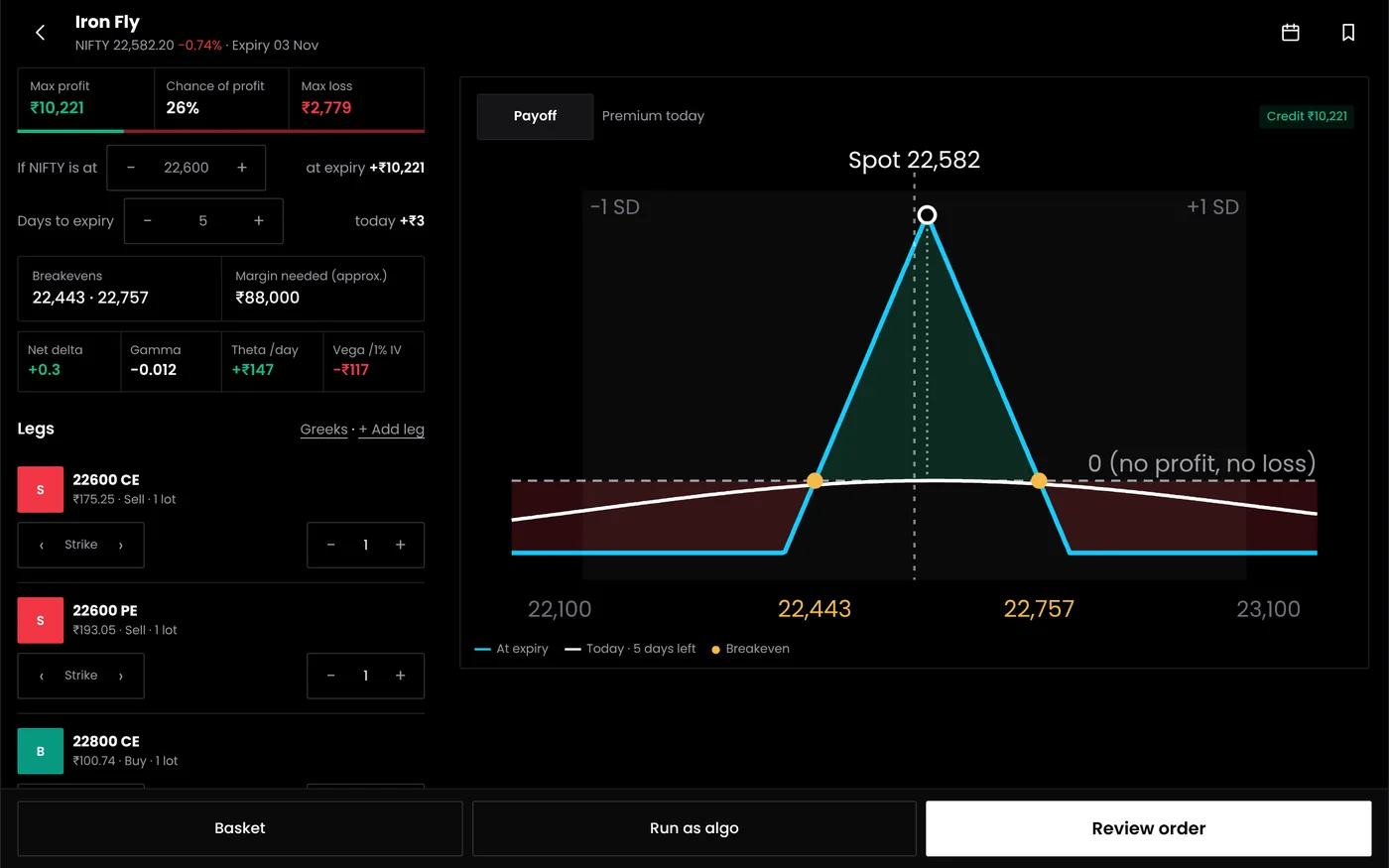
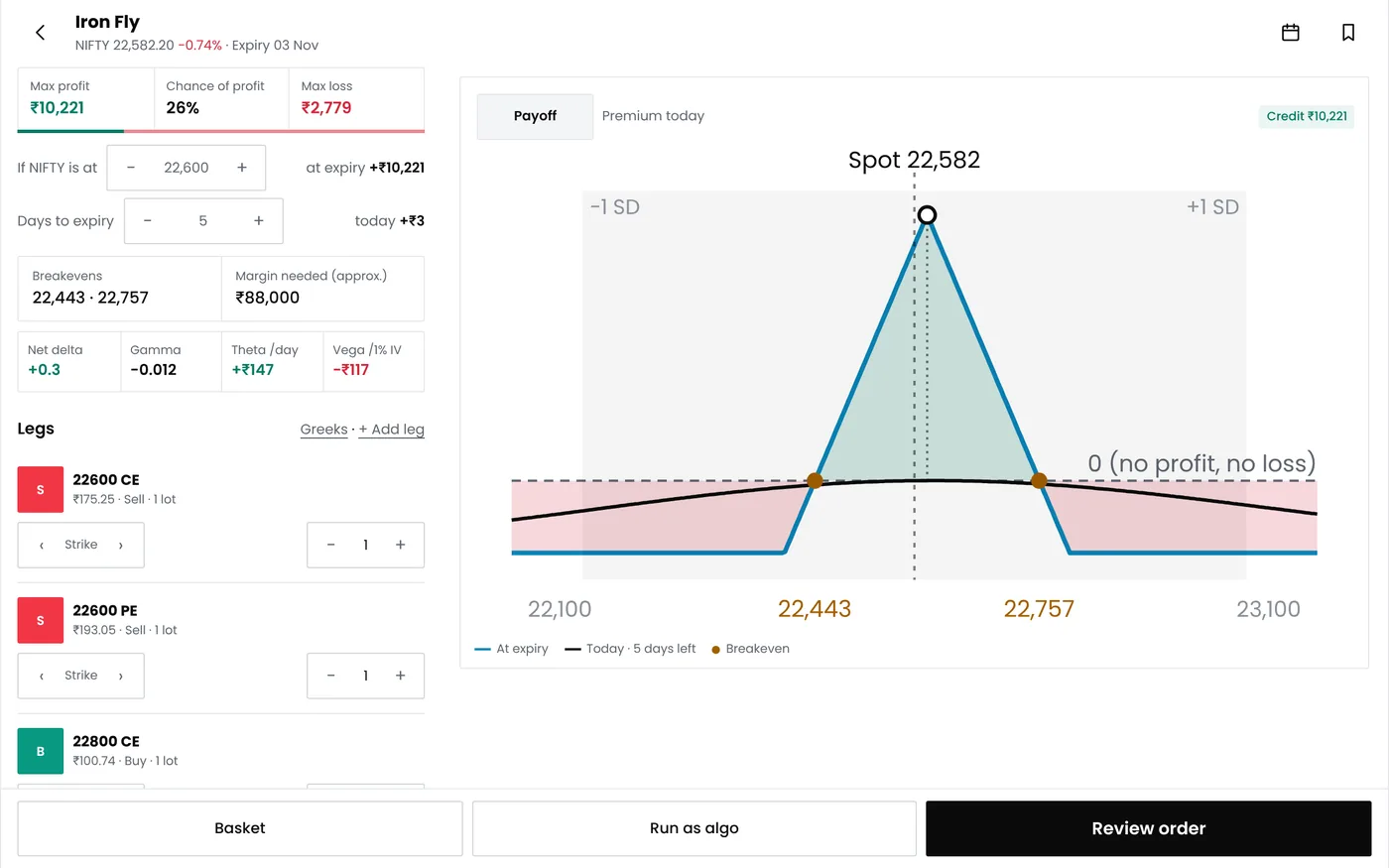
QuantPower's strategy builder lets you choose strikes by delta, by premium or by distance from the ATM strike, and shows the position's delta, gamma, theta and vega as you build it. The option chain shows the same Greeks live for every strike, and the rules can be tested in the backtesting engine before they run as a bot on your broker account.
Frequently asked questions
What are the options Greeks in simple words?
They are measures of risk. Delta shows how much an option moves with the index, gamma shows how fast that changes, theta shows the daily loss of time value, vega shows the effect of a change in volatility and rho shows the effect of interest rates.
Which Greek matters most for option buyers?
Delta and theta. Delta decides how much you make if the market moves your way, and theta decides how much you lose each day that it does not. In the model, the at-the-money Nifty call gains about ₹35 a lot per point and loses about ₹850 a lot per day.
Which Greek matters most for option sellers?
Gamma and vega. Sellers earn theta, but a large move or a jump in volatility can cost far more than a day's decay: a 400-point day costs the model short straddle several days of theta.
Why does theta increase near expiry?
Because the remaining time value has to reach zero at expiry. With fewer days left, each day removes a larger share of what is left, especially for at-the-money options.
Is delta the probability of an option expiring in the money?
Roughly. A call with a delta of 0.25 has around a one-in-four chance of expiring in the money in the model, though delta slightly overstates the probability for calls, and the chance of finishing above the break-even is lower still. Treat it as a quick estimate.
Do the Greeks work for Bank Nifty and stock options?
Yes. The same rules apply. Bank Nifty options have monthly expiries only. Stock options in India are European-style but, if held to expiry in the money, are settled by physical delivery of shares, so each contract's lot size, IV and settlement rules need checking.
Why is my option losing value even though the market moved my way?
Usually because theta and a fall in IV outweighed the gain from delta. This is common after events, when IV drops sharply: in the model, a 200-point rise with IV falling from 20% to 13% lifts a three-day at-the-money call by only about 25%.
Related guides and terms
- Options trading, options trading strategies and strike price selection
- Implied volatility crush, implied volatility option trading and India VIX report
- Delta neutral strategy, short straddle strategy, iron fly strategy, iron condor strategy and hero zero option trading
- Option buying strategies, option selling strategies and options risk management
- Tools: Black Scholes option pricing calculator, option profit calculator and Nifty option chain
- Glossary: Delta meaning, gamma meaning, theta meaning, vega meaning, volatility meaning, intrinsic value meaning
Sources
- Black, F. and Scholes, M. (1973). The Pricing of Options and Corporate Liabilities. Journal of Political Economy, 81(3), 637–654
- Hull, J. C. Options, Futures, and Other Derivatives. Pearson
- Natenberg, S. (2014). Option Volatility and Pricing. McGraw-Hill
- NSE: India VIX
- SEBI circular SEBI/HO/MRD/TPD-1/P/CIR/2024/132: Measures to strengthen the equity index derivatives framework, 1 Oct 2024 (additional 2% extreme loss margin on expiry day)
- NSE: Equity derivatives contract specifications