
This guide covers option buying from the ground up: what the premium pays for, how far Nifty must move to break even and how that grows with every day you hold, the volatility risk, which buying strategy suits which market, strike and expiry choice, a complete momentum rule set, three worked trades on one lot, exits, sizing, charges, stock options, backtesting, and how to run the rules as an algo in QuantPower.
Option buying strategies at a glance
| Feature | Option buying strategies |
|---|---|
| Market view | Directional: a move up (calls) or down (puts) that is expected soon |
| Instruments | Nifty and Sensex weekly options, Bank Nifty monthly options, liquid stock options |
| Entry | A signal on the index or its futures that confirms the move has started |
| Strike | At the money or one strike in the money, a delta of about 0.5 to 0.7 |
| Expiry | The weekly with at least three trading days left, or the monthly for trades held several days |
| Exits | An index level that proves the signal wrong, a premium stop, a target and a time stop |
| Maximum loss | The premium paid, plus charges |
| Capital for one lot | About ₹11,400 for an at-the-money Nifty call five days before expiry, with no margin on top |
| Main risks | Time decay, a fall in implied volatility, failed breakouts and overtrading |
| Difficulty | Easy to place, hard to make pay: most of the edge is in the exits |
Key takeaways
- An at-the-money option is all time value. In the model, the at-the-money Nifty call five days before expiry costs ₹174.72 and loses about 19.5 points, or ₹1,269 a lot, on a day when Nifty does not move.
- For a call bought 12 days out, the break-even level moves about 23 points further away for every day it is held, and the model chance of being above it falls from 46% after a few hours to 33% at expiry.
- A two-point fall in implied volatility (IV) straight after entry raises the move needed to break even from 3 points to 66. Buying before an event, when IV is high, is the most common way to be right on direction and still lose.
- Cheap options are expensive per point of exposure. The 25,500 call costs ₹1,655 a lot, but it pays about 67 points of decay a day for each unit of delta it carries, against 37.5 for the at-the-money call.
- In the worked week, the one trade that reached its target made ₹5,974 after charges. A failed breakout closed on the index rule cost ₹892, against ₹2,643 with only a premium stop and ₹4,346 with no stop at all.
- With a target of +50% and a stop of −25%, the rules need to win about 35% of trades to break even if every loss is a full stop. Closing failed signals early is what brings that rate down.
What the premium pays for
A call's premium has two parts. Intrinsic value is the amount by which the option is already in the money: a 24,800 call with Nifty at 25,000 has 200 points of it. Time value is the rest, the price of the chance that Nifty moves further before expiry. At expiry, time value is zero. A buyer pays for time value and needs a move larger than the one it priced in.
Model values for Nifty calls with Nifty at 25,000, five days to the weekly expiry, IV of 14% and a lot of 65:
| Call strike | Premium | Per lot | Delta | Intrinsic value | Time value | Break-even at expiry | Move needed | Model chance of profit at expiry | Decay on a flat day, per lot |
|---|---|---|---|---|---|---|---|---|---|
| 24,800 (200 points in the money) | ₹297.27 | ₹19,323 | 0.71 | 200.00 | 97.27 (33%) | 25,097 | +97 | 41% | ₹1,154 |
| 24,900 (100 points in the money) | ₹231.33 | ₹15,037 | 0.62 | 100.00 | 131.33 (57%) | 25,131 | +131 | 37% | ₹1,244 |
| 25,000 (at the money) | ₹174.72 | ₹11,357 | 0.52 | 0 | 174.72 (100%) | 25,175 | +175 | 33% | ₹1,269 |
| 25,100 (100 points out) | ₹127.77 | ₹8,305 | 0.43 | 0 | 127.77 (100%) | 25,228 | +228 | 29% | ₹1,220 |
| 25,200 (200 points out) | ₹90.28 | ₹5,868 | 0.34 | 0 | 90.28 (100%) | 25,290 | +290 | 24% | ₹1,104 |
| 25,300 (300 points out) | ₹61.52 | ₹3,999 | 0.25 | 0 | 61.52 (100%) | 25,362 | +362 | 19% | ₹940 |
| 25,500 (500 points out) | ₹25.47 | ₹1,655 | 0.13 | 0 | 25.47 (100%) | 25,525 | +525 | 10% | ₹567 |
How to read it:
- In-the-money strikes need the smallest move. Most of their price is intrinsic value, which does not decay. The 24,800 call breaks even 97 points higher at expiry; the 25,500 call needs 525.
- At-the-money strikes lose the most rupees to a flat day, because time value peaks at the money: ₹1,269 a lot for the 25,000 call.
- Far out-of-the-money strikes lose the most as a share of their price. The 25,500 call loses about a third of its value on a flat day; the at-the-money call loses about a ninth.
- The model chance of profit assumes IV stays at 14% and that Nifty's moves follow a normal distribution. Real moves have fatter tails, which pays a far out-of-the-money buyer on rare days and costs them on most others.

Our glossary entries on intrinsic value, delta and theta explain each column, and options Greeks explained covers how they interact.
The move a bought option needs, day by day
Every day a bought option is held, two things happen. Time value decays, so the level Nifty must reach to break even moves further away. And the range Nifty is likely to cover grows, but only with the square root of time. The second grows more slowly than the first, so the odds of a profitable exit get worse the longer the trade waits for its move.
The at-the-money 25,000 call bought at ₹280.48 with 12 days to expiry, IV 14%, with ₹90 of round-trip charges included:
| Days held | Nifty must be higher by | Typical move over the period (one standard deviation) | Model chance of being above break-even |
|---|---|---|---|
| A few hours | 9 points | 92 points | 46% |
| 1 day | 27 points | 183 points | 44% |
| 2 days | 51 points | 259 points | 42% |
| 3 days | 75 points | 317 points | 41% |
| 6 days | 151 points | 449 points | 37% |
| 9 days | 227 points | 550 points | 34% |
| At expiry, 12 days | 282 points | 635 points | 33% |

Three practical conclusions follow:
- A buying strategy earns its edge early. In the first hours the break-even is within a few points, and the odds are close to even. The trade needs to start working quickly.
- A trade that has not moved is losing its odds, even when it shows only a small loss. This is what a time stop is for.
- The red line is the volatility risk. If IV falls two points just after entry, the break-even jumps to 66 points before any time has passed. The next section deals with it.
Puts work the same way in the other direction.
Volatility: the second bet in every bought option
An option's price rises when implied volatility rises and falls when it falls. Vega measures this: the at-the-money Nifty call 12 days before expiry gains or loses about 18 points, or ₹1,170 a lot, for each point of IV, and the call five days out about 11.7 points, or ₹757 a lot. A buyer is long volatility whether they intend it or not.

Before buying, check:
- India VIX, NSE's measure of the volatility implied by Nifty options over the next 30 days, and how much it has risen today.
- The option's IV against its own recent range. An IV in the top fifth of its past year makes every bought option expensive.
- The event calendar. RBI policy, the Union Budget and election results for index options; quarterly results for stock options.
Buying when IV is low against its recent range and no event is due keeps the volatility bet on your side. A trade designed to profit from the event itself, whatever the direction, is a different strategy: see the long straddle strategy and IV crush guides.
The best option buying strategy for each market
No single setup works in every market. The useful question is which buying strategy matches the day, and the most valuable rule is the one that says when not to buy.
| Market | Buying strategy | Strike and expiry | Main risk |
|---|---|---|---|
| A trend day starting from the open | Opening range breakout: buy a call or put when price leaves the first 15-minute range | At the money or one strike in the money, weekly | Failed breakouts that fall back into the range |
| An intraday trend already under way | Pullback to VWAP: buy in the trend's direction when price returns to VWAP and turns | One strike in the money, weekly | A pullback that becomes a reversal |
| A trend lasting several days | Swing entry on a daily signal, such as a Supertrend flip or a moving average cross | One or two strikes in the money, monthly | Decay over several days and IV easing as the trend matures |
| A moderate move expected, IV high | Debit spread: buy one strike and sell a further one | Bull call or bear put spread | The profit is capped at the spread width |
| A large move expected, direction unknown | Long straddle or strangle before an event | At the money, both sides | IV falling after the event |
| A quiet, range-bound market | No buying strategy | None | Decay with no move to pay for it |
- Opening range breakout. The first 15 minutes set a high and a low; a 5-minute close outside them, in the direction of VWAP, is the trigger. It is the setup used in the rule set and the worked trades below.
- VWAP pullback. On a day that is already trending, price often returns to VWAP before the next leg. Buying the turn, with a stop just beyond VWAP, gives a tighter invalidation point than a breakout.
- Swing entries. A daily signal such as a Supertrend strategy flip or a moving average crossover strategy can hold for days, so the monthly expiry and an in-the-money strike keep the decay manageable.
- Momentum and volume breakouts. A break of a multi-day high on rising volume suits stock options as well as index options.
- Spreads when IV is high. Selling a further strike against the one bought offsets part of the decay and part of the vega. The bull call spread strategy and the bear put spread strategy cover the numbers.
How buying compares with selling as an approach is covered in option buying vs selling.
Choosing the strike
The same signal, the same next-day move, six different strikes. One lot of Nifty calls bought with five days to expiry, valued a day later:
| Call strike | Cost per lot | Nifty +150 the next day | Nifty flat | Nifty −100 |
|---|---|---|---|---|
| 24,900 | ₹15,037 | +₹5,600 (+37%) | −₹1,244 (−8%) | −₹4,990 (−33%) |
| 25,000 | ₹11,357 | +₹4,600 (+41%) | −₹1,269 (−11%) | −₹4,311 (−38%) |
| 25,100 | ₹8,305 | +₹3,608 (+43%) | −₹1,220 (−15%) | −₹3,576 (−43%) |
| 25,200 | ₹5,868 | +₹2,690 (+46%) | −₹1,104 (−19%) | −₹2,839 (−48%) |
| 25,300 | ₹3,999 | +₹1,899 (+47%) | −₹940 (−24%) | −₹2,151 (−54%) |
| 25,500 | ₹1,655 | +₹792 (+48%) | −₹567 (−34%) | −₹1,065 (−64%) |
The percentage gain on the good day hardly changes from strike to strike, from 37% to 48%. The percentage loss on a flat or bad day rises steeply as the strike moves out of the money. A trader who buys six lots of the 25,500 call to match the at-the-money call's rupee gain (six lots make ₹4,752 on the good day) loses ₹3,402 on a flat day, against ₹1,269 for one lot of the at-the-money call. Per point of index exposure, the far strike pays almost twice the decay.
The rule that follows: buy at the money, or one strike in the money, with a delta of about 0.5 to 0.7. Go deeper in the money for trades held several days, where less of the price is time value, but check the spread, because deep strikes trade less. For puts, in the money means a strike above the index.
Choosing the expiry
The at-the-money Nifty call with different amounts of time left, one lot:
| Days to expiry | Premium per lot | Delta | Decay on a flat day | Vega, one IV point | Nifty +150 in a day | Nifty −150 in a day |
|---|---|---|---|---|---|---|
| 1, the Monday before a Tuesday expiry | ₹4,896 | 0.51 | −₹4,896, all of it by expiry | ₹339 | +₹4,854 | −₹4,896 |
| 5 | ₹11,357 | 0.52 | −₹1,269 | ₹757 | +₹4,600 | −₹5,570 |
| 12 | ₹18,231 | 0.54 | −₹850 | ₹1,170 | +₹4,857 | −₹5,605 |
| 30, the monthly | ₹30,507 | 0.56 | −₹589 | ₹1,837 | +₹5,159 | −₹5,753 |
The gain from a 150-point move is about the same whichever expiry you buy, between ₹4,600 and ₹5,159 a lot. What changes is the cost of waiting, the capital tied up and the exposure to IV:
- The final day is a coin toss with a very fast clock: the option is worth nothing at the close unless Nifty is beyond the strike. It suits only strategies built for that session.
- Weekly options with three or more trading days left balance decay, cost and vega for intraday signals. Nifty's new weekly contract becomes the front expiry each Wednesday, so on Monday and Tuesday an intraday buyer moves to the next week's contract.
- Monthly options cost more and carry more vega, but lose the least to a quiet day, which suits trades held for several sessions.
Sensex weekly options expire on Thursdays on BSE. Bank Nifty has only monthly options since November 2024, so its nearest expiry can be weeks away and behaves more like the 12- or 30-day rows. Check the Nifty expiry date for holiday changes.
A complete momentum buying rule set
Here is a complete rule set for buying Nifty options on an opening range breakout, one lot at a time. It shows how exact the rules need to be, and the worked trades below follow it. It is a template, not a recommendation.
- Signals from the futures. The index has no traded volume, so VWAP is calculated on the current-month Nifty futures, using 5-minute candles.
- Opening range. The high and the low of the futures from 9:15 to 9:30 am.
- Entry signal. Calls: a 5-minute close above the range high while the futures are above VWAP. Puts: a 5-minute close below the range low while they are below VWAP.
- Entry window and skips. New entries from 9:35 am to 1:30 pm. Skip RBI policy and Union Budget days, and no entries within five minutes of other scheduled news.
- Strike and expiry. The at-the-money strike, or one strike in the money when the index sits between strikes. The current weekly expiry if at least three trading days remain; otherwise the next week's.
- Entry order. A limit order at the ask, cancelled if it does not fill within ten seconds.
- Exit when the signal fails. A 5-minute close back inside the opening range closes the trade at once.
- Premium stop. 25% below the entry price, as a stop-loss limit order with a buffer of about 2 points.
- Target. 50% above the entry price, as a limit order placed as soon as the entry fills.
- Time stop and day end. If the premium is not up 15% within 90 minutes, exit. Be flat by 3:10 pm.
- Daily limits. At most two trades a day; stop for the day after two losses.
- Size and account limit. Risk per trade, meaning 25% of the premium plus charges and a point of slippage, no more than 1% of trading capital, with a daily MTM loss limit for the whole account.
The put rules mirror the call rules. The same structure runs on Sensex weekly options and Bank Nifty monthly options, with the range and the targets scaled to their prices.
Three worked trades on one lot
Here is how the rules play out over one week on one lot. Prices come from the model, with the buy at the ask and the sale at the bid, 0.1 points either side of the model price, rounded to the 0.05 tick. It is an illustration of the mechanics, not a record of results.
- Wednesday, 9:30 amSix days to the Tuesday expiry, IV 14%. The opening range is 25,020 to 25,075.
- Wednesday, 10:40 amA 5-minute close at 25,008, below the range low, with the futures below VWAP. Buy the 25,000 put at ₹159.30. Stop ₹119.50, target ₹238.95.
- Wednesday, 12:10 pmNinety minutes later Nifty has drifted only to 24,985, and the put is at ₹166.90, up 4.8%. The time stop closes it: +7.60 points, or ₹421 after charges.
- Thursday, 9:30 amFive days to expiry. The opening range is 24,960 to 25,010.
- Thursday, 9:50 amA 5-minute close at 25,025, above the range high, with the futures above VWAP. Buy the 25,000 call at ₹186.50. Stop ₹139.90, target ₹279.75.
- Thursday, 11:20 amNifty reaches 25,182 and the target fills at ₹279.75: +93.25 points, or ₹5,974 after ₹88 of charges.
- Friday, 9:30 amFour days to expiry. The opening range is 24,940 to 24,990.
- Friday, 10:05 amA 5-minute close at 25,004, above the range high. Buy the 25,000 call at ₹154.65. Stop ₹116.00, target ₹232.00.
- Friday, 10:25 amNifty slips back and a 5-minute candle closes at 24,982, inside the range. The bot sells at ₹142.00: −12.65 points, or −₹892 after charges.
- Friday, 1:30 pmThe entry window closes. The week's trades are done.
| Wednesday put | Thursday call | Friday call | The week | |
|---|---|---|---|---|
| Exit | Time stop | Target | Signal failed | |
| Points | +7.60 | +93.25 | −12.65 | +88.20 |
| P&L before charges | +₹494 | +₹6,061 | −₹822 | +₹5,733 |
| Charges | ₹73 | ₹88 | ₹69 | ₹230 |
| Net P&L | +₹421 | +₹5,974 | −₹892 | +₹5,503 |
The Friday trade under looser rules, from the same entry at ₹154.65:
| Exit rule | Exit | Net P&L |
|---|---|---|
| Signal failure, as above | ₹142.00 at 10:25 am | −₹892 |
| Premium stop only | Stop at ₹116.00, filled a point lower at ₹115.00 | −₹2,643 |
| No stop, closed at 3:10 pm after Nifty falls to 24,900 | ₹88.75 | −₹4,346 |
Three things stand out. One trade that reached its target paid for the week; a week of three failed breakouts would have cost about ₹2,676. The time stop and the signal exit kept the two trades that did not work small, which matters more than the size of the winner. And the arithmetic is unforgiving if every loss is a full stop: with a win of ₹5,974 and a loss of ₹3,164, the rules need to win about 35% of trades to break even. If half the losses are closed early, like Friday's, the break-even rate falls to about 25%.
Exits decide the result
A buying strategy's entry decides which trades it takes; its exits decide what they are worth.
- Exit when the signal fails. A level on the index that proves the trade wrong, such as a close back inside the opening range or back through VWAP, gives the smallest losses because it acts before the premium has fallen far.
- The premium stop is the backstop for fast moves. NSE discontinued stop-loss market (SL-M) orders in index and stock options from 27 September 2021, so a premium stop is a stop-loss limit order with a gap between the trigger and the limit. Too small a gap can leave it unfilled in a fast market; too large a gap can fill well below the trigger.
- Targets can be fixed, as in the rule set, or trailing. A common variation moves the stop to the entry price once the premium is up 30%, then trails it. With two or more lots, selling half at the target and trailing the rest is another.
- Time stops follow from the break-even table. If the move has not come within the window the signal implies, the odds have already turned.
- Overnight and weekends. A bought option held overnight carries gap risk in both directions and a full calendar day of decay. In the model, the at-the-money call with expiry on Tuesday falls from ₹155.19 at Friday's close to ₹84.86 at Monday's open if Nifty does not move: ₹4,571 a lot over a weekend. Markets price part of this in on Friday, but the scale is the point. Intraday buying rules close by the end of the session.
Sizing an option buying strategy
A bought option needs only the premium, with no margin on top, so it is tempting to size by what the account can pay for. Size from the loss instead. For the at-the-money call five days out, the risk per lot under the rules above is 25% of the ₹11,357 premium, plus about ₹75 of charges and a point of slippage: about ₹2,973.
| Trading capital | 1% risk per trade | Lots within that risk |
|---|---|---|
| ₹2 lakh | ₹2,000 | None: one lot risks about 1.5% |
| ₹5 lakh | ₹5,000 | 1 |
| ₹10 lakh | ₹10,000 | 3 |
Two more limits sit above the per-trade one: the two-losses rule caps a bad day at about two trades' risk, and the account's daily MTM limit, set as in how to place stop loss order, squares everything off if several strategies lose together. The position size calculator does these sums for any premium and stop.
Charges, spreads and slippage
Each round trip pays brokerage on two orders, STT of 0.15% on the sale, exchange transaction charges, the SEBI fee, stamp duty on the purchase and GST. At ₹20 per order:
| One lot, one round trip | Approximate charges |
|---|---|
| At-the-money call, 5 days out, sold flat | ₹74 |
| At-the-money call, 5 days out, sold 50% higher | ₹85 |
| At-the-money call, 12 days out, sold flat | ₹90 |
Two trades a day for 20 sessions comes to about ₹3,200 a month in charges per lot. The spread costs less than it does for a scalper, because the targets are larger: a 0.2-point spread is about ₹13 a lot each round trip. Slippage on stops in fast markets is usually the bigger cost, which is why the rule set puts a buffer on the premium stop and why the backtest should assume a point or more on every stop. Use the calculator below with your broker's rates.
Brokerage, STT, exchange charges, SEBI fee, stamp duty and GST for one round trip, by broker.
Profits from options are generally taxed as non-speculative business income.
Buying stock options
| Index options | Stock options | |
|---|---|---|
| Expiries | Nifty weekly on Tuesday, Sensex weekly on Thursday, Bank Nifty monthly | Monthly only |
| Settlement | Cash | Delivery of shares if in the money at expiry |
| Liquidity | Deep near the money | Varies widely by stock and strike; check the spread and depth before each trade |
| The main event | RBI policy, the Budget, global moves | Quarterly results and company news |
| IV pattern | Rises before policy days and the Budget | Rises into results and often falls sharply the next day |
| Position limits | Market-wide limits rarely bind | A stock enters the F&O ban when open interest crosses 95% of its market-wide position limit; no new positions until it falls |
Three adjustments for stock options:
- Exit before expiry week ends. An in-the-money stock option held to expiry is settled by physical settlement, and many brokers ask for extra margin or close such positions in the final days.
- Treat results day as an IV event. A call bought the day before results needs the stock to move more than the IV built into the price. Buying after the results, once IV has reset, is usually the cleaner trade.
- Check the market depth. A spread of a rupee on a ₹20 option is 5% before the trade starts. The market depth guide explains what to look for.
Why most option buyers lose, and the rule that answers each habit
SEBI's study of FY26 found that 87.7% of individual traders in equity derivatives lost money after costs. Most of the habits behind those losses show up in this guide's numbers, and each has a rule that answers it:
| Habit | What it costs, from the examples above | The rule that answers it |
|---|---|---|
| Buying far out-of-the-money options because they are cheap | About a third of the premium on a flat day for the 25,500 call | At the money or one strike in the money |
| Holding a trade that has not moved | The break-even moves about 23 points further away each day | A time stop |
| Buying before an event when IV is high | A 100-point gain in Nifty became a ₹1,480 loss | Skip event days, or use a strategy built for them |
| Moving or removing the stop | −₹4,346 instead of −₹892 on Friday's trade | Signal exit and premium stop placed at entry |
| Trading more after losses | More charges and more failed signals | Two trades a day; stop after two losses |
| Sizing from the premium | One lot is 1.5% of ₹2 lakh at a 25% stop | Size from the loss |
Backtesting an option buying strategy
Buying strategies are easy to flatter in a backtest, because most of their profit comes from a few large winners and most of their risk from fills:
- Use option prices, not the index. The option's own price includes changes in IV, which a test built on the index alone cannot see.
- Buy at the ask and sell at the bid, or add half the spread to each fill.
- Add slippage to every stop, at least a point on Nifty options and more on fast days.
- Resolve same-candle ambiguity against yourself. If the target and the stop both fall inside one candle, count the trade as a loss.
- Test event days separately, and confirm the skip rules remove them.
- Use the real expiries. Weekly expiry days have changed several times, and Bank Nifty's weekly options ended in November 2024.
- Count enough trades. A hundred or more, across trending, range-bound and volatile periods, say more than one strong month.
- Compare with paper trading. If live fills are much worse than the backtest assumed, the backtest was too generous.
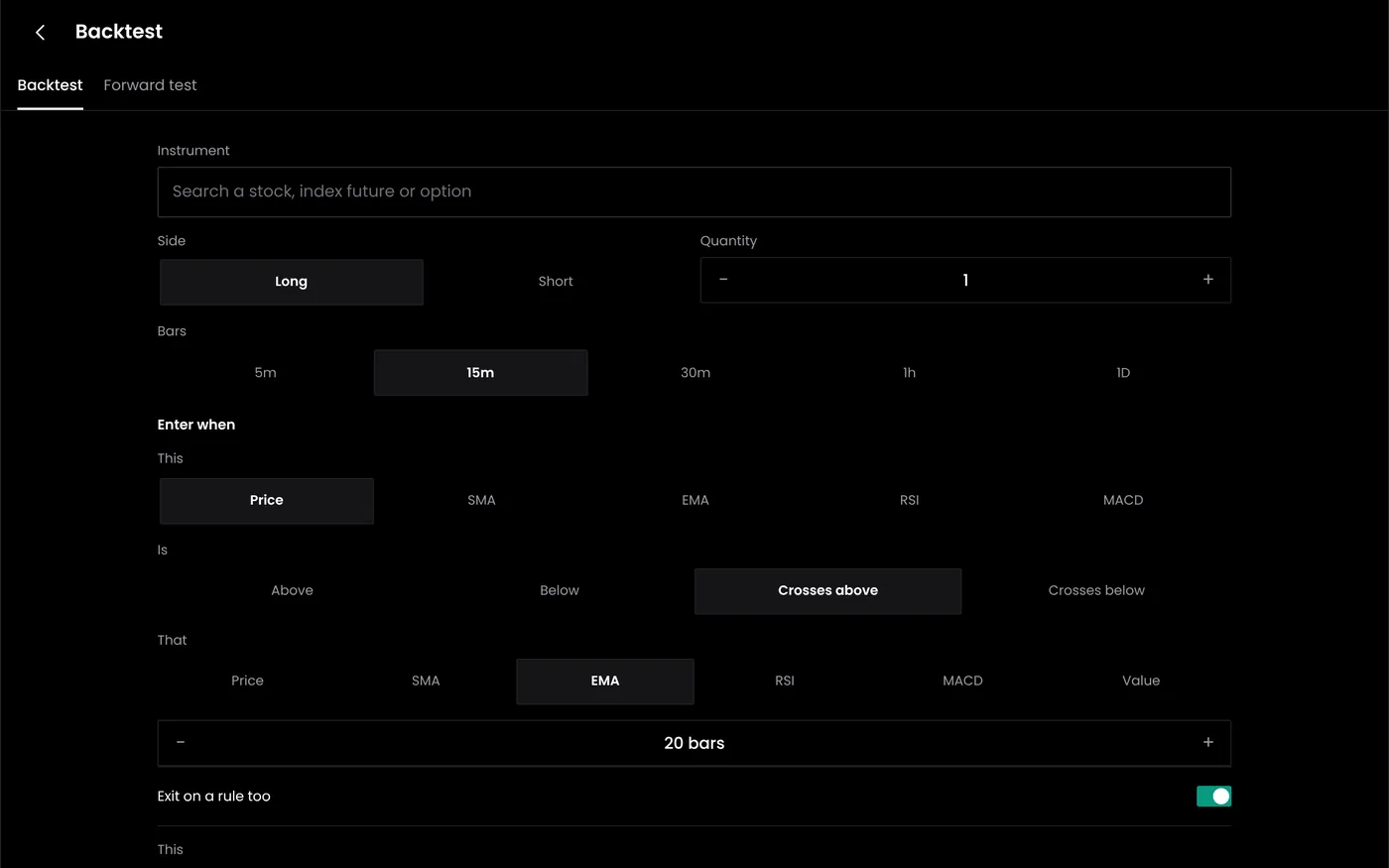
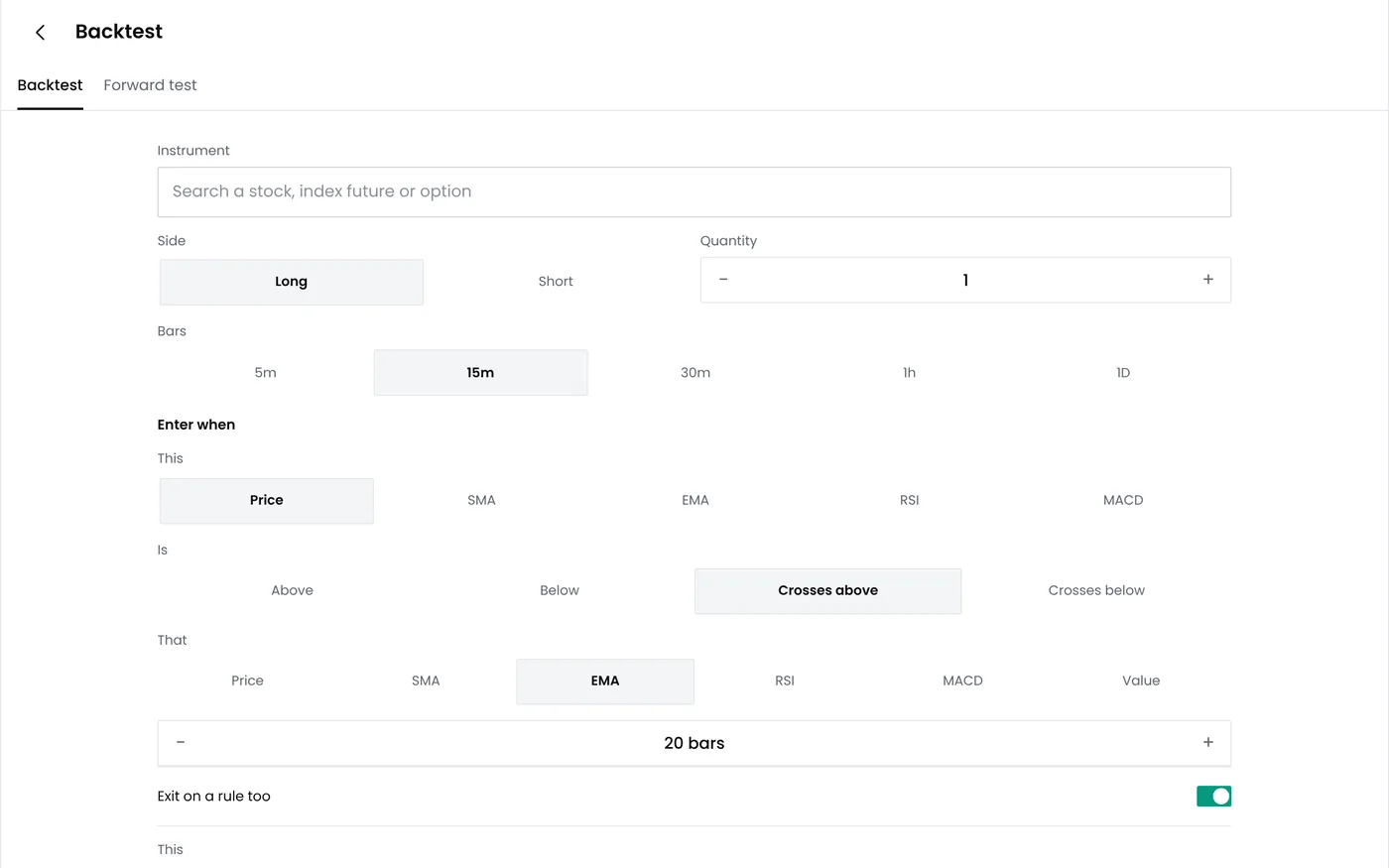
Our guides on how to backtest trading strategies and avoiding overfitting cover each step, and the backtesting engine runs the rules with costs included.
Setting up an option buying algo strategy in QuantPower
Buying rules are exact and time-sensitive, which suits automation: the signal exit has to act on the candle close, and the target and the stop have to be in place the moment the entry fills. A sample setup for the rule set above:
| Rule | Example setting |
|---|---|
| Instrument | Nifty options, weekly expiry with at least three trading days left, otherwise the next week |
| Signal | A 5-minute close of Nifty futures outside the 9:15 to 9:30 am range |
| Direction filter | Calls while the futures are above VWAP; puts while they are below |
| Strike | At the money, or one strike in the money |
| Entry window | 9:35 am to 1:30 pm |
| Entry order | Limit |
| Exit on signal failure | A 5-minute close back inside the range |
| Stop loss | 25% of the premium, as an SL order with a buffer |
| Target | 50% of the premium |
| Time stop | Exit after 90 minutes unless the premium is up 15% |
| Day end | 3:10 pm |
| Trades per day | Two, stopping after two losses |
| Account limit | Daily MTM loss limit |
Step 1. Build the rules
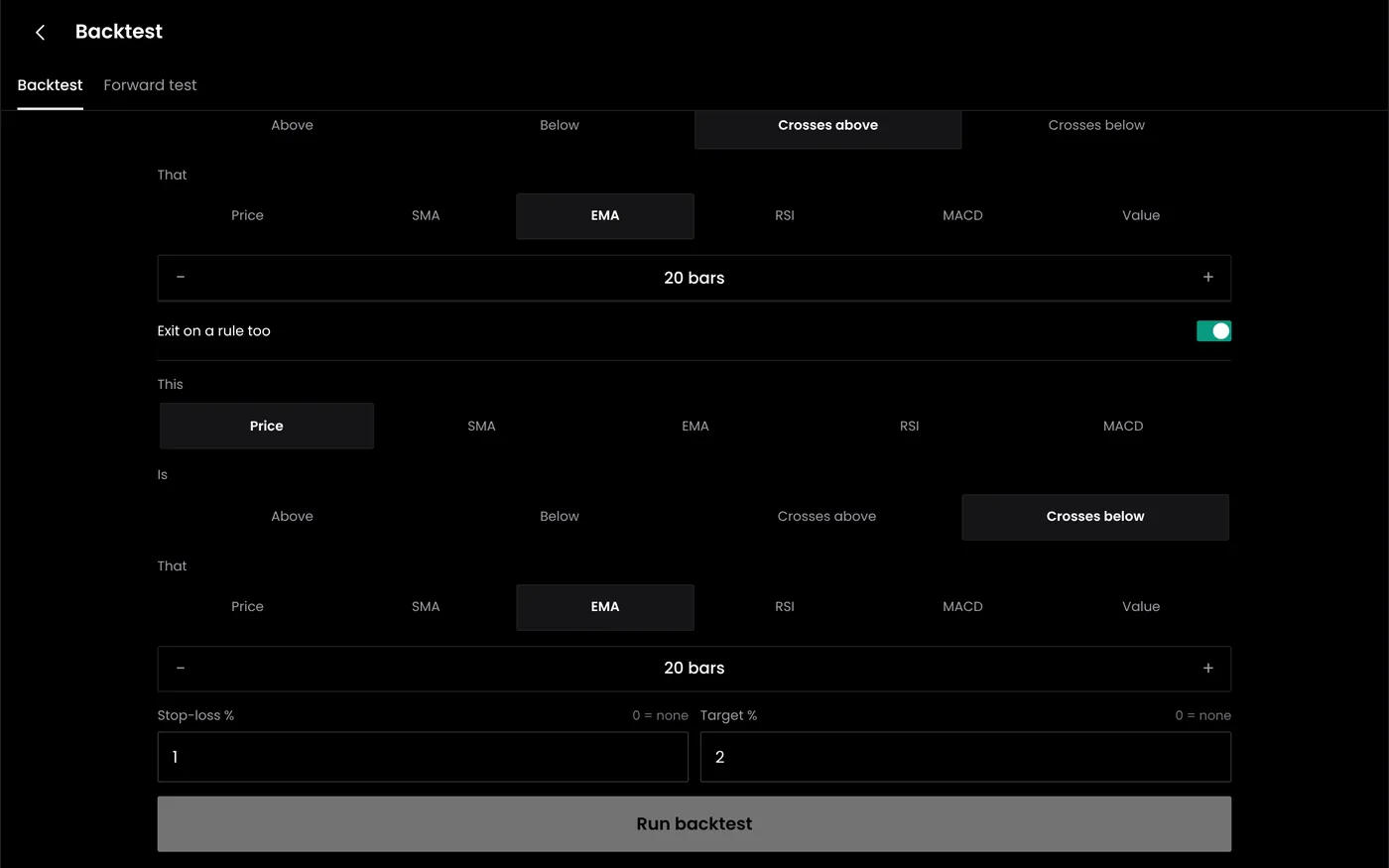
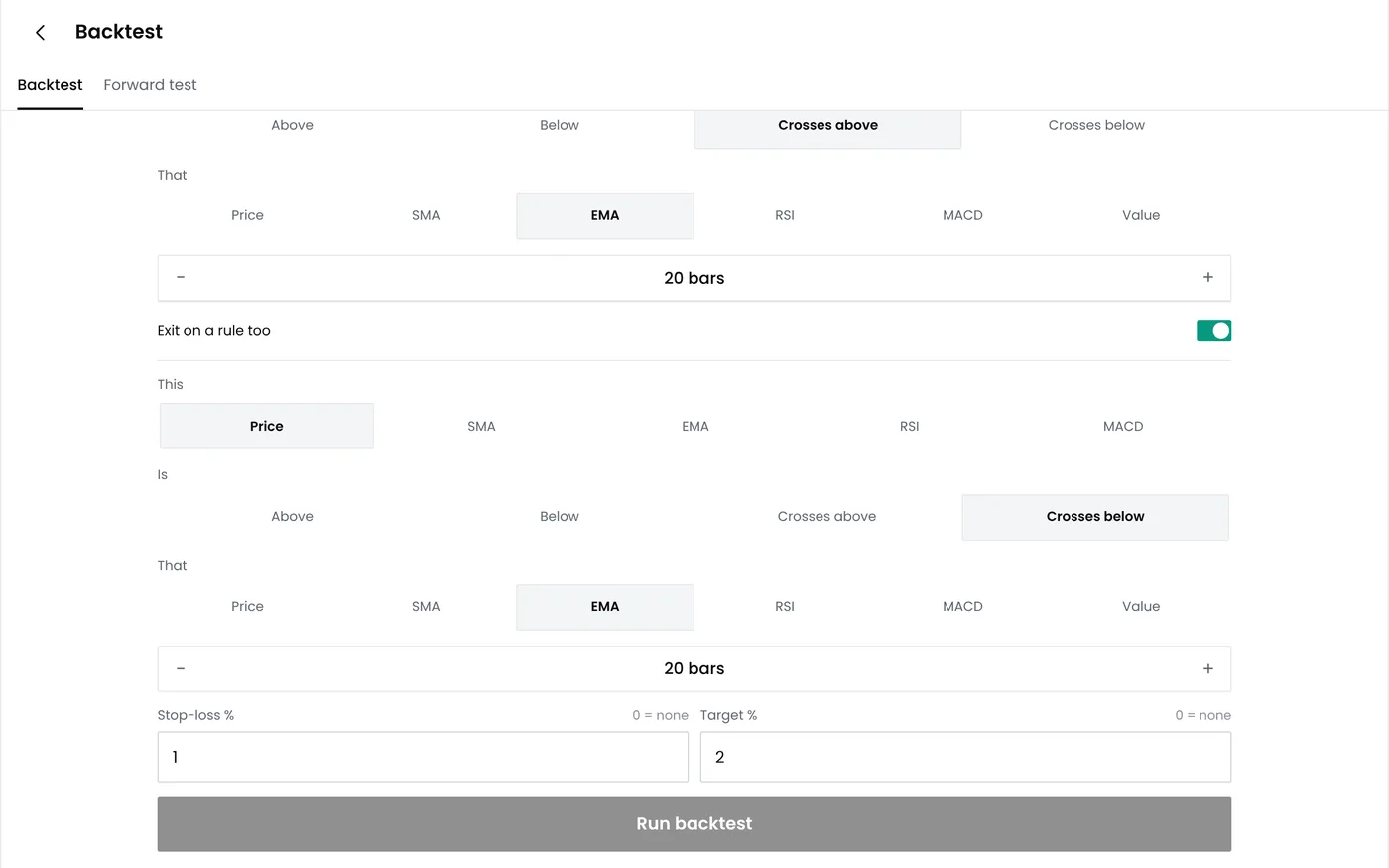
In the option strategy builder, choose Nifty weekly options, add the opening range breakout on 5-minute candles of the futures as the entry, then the VWAP filter, the entry window and the strike rule. If your signal comes from a TradingView chart instead, signal trading can turn its alerts into orders.
Step 2. Set the exits and limits
Add the signal-failure exit, the premium stop, the target, the time stop, the 3:10 pm exit and the daily trade cap.
Step 3. Backtest it
Run the rules over past months with slippage and charges on. Change one setting at a time, such as the stop, the target or the time stop, and look at how the exits split between the four types.
Step 4. Paper trade it
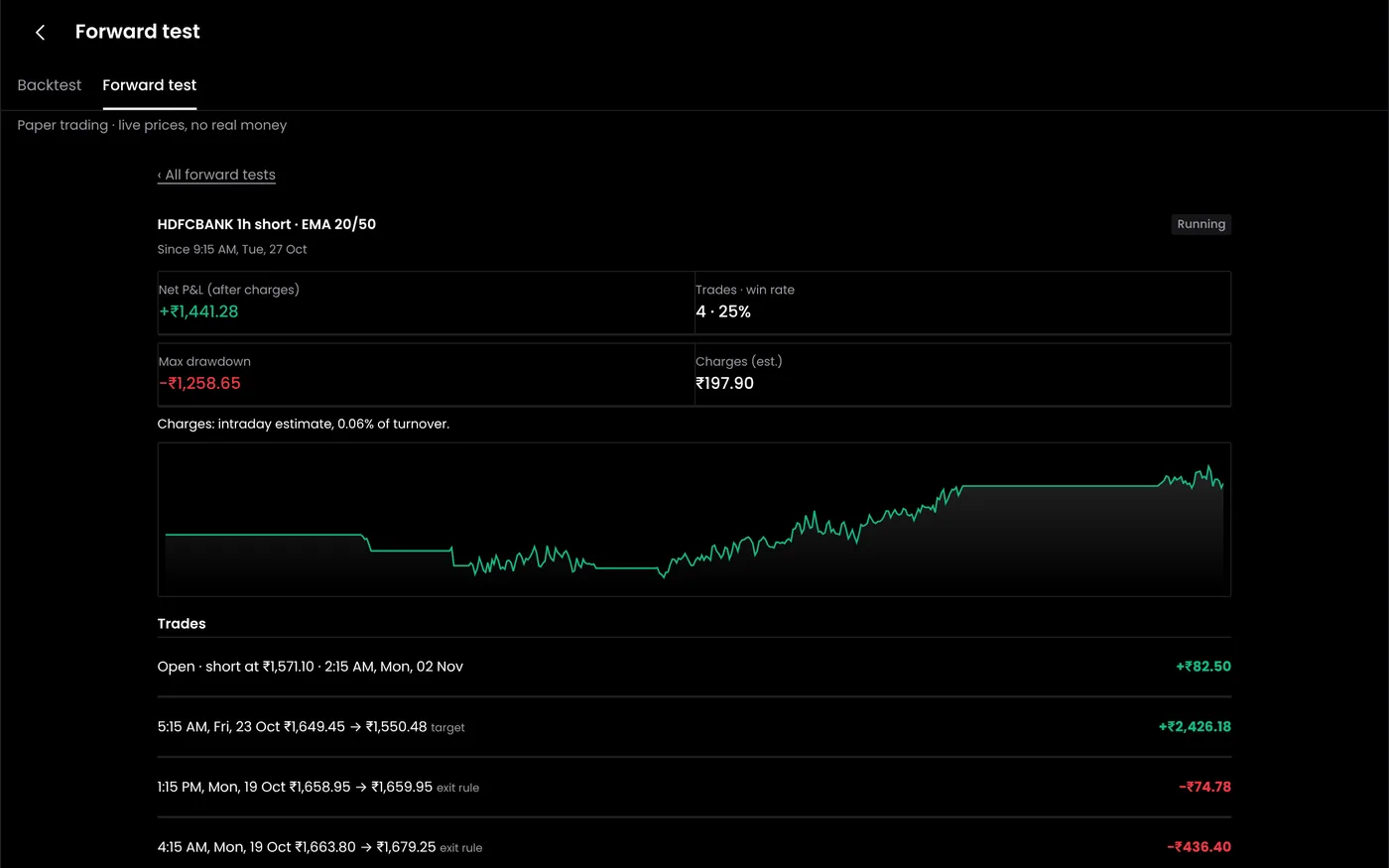
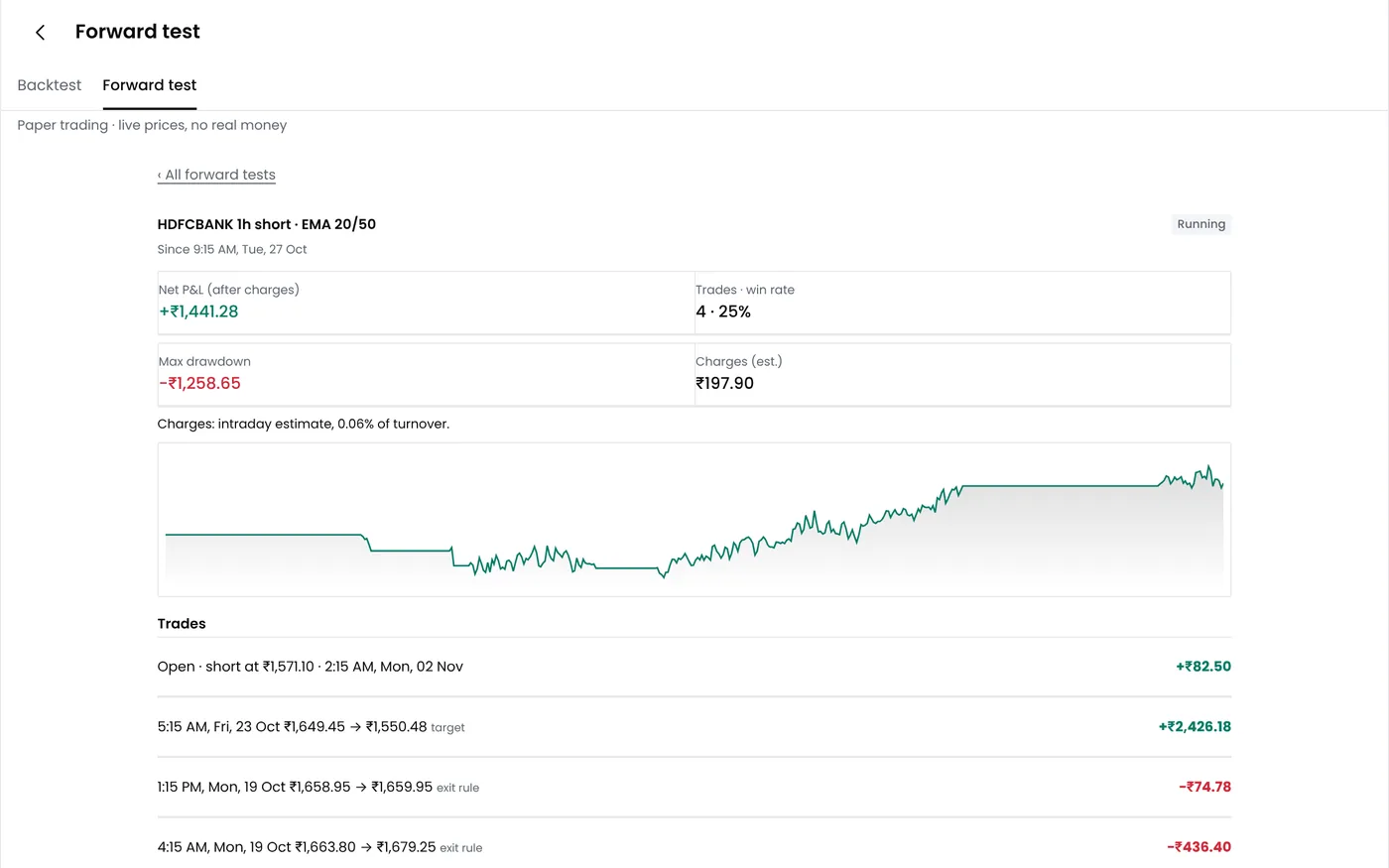
Run the strategy on live prices with virtual money for a few weeks, and compare each fill with the price the backtest assumed.
Step 5. Set the account limit
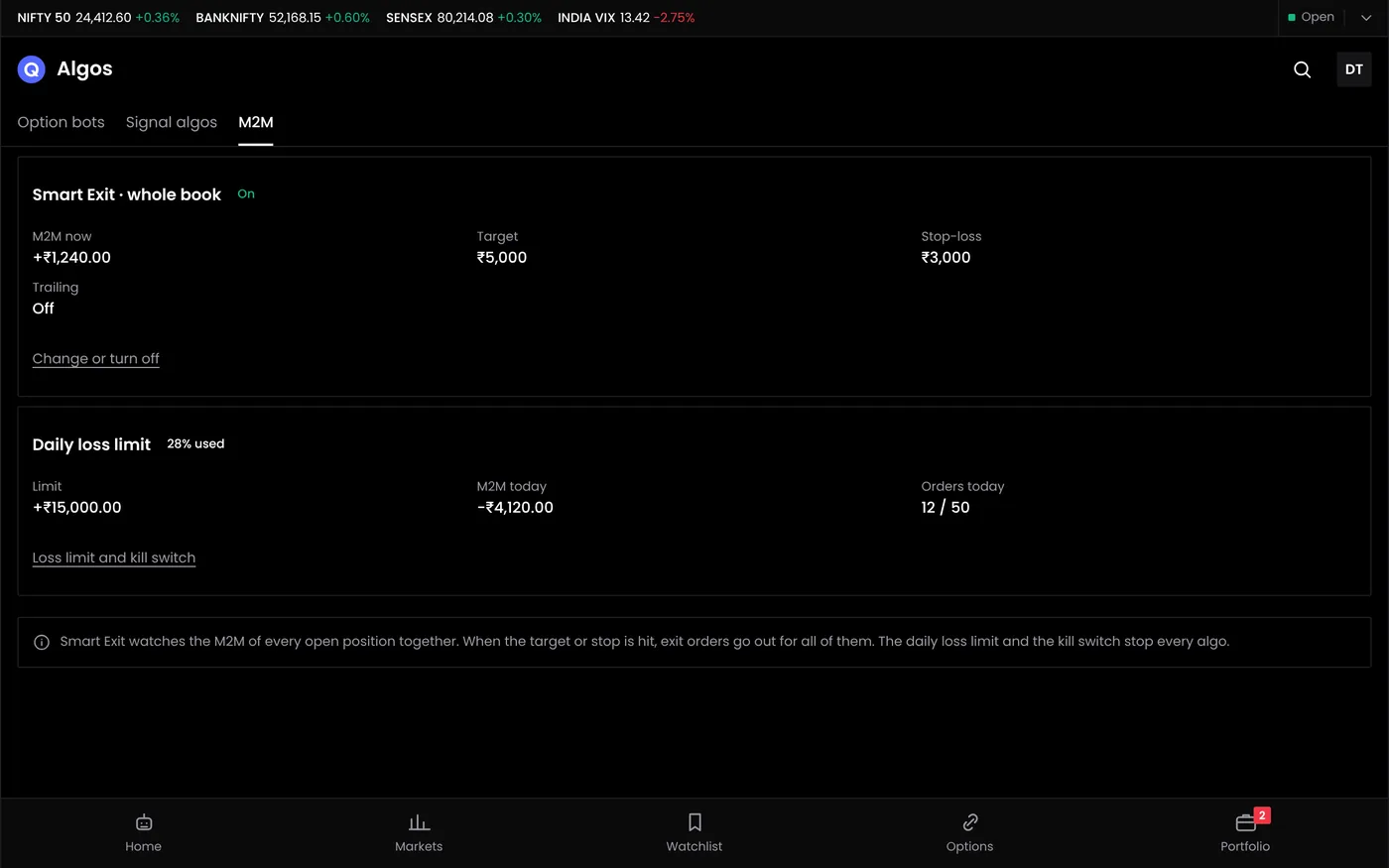
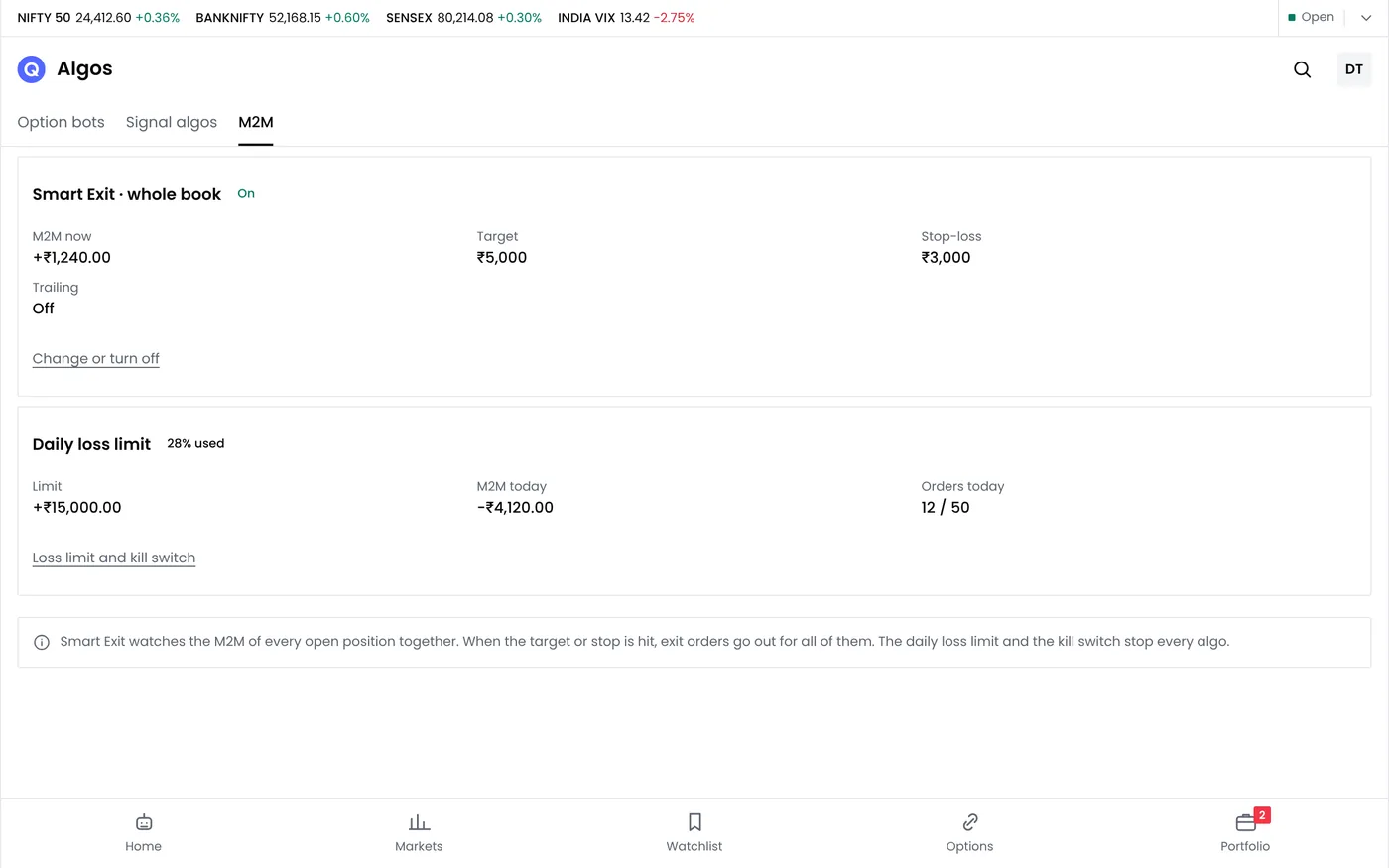
Set the daily MTM loss limit in the risk settings before going live. It squares off every position when it is hit, including positions from other strategies.
Step 6. Deploy and monitor
Connect your broker, choose the strategy and the number of lots, confirm the limits and deploy. The bot places the target and the stop as soon as each entry fills, and watches the signal exit and the time stop. Orders go through your connected broker under the requirements applicable to your strategy and account; a named example is not a claim of strategy approval. Use Pause all to stop every bot at once.
Measuring an option buying strategy
| Measure | What to look for |
|---|---|
| Net result per trade | Positive after charges and slippage, over at least a hundred trades |
| Win rate against the break-even rate | Above the rate your average win and loss imply: about 35% with a +50% target and a −25% stop |
| Average loss | Closer to the signal-failure exit than to the full stop |
| Exits by type | The share of trades closed by the target, the stop, the signal exit and the time stop |
| Results on event days | Separate from other days; the skip rules should remove most of them |
| Fills against the backtest | Large gaps mean the backtest's fills were too kind |
A trade journal helps track these week by week.
Common option buying mistakes
- Buying in the first minutes after the open, when spreads are widest and the range has not formed.
- Chasing a move that is already 150 points old, where the remaining move has to be large to pay for the entry.
- Averaging down a losing option.
- Holding weekly options over a weekend without a reason that justifies three days of decay.
- Buying the final day's options as a cheap ticket.
- Treating a model probability as a forecast. The figures here describe the shape of the odds, not tomorrow's market.
- Ignoring other positions in Sensex or stock options that add to the same direction.
Pre-trade checklist
- No RBI policy, Budget or other scheduled event is due today, or the strategy is built for it.
- India VIX and the option's IV are not at the top of their recent range.
- The strike is at the money or one strike in the money, and the expiry has at least three trading days left.
- The signal exit, the premium stop, the target and the time stop are set before the entry order.
- The lots follow from the risk per trade, not from the premium.
- The daily trade cap and the account's MTM limit are set.
- The strategy has been backtested with charges and paper traded with fills close to the test.
Start your free trial
Connect your broker, build a strategy and test it on paper before a single live order goes out.
Frequently asked questions
What is the best option buying strategy?
The one whose signal matches the market. On a trend day, an opening range breakout with an at-the-money option; in an established intraday trend, a pullback to VWAP with a strike in the money; for a view that may take days, a monthly option or a debit spread. On quiet, range-bound days the best option buying strategy is not to buy. Whatever the setup, the exits matter more than the entry.
Is option buying profitable?
For most traders it has not been. SEBI's study of FY26 found that 87.7% of individual traders in equity derivatives lost money after costs. A buying strategy can work with a tested signal, strikes near the money, a time stop and sizing based on the loss, but test it with every cost before trading. We do not publish returns for any strategy, and nothing here is a performance claim.
How much capital do I need for option buying?
One lot of an at-the-money Nifty call five days before expiry costs about ₹11,400 in premium, with no margin on top. The risk rule matters more than the premium: at a 25% stop, one lot risks about ₹3,000, which is 1% of about ₹3 lakh. With less capital, a single lot is a larger share of the account than most risk rules allow.
How many days to expiry should a bought option have?
For intraday signals on Nifty, at least three trading days, so that decay is moderate; on Monday and Tuesday that means the next week's contract. For trades held several days, the monthly. Options on their last day suit only strategies designed for expiry day.
When should I exit a bought option?
When the signal fails, when the premium stop or the target is reached, or when the time stop says the move has not come. Decide all four before the entry. Holding a bought option in the hope of a late move is the most expensive habit in option buying.
Why can a bought call lose money when Nifty rises?
Because time decay and a fall in implied volatility can take more out of the premium than the move adds. In the model, an at-the-money call bought at IV 18% the day before a policy announcement lost ₹1,480 a lot when Nifty rose 100 points and IV fell to 13%.
How much can I lose buying options?
The premium you paid, plus charges, as long as you only buy options. That can be the whole premium: an option on its last day is worth nothing at the close if the index has not crossed the strike.
Can I automate an option buying strategy?
Yes, and buying rules suit automation because their exits are exact and time-sensitive. An option buying algo strategy built in QuantPower runs as a bot on your own broker account. Orders go through your connected broker under the requirements applicable to your strategy and account; a named example is not a claim of strategy approval.
Related guides and terms
- Opening range breakout strategy, VWAP indicator for option trading and momentum breakout strategy
- Bull call spread, bear put spread, long straddle strategy and long strangle strategy
- Option buying vs selling and option selling strategies
- Nifty option trading, scalping in option trading and hero zero option trading
- Strike price selection, option greeks and implied volatility crush
- Option profit calculator, position size calculator and brokerage calculator
- Glossary: Delta meaning, gamma meaning, theta meaning, vega meaning, intrinsic value meaning
- Short straddle strategy
- Short strangle strategy
- Short selling meaning
Sources
- SEBI, Profitability of Individual Traders in the Equity Derivatives Segment (FY25–FY26), PR No. 50/2026, 20 August 2026
- SEBI circular on safer participation of retail investors in algorithmic trading, 4 Feb 2025, and the implementation timeline to 1 April 2026
- NSE circular NSE/FAOP/49677: SL-M orders discontinued in index and stock options from 27 September 2021
- NSE: Equity derivatives contract specifications (lot sizes, expiry days and settlement)
- Finance Act, 2026: STT of 0.15% on the sale of options from 1 April 2026
- Black, F. and Scholes, M. (1973). The Pricing of Options and Corporate Liabilities. Journal of Political Economy, 81(3), 637–654