
This guide covers the whole trade: how an option responds to small moves in the index, the arithmetic of costs and win rates, a complete rule set, a worked session on one lot with every charge counted, the chart setup and indicators, strike and expiry choice, order types, expiry-day scalping, risk limits, backtesting, and how to run the rules as an algo bot in QuantPower.
Option scalping at a glance
| Feature | Option scalping |
|---|---|
| Market view | Short bursts of momentum, in either direction |
| Instruments | Nifty and Sensex weekly options near the money; Bank Nifty monthly options |
| Charts | 1-minute candles for the trigger, 5-minute candles for the direction |
| Entry | A fast trigger in the direction of the short-term trend |
| Target and stop | A few points of premium: 8 and 5 points in the rules below |
| Holding time | 30 seconds to a few minutes |
| Trades per day | Capped, for example at eight |
| Pattern of results | Many small wins and losses; costs take a large share of the gains |
| Main risks | Costs, slippage, falling implied volatility and overtrading |
| Capital | The premium: about ₹11,300 for one lot of an at-the-money Nifty option five days before expiry |
| Difficulty | Advanced: simple rules, demanding execution |
Key takeaways
- An at-the-money Nifty option moves about half as many points as the index. In the model, a 20-point rise in Nifty adds 10.7 points to the call, or ₹695 a lot.
- One round trip on one lot costs about ₹75 in charges, more than half of it the ₹40 of brokerage. That is 1.15 points of premium on every trade, win or lose.
- With charges, a 0.2-point spread and 1 point of slippage on stops, a 5-point target with a 5-point stop needs to win 67% of trades to break even. An 8-point target with a 5-point stop needs 52%.
- In the worked session, seven trades made 19 points, or ₹1,235, before costs. Charges took ₹505 of it, 41%. On a choppy day the same rules lost ₹963.
- A one-point fall in implied volatility takes about 11.6 points off the at-the-money call, more than the whole target. A scalper who buys options is also trading volatility.
- Scalping futures now costs about seven times as much per lot as scalping options, measured in index points, because of the 0.05% STT on futures sales since 1 April 2026.
What is scalping in option trading?
A scalper waits for a short burst of movement in the index, such as a break above the morning's high or a quick drop through VWAP, buys a call or a put in that direction and sells it a few points later. Many scalpers trade both directions, several times a day, and never hold a position overnight.
The options of choice are at the money or one strike in the money, on the nearest expiry:
- They move with the index. An at-the-money option has a delta of about 0.5, so it gains or loses about half a point for each point of Nifty.
- They are the most traded strikes. Volume is highest and the bid-ask spread is usually a tick or two, which matters when the target is only a few points.
- They cost less to trade than futures. Brokerage is charged per order, and STT on options is charged on the premium, not on the value of the contract.
Most of the time the other side of a scalper's trade is a market maker or another algorithm that quotes both sides and earns the spread. A scalper who buys at the ask and sells at the bid pays that spread on every round trip. It is one reason the better scalping rules wait for moves large enough to make the spread small by comparison.
Retail scalping is not high-frequency trading, which relies on co-location and trades in microseconds. A retail scalper trades in seconds and minutes through a broker, and competes on rules and discipline rather than speed.
How an option responds to small moves
Model values with Nifty at 25,000 at 9:30 am, five days to the weekly expiry and implied volatility (IV) of 14%:
| Call strike | Premium | Delta | Gamma | Nifty +20 | Nifty −20 | Decay per hour | Vega (1 IV point) |
|---|---|---|---|---|---|---|---|
| 24,900 (in the money) | ₹230.60 | 0.62 | 0.00093 | +12.60 | −12.23 | −2.96 | 11.12 |
| 25,000 (at the money) | ₹173.97 | 0.53 | 0.00098 | +10.69 | −10.29 | −3.01 | 11.61 |
| 25,100 (out of the money) | ₹127.05 | 0.43 | 0.00096 | +8.75 | −8.36 | −2.90 | 11.45 |
| 25,200 (further out) | ₹89.63 | 0.34 | 0.00089 | +6.88 | −6.52 | −2.65 | 10.68 |
The moves, the decay and vega are in points of premium; multiply by 65 for rupees on one lot. Four things matter for a scalper:
- Delta sets the reward. The at-the-money call gains about 10.7 points when Nifty rises 20, or ₹695 a lot. The 25,200 call gains 6.9 points. A cheaper option is not a better scalp; it simply moves less.
- Gamma is small five days out. Delta changes by about 0.01 for every 10 points, so over a scalper's range the option moves almost in a straight line with the index. Near expiry, gamma is several times larger, as the section on expiry day shows.
- Time decay is slow per trade. The at-the-money call loses about 3 points an hour if Nifty stands still, or 0.05 points a minute. A three-minute hold costs about 0.15 points, or ₹10 a lot.
- Vega is the hidden risk. If IV falls by one point, the at-the-money call loses about 11.6 points even if Nifty does not move, more than an 8-point target. IV often eases after a busy open or once an event has passed, so a bought call can lose money on a day when the index rises.

The arithmetic: costs and the break-even win rate
Each round trip pays brokerage on two orders, STT on the sale, exchange transaction charges, the SEBI fee, stamp duty on the purchase and GST. On one lot of the at-the-money call, bought at ₹173.97 and sold 8 points higher at ₹181.97:
| Charge | Amount |
|---|---|
| Brokerage, ₹20 per order | ₹40.00 |
| STT, 0.15% of the sale value | ₹17.74 |
| Exchange transaction charges | ₹8.21 |
| GST, 18% of brokerage, exchange charges and the SEBI fee | ₹8.68 |
| Stamp duty, 0.003% of the purchase | ₹0.34 |
| SEBI fee | ₹0.02 |
| Total | ₹75.00 |
That is 1.15 points of premium on one lot. Brokerage is a flat fee per order, so it falls per lot as the order grows: the same round trip costs about ₹51 a lot on a 2-lot order and ₹40 a lot on a 4-lot order.
Two more costs come on top. The spread: buying at the ask and selling at the bid gives up the gap between them on every round trip, and this guide assumes 0.2 points. And slippage: a stop triggers when the price is moving against you, and the order often fills beyond the trigger, so this guide assumes 1 point on every stop.
| Target and stop (points) | Before costs | With charges | With charges, spread and stop slippage |
|---|---|---|---|
| 3 and 3 | 50.0% | 69.0% | 76.3% |
| 5 and 5 | 50.0% | 61.4% | 66.7% |
| 8 and 5 | 38.5% | 47.2% | 52.4% |
| 10 and 5 | 33.3% | 40.9% | 45.9% |
| 10 and 10 | 50.0% | 55.7% | 58.8% |
| 15 and 10 | 40.0% | 44.6% | 47.5% |

Costs are close to a fixed amount per trade, so they hurt small targets most. A 3-point scalp has to win three trades in four just to break even. This is why many scalpers who are right more often than not still lose money, and why the rules below use an 8-point target with a 5-point stop.
SEBI's study of FY26 found the same effect across all individual F&O traders: 82.1% lost money before costs and 87.7% after them, so costs alone moved about 5.6% of traders from a gross profit or break-even into a net loss.
The scalping rules
A complete rule set for Nifty options on the nearest weekly expiry, one lot at a time:
- Signals from the futures. The index has no traded volume, so VWAP is calculated on Nifty futures. The rules read the current-month futures on 1-minute and 5-minute candles and choose the option strike from the index level.
- Direction. Trade calls only while the futures' 5-minute close is above the day's VWAP, and puts only while it is below.
- Trigger. On 1-minute candles, the 9-period EMA crosses the 21-period EMA in the direction of the trade.
- Option. Buy the strike nearest to the index, on the current weekly expiry.
- Entry order. A limit order at the ask, cancelled if it does not fill within a few seconds. Do not chase.
- Target. 8 points above the entry price, placed as a limit sell order as soon as the entry fills.
- Stop. 5 points below the entry, as a stop-loss limit order with a buffer of about 2 points between the trigger and the limit.
- Exit signal. Sell at the bid if the EMAs cross back before the target or the stop is reached.
- Session windows. New entries from 9:30 to 11:30 am and from 1:30 to 3:00 pm. Be flat by 3:10 pm, before the closing auction in the index stocks begins at 3:15 pm.
- Daily limits. At most eight trades. Stop for the day after three losses in a row or a loss of ₹1,500 a lot, whichever comes first.
- Skip filters. No entries in the five minutes either side of scheduled news, such as the RBI policy announcement, and none while the spread on the strike is wider than 0.5 points.
The put rules are the mirror image. The same structure works on Sensex weekly options and Bank Nifty monthly options, with targets and stops scaled to their prices, as the section on strike and expiry shows.
A worked scalping session
Here is how the rules play out on one lot in a model session. Option prices come from the same model, with the buy at the ask and the sale at the bid, 0.1 points either side of the model price. It is an illustration of the mechanics, not a record of results.
- 9:15 amNifty opens at 24,990, five days before the Tuesday expiry, with IV at 14%. The bot does not trade the first 15 minutes, when spreads are wider and the opening range is still forming.
- 9:42 amThe futures are above VWAP and their 1-minute EMAs cross up, with the index at 25,034. Buy the 25,050 call at ₹165.55. Target ₹173.55, stop ₹160.55.
- 9:45 amNifty reaches 25,051 and the target fills at ₹173.55: +8 points, or ₹520 before charges of ₹74.
- 10:06 amA second cross up, with Nifty at 25,072. Buy the 25,050 call at ₹184.40. Two minutes later Nifty slips back to about 25,063, the stop triggers at ₹179.40 and fills at ₹178.40 in the fast market: −6 points, or −₹390.
- 10:31 amA cross up with Nifty at 25,088 makes 25,100 the nearest strike. Buy the 25,100 call at ₹165.45. The target fills at ₹173.45 at 10:34 am, with Nifty at 25,104: +₹520.
- 10:52 amA cross up with Nifty at 25,109. Buy the 25,100 call at ₹175.40. Nifty stalls, and at 10:57 am the EMAs cross back with Nifty at 25,108. Sell at ₹174.40: −1 point, the cost of the spread and five minutes of time decay.
- 1:34 pmThe futures have fallen below VWAP and the EMAs cross down, with Nifty at 25,046. Buy the 25,050 put at ₹144.55. The target fills at ₹152.55 at 1:37 pm, with Nifty at 25,029: +₹520.
- 2:12 pmA cross down with Nifty at 25,038. Buy the 25,050 put at ₹146.85. Nifty bounces to 25,048 by 2:14 pm and the stop fills at ₹140.85: −₹390.
- 2:41 pmA cross down with Nifty at 25,012. Buy the 25,000 put at ₹133.90. The target fills at ₹141.90 at 2:45 pm, with Nifty at 24,994: +₹520.
- 3:00 pmNo new entries. The bot is flat after seven trades: four targets, two stops and one exit on the signal.
| Model session | Choppy day, same rules | |
|---|---|---|
| Trades | 7: four targets, two stops, one signal exit | 6: two targets, four stops |
| Points before costs | +19 | −8 |
| P&L before costs | +₹1,235 | −₹520 |
| Charges | ₹505 | ₹443 |
| Net P&L | +₹730 | −₹963 |
| Win rate | 57% | 33% |
Three things stand out. Charges took ₹505, or 41% of the gross gain, on a good day, and on the choppy day they almost doubled the loss. The margin of safety was thin: the session won 57% of its trades against the 52% needed at these costs, and if each target had filled a point lower, the net would have fallen by ₹260 to about ₹470. And the signal exit did its job: the trade at 10:52 am was closed for a point, before it could turn into a 6-point stop.
A scalping chart setup
A fixed chart layout helps, whether the trades are manual or automated:
- Nifty futures, 1-minute candles, with the 9- and 21-period EMAs. This is where the trigger comes from.
- Nifty futures, 5-minute candles, with VWAP and the day's opening range. This sets the direction and shows the levels where moves often pause.
- The option itself, 1-minute candles, to see the premium you actually trade and how far the target and the stop sit from it.
- Market depth for the strike. The best five bids and offers show whether the spread is normal and whether there is enough quantity at your price.
- Futures volume, to see whether a break has participation behind it.
Signals on the futures are cleaner than signals on the option's own chart, because the option's price also moves with time decay and IV.
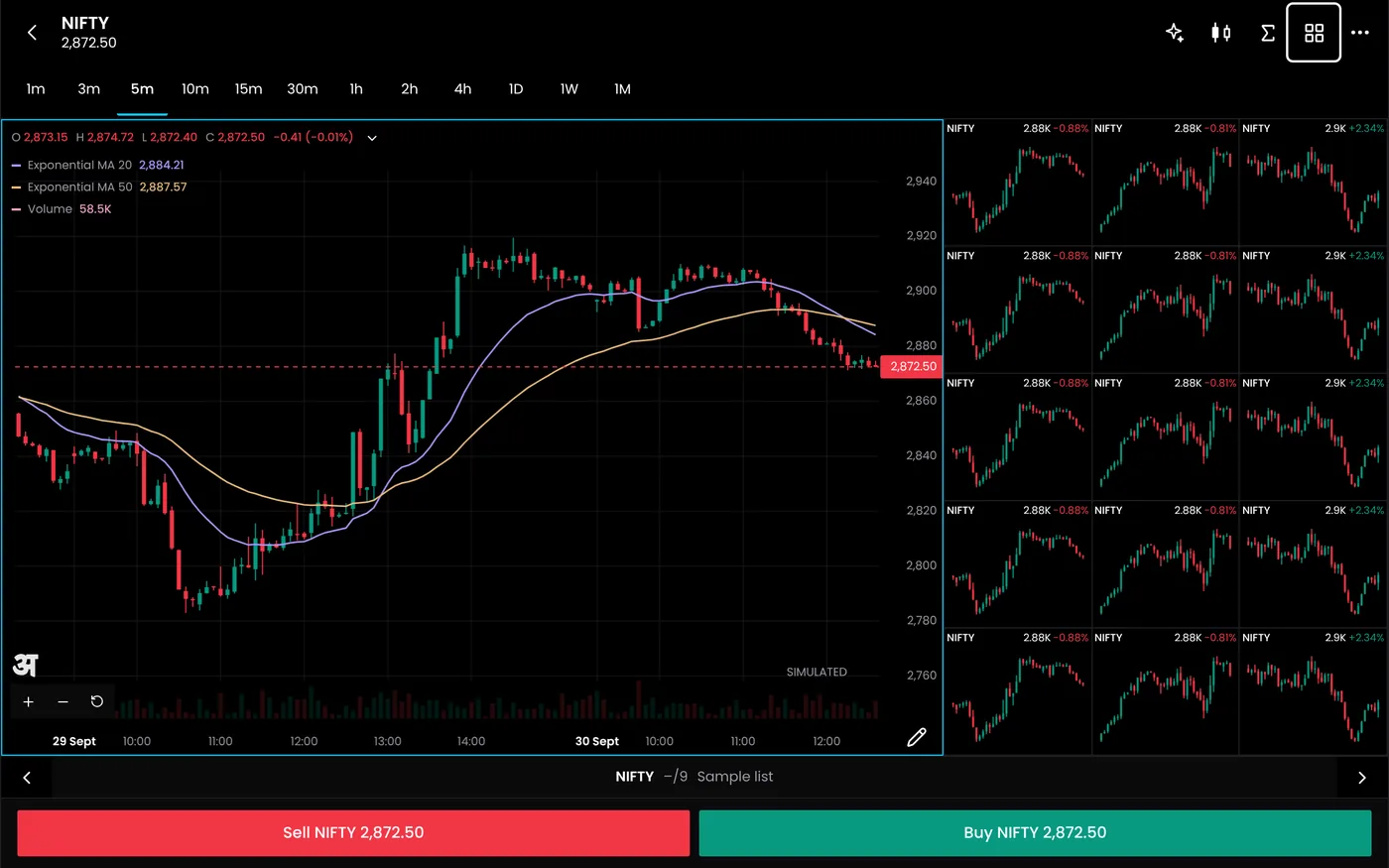
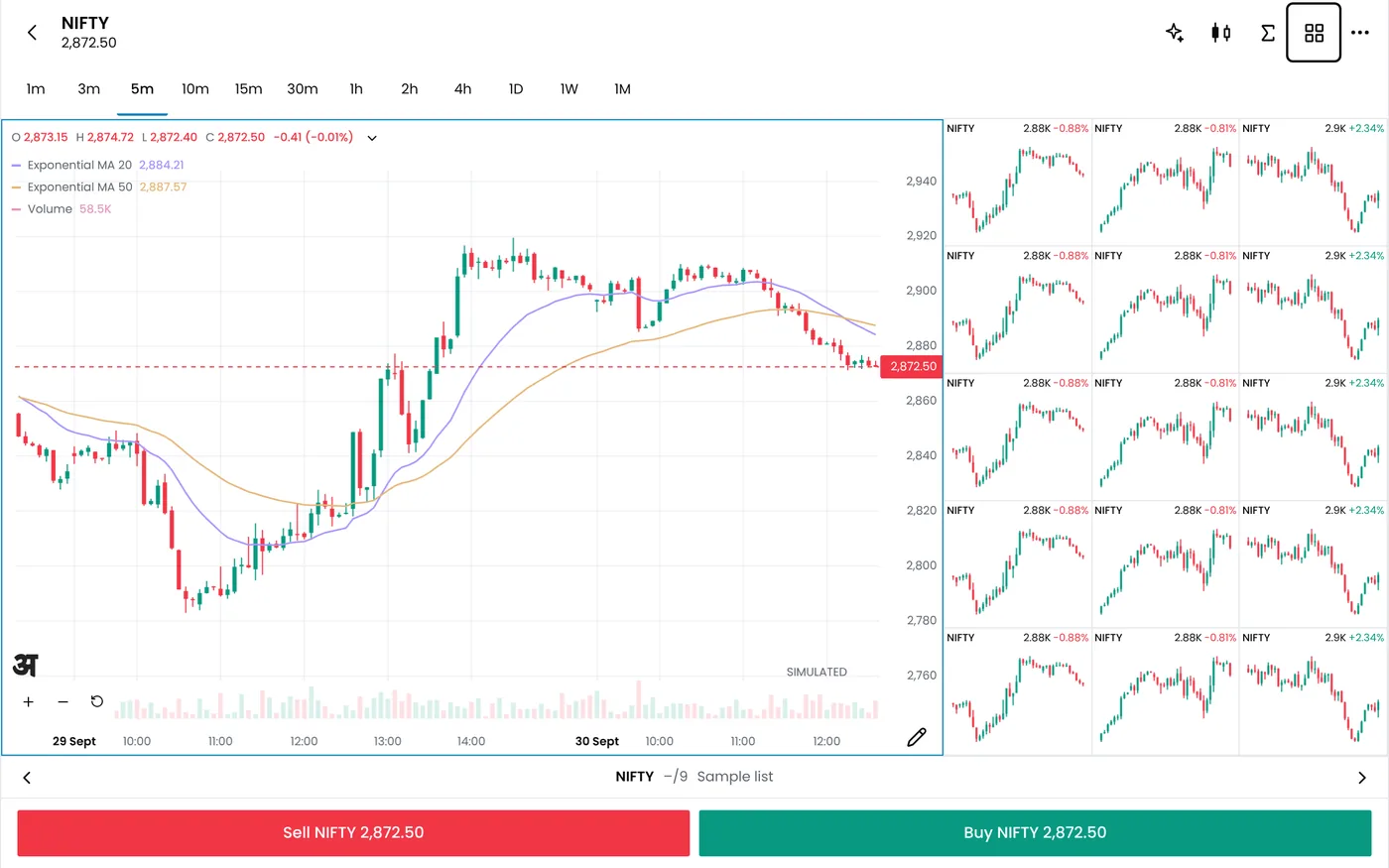
QuantPower's multiple charts feature shows up to four charts on one screen, and market alerts can tell you when the index reaches a level you are watching.
Indicators for Nifty and Bank Nifty scalping
There is no single best indicator for scalping. Most rule sets combine one tool for direction, one for the trigger and one check on liquidity:
| Indicator | How scalpers use it | Watch out for |
|---|---|---|
| VWAP | Direction: calls above it, puts below; pullbacks to it as entry points | A flat VWAP on a range day gives many false signals |
| EMA 9 and 21 | Trigger: a cross in the direction of the trend | Whipsaws in a range; needs the direction filter |
| Opening range | Breaks of the high or low of the first 15 minutes | Many early breaks fail; see the opening range breakout |
| Supertrend, short settings | Trend direction on 3- or 5-minute candles | Flips late after sharp moves |
| RSI(7) or RSI(14) | Avoid buying into a stretched move; time pullback entries | Stays stretched in strong trends |
| Futures volume | Confirms that a break has participation | Volume spikes at the open and around news |
| Market depth | The spread and the quantity at the best price | Quotes can vanish in a fast market |
Bank Nifty moves more points than Nifty for the same percentage move and its options are priced higher, so the same tools need wider levels. Testing each filter on its own, with costs, matters more than the choice of indicator. Our guide to the VWAP indicator for option trading covers the VWAP rules in full.
Choosing the strike and expiry
- Strike. At the money or one strike in the money. Deep out-of-the-money options are cheaper, but they move less per point and the same spread is a larger share of their price.
- Nifty. Weekly options on NSE expire on Tuesdays. The nearest expiry has the most volume.
- Sensex. Weekly options on BSE expire on Thursdays. Check BSE's current lot size before setting the rupee limits.
- Bank Nifty. Only monthly options have been available since November 2024, expiring on the last Tuesday of the month, so the nearest expiry can be weeks away.
The difference between a Nifty weekly and a Bank Nifty monthly option, in the model:
| One lot, at the money | Nifty weekly | Bank Nifty monthly |
|---|---|---|
| Model inputs | 25,000, 5 days, IV 14% | 56,000, 15 days, IV 16% |
| Lot size | 65 | 30 |
| Premium | ₹173.97, or ₹11,308 a lot | ₹800.78, or ₹24,023 a lot |
| Delta | 0.53 | 0.54 |
| Rupees per index point | ₹34 | ₹16 |
| Charges per round trip | ₹75, or 1.15 points | ₹105, or 3.49 points |
| Vega, one IV point | 11.6 points, or ₹755 a lot | 45.1 points, or ₹1,352 a lot |
A Bank Nifty option needs about three times as many points of target to cover its charges, and it carries almost twice the rupee vega per lot. Scalpers there use wider targets and stops in points and pay closer attention to IV.
Scalping futures instead of options
| One lot, one round trip | Nifty futures | At-the-money Nifty option |
|---|---|---|
| Gain for a 20-point rise in Nifty | ₹1,300 | About ₹695 |
| Charges | About ₹967, of which STT ₹813 | About ₹75, of which STT ₹18 |
| Charges in index points | 14.9 | About 2.2, at a delta of 0.53 |
| Time decay | None | About 0.05 points a minute |
| Vega | None | 11.6 points per IV point |
| Capital | Margin of roughly ₹2 lakh | The premium, about ₹11,300 |
Since STT on futures rose to 0.05% of the sale value on 1 April 2026, a futures round trip costs about 15 Nifty points before slippage, and a 20-point futures scalp keeps only about a quarter of its gain. Options pay STT on the premium, so the same round trip costs the equivalent of about 2 index points. This is the main reason most retail scalping in India is done in options. Futures still avoid time decay and IV risk, which matters more for trades held longer.
Order types and execution
- Limit orders control the price but may not fill. A buy limit at the ask, cancelled after a few seconds, is the usual entry.
- IOC orders (immediate or cancel) fill what they can at once and cancel the rest, so no stale order is left in the book. Watch for partial fills.
- Stop-loss limit (SL) orders carry the stop. NSE discontinued stop-loss market (SL-M) orders in index and stock options from 27 September 2021, so an options stop is an SL order with a gap between the trigger and the limit. Too small a gap and the order can be left unfilled in a fast move; too large and it can fill well beyond the trigger.
- Market orders fill at once but can slip. Some brokers block them in some option contracts, and orders sent through an API may need a market protection setting.
- Freeze quantity. Orders above the exchange's freeze limit are rejected, so larger sizes must be split, for example with an iceberg order.
- Partial fills leave you with less than the planned size. The target and the stop must follow the quantity that actually filled.
Order rate and SEBI's algo rules
A scalping bot sends many orders: an entry, a target and a stop for each trade, plus modifications and cancellations. Follow the applicable broker and exchange requirements; this strategy example is not a claim of approval. One lot traded a few times an hour comes nowhere near that rate, but a logic error can, and brokers also reject orders above their own rate limits.
The bot uses broker infrastructure or the client’s own static IP setup, not Wisdom Tree Ventures servers. Client-hosted operation needs the host and broker session to stay available; broker-hosted clients do not need their own static IP.
Scalping on expiry day
Options behave differently in their final session:
- Time decay is five times faster. At 2:30 pm on expiry day, with an hour left in the model, the at-the-money call is worth about ₹29.59 and loses about 0.25 points a minute if Nifty stands still, against 0.05 points five days earlier. A three-minute hold costs about 0.76 points.
- Gamma is more than five times larger. A 20-point rise adds 11.17 points to the call, while a 20-point fall takes away 9.01, and a 5-point stop is now a sixth of the premium.
- Spreads widen late in the day, and the index stops moving with trades at 3:15 pm, when the closing auction in its stocks begins. F&O contracts trade until 3:40 pm, but against a settlement price set by the auction.
- Buyers pay no extra margin. The additional 2% extreme loss margin on expiry day applies to short index options, not to options you buy.
Expiry-day scalping rules usually trade fewer lots, scale the target and stop to the smaller premiums and stop taking entries well before 3:15 pm. Our guide to hero zero option trading covers the whole session.
Risk rules and position sizing
Size a scalping strategy from its daily loss limit, not from the premium.
The other rules that keep a scalper in the game:
- A cap on trades per day, to stop overtrading on a choppy day.
- A pause after three losses in a row.
- A fixed size in lots, not raised after wins or losses.
- One position at a time, with no averaging down.
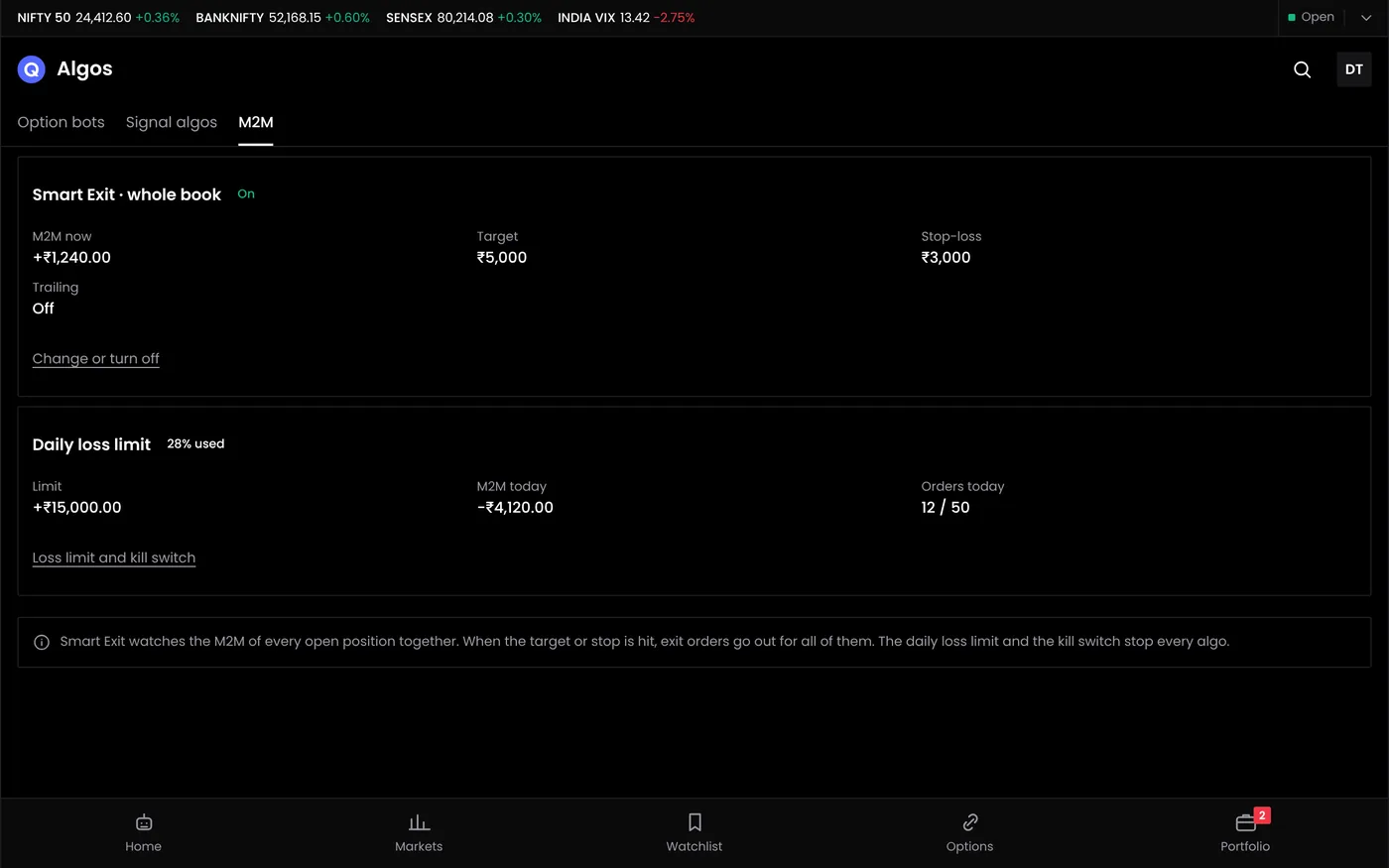
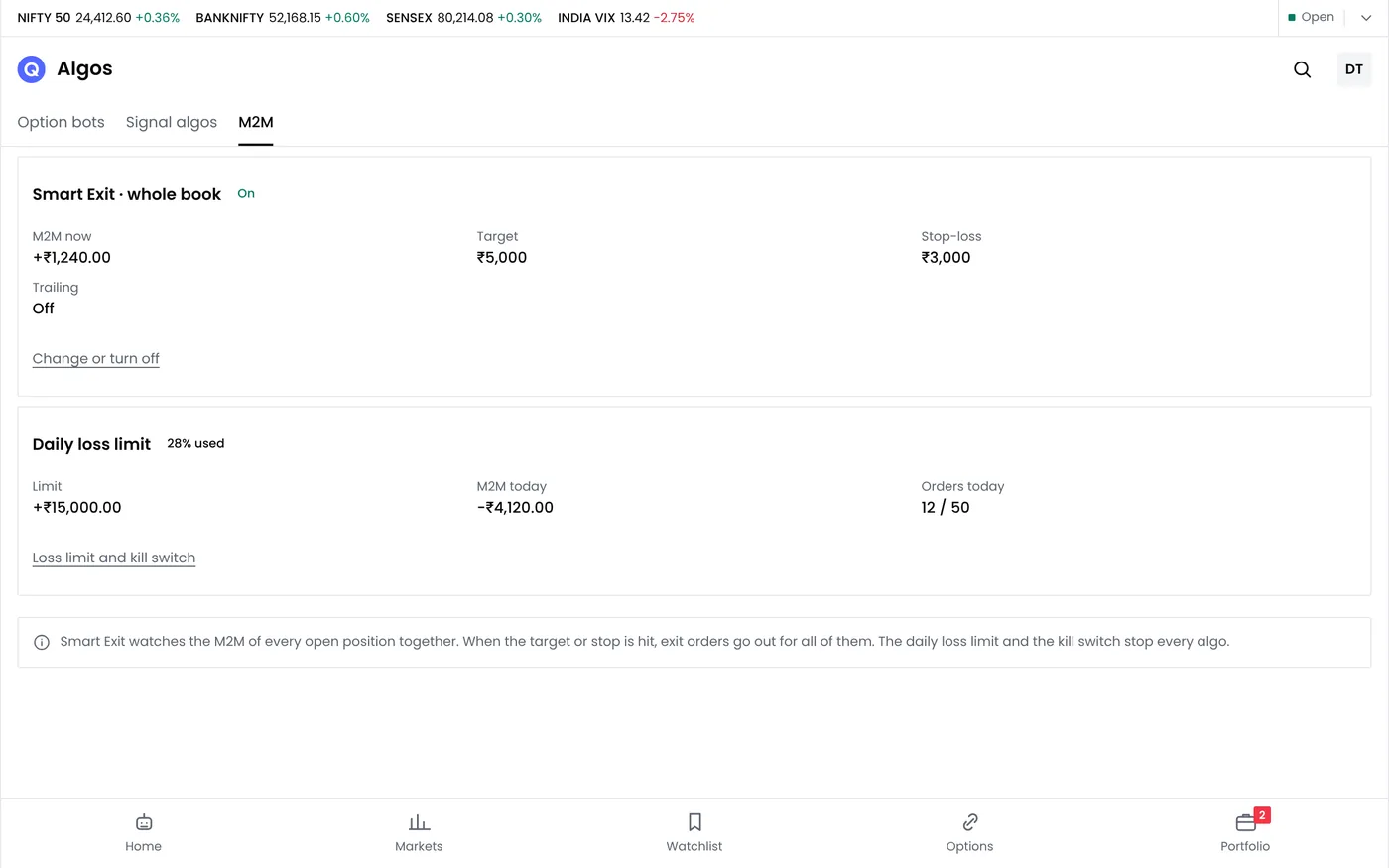
- An account-level MTM limit (see how to place stop loss order) that squares off everything if several strategies lose together.
- No trading into scheduled news.
Bought options need only the premium, with no margin on top. A strategy that scalps by selling options needs SPAN and exposure margin, plus the extra 2% on expiry day; see the F&O margin calculator.
Choosing a broker and app for scalping
The broker matters more for scalping than for any other style, because every cost and every delay repeats many times a day:
| What to check | Why it matters for scalping |
|---|---|
| Brokerage per order | Paid twice per round trip: at eight trades a day and ₹20 per order, ₹320 a day |
| Order types in options | Limit, IOC and SL orders; whether market orders are blocked |
| API rate limits | How many orders per second the broker accepts before rejecting |
| Stability at the open and on expiry day | Outages and slow screens cost scalpers most |
| Market depth and fast order entry | The spread and the quantity at the best price |
| Data and API plans | Some brokers charge separately for live data through their API |
At ₹320 a day, brokerage alone comes to about ₹6,400 a month over 20 sessions, before GST and the other charges. Compare the per-order charges of the brokers QuantPower works with (connections verified as Available for your release) in the brokerage calculator. Zerodha users, for example, need their own Kite Connect plan for live prices.
As for the app, manual scalping on a phone is slow. A bot places the target and the stop the moment the entry fills, wherever you are. QuantPower runs on the web and on Android; on an iPhone, use the web platform in Safari.
Costs, slippage and tax
A strategy that trades eight times a day pays about ₹600 a day in charges on one lot, or about ₹12,000 a month over 20 sessions, before the spread and slippage. Slippage is usually the larger cost: stops trigger in fast markets, and a point lost on every stop adds up faster than any fee. Use the calculator below with your broker's rates, and put the result into every backtest.
Brokerage, STT, exchange charges, SEBI fee, stamp duty and GST for one round trip, by broker.
Profits from options trading are generally taxed as non-speculative business income, and frequent trading builds up turnover quickly.
How to backtest a scalping strategy
Scalping backtests are easy to get wrong, because the profit per trade is small and every modelling shortcut flatters it:
- Use the finest data available. With 1-minute candles you often cannot tell whether the target or the stop was hit first. When both lie inside the same candle, count the trade as a loss.
- Use option prices, not the index. The option's own price includes changes in IV and time decay, which the index does not show.
- Buy at the ask and sell at the bid, or add half the spread to each fill.
- Put slippage on every stop, at least a point on Nifty options and more on expiry day.
- Count every charge on every order, including on trades closed for a point.
- Respect the order rules: SL orders instead of SL-M, the freeze quantity and the time it takes to send an order.
- Use the actual expiries. Weekly expiry days have changed several times, and Bank Nifty's weekly options ended in November 2024.
- Count trades and days. Several hundred trades across trending, range-bound and volatile days say more than one strong month.
- Compare with paper trading. If paper fills are much worse than the backtest's, the backtest's fills were unrealistic.
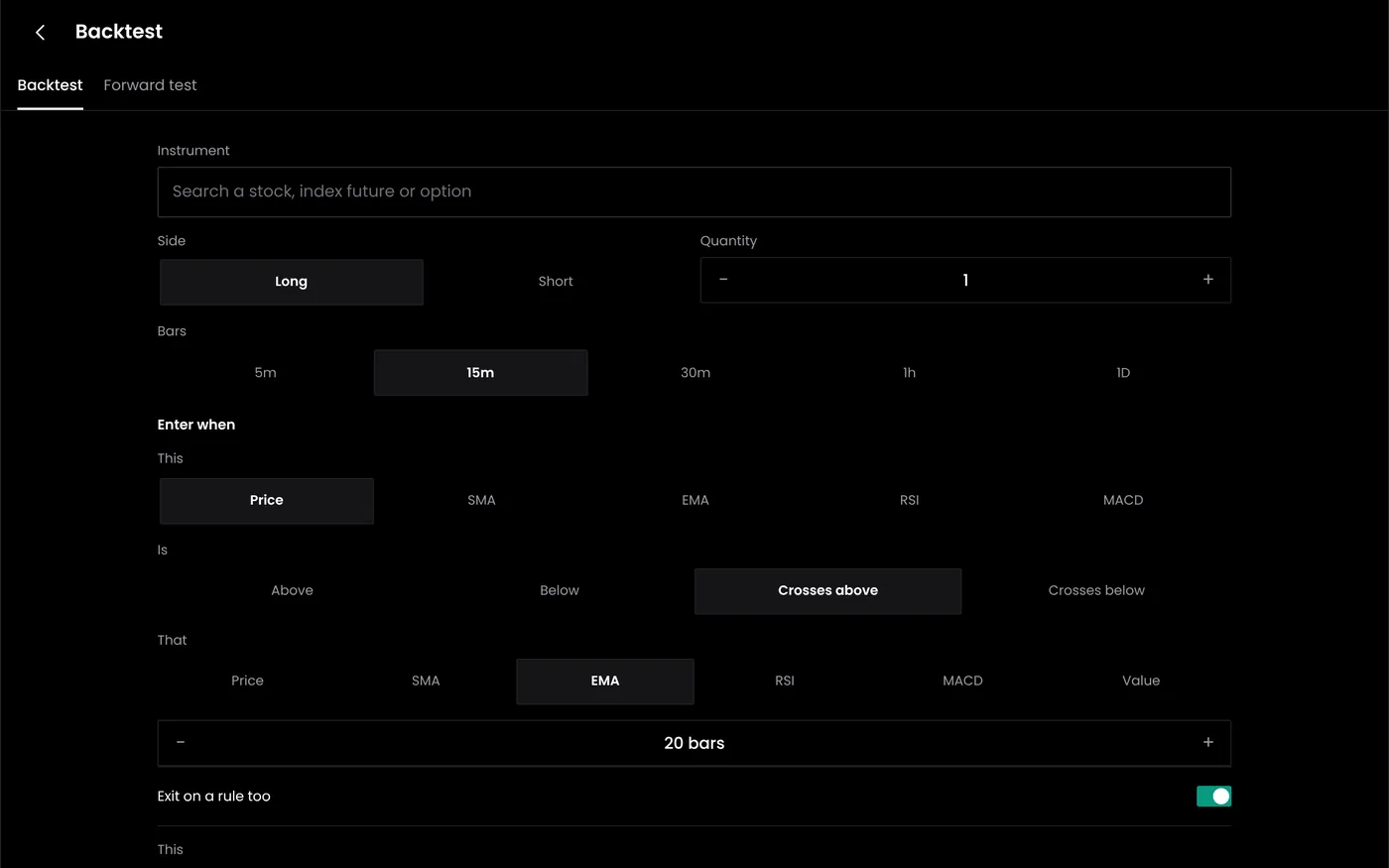
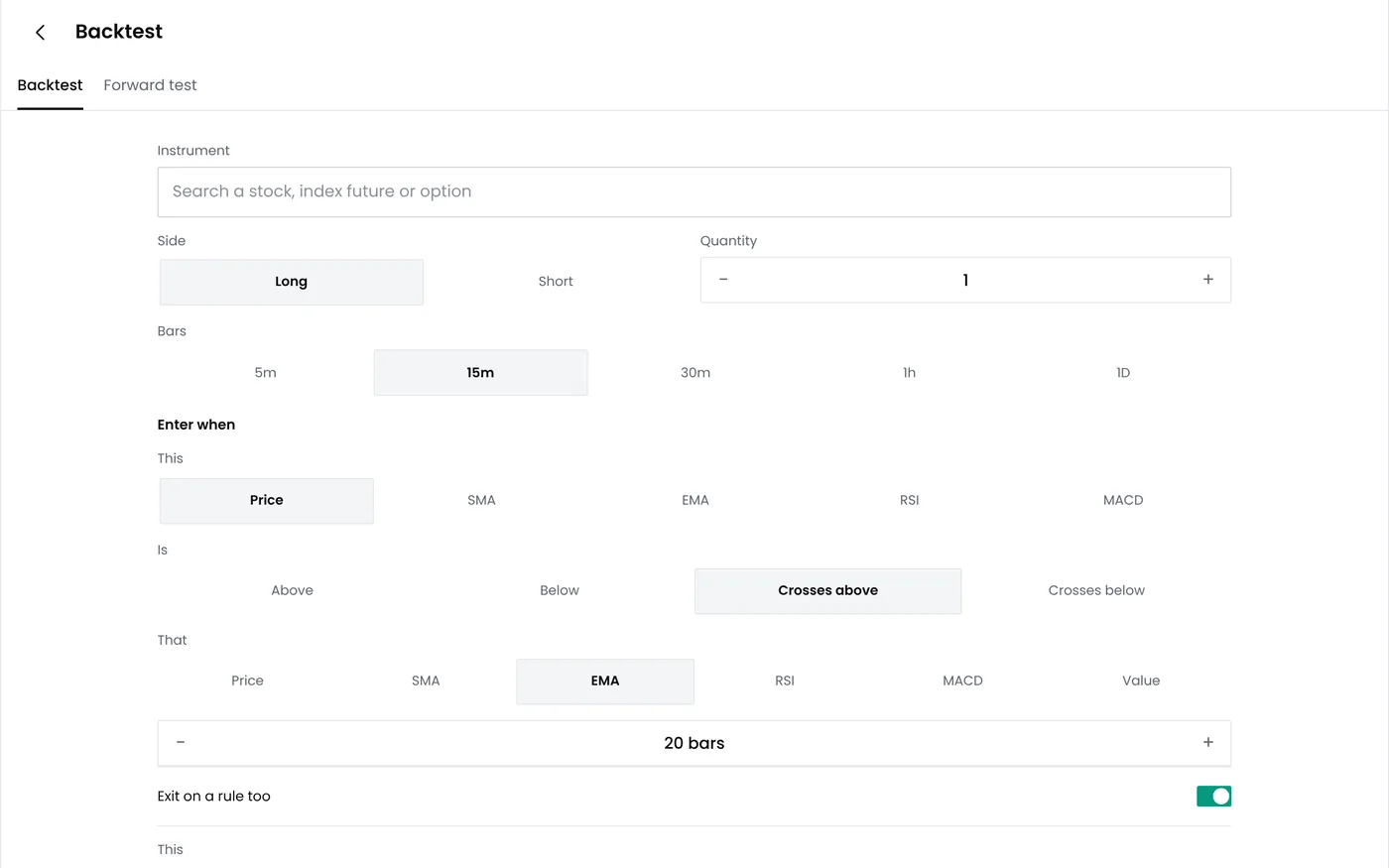
Our guides on how to backtest trading strategies, avoiding overfitting and look-ahead bias cover each step, and the backtesting engine runs the rules with costs included.
Setting up the scalping strategy in QuantPower
Scalping rules are exact, which makes them easy to automate and hard to follow by hand: after two stops in a row, the hardest thing is to take the next signal at the same size, or to stop when the limit says so. A sample rule set:
| Rule | Example setting |
|---|---|
| Instrument | Nifty options, current weekly expiry, the strike nearest to the index at entry |
| Signal | The 9-period EMA crosses the 21-period EMA on 1-minute candles of Nifty futures |
| Direction filter | Calls while the futures are above VWAP; puts while they are below |
| Entry windows | 9:30 to 11:30 am and 1:30 to 3:00 pm |
| Entry order | Limit |
| Target | 8 points on the option premium |
| Stop loss | 5 points, as an SL order with a buffer |
| Exit signal | The EMAs cross back |
| Time exit | 3:10 pm |
| Re-entry | Up to seven times a day, or eight trades in all |
| Strategy stop loss | ₹1,500 per lot for the day |
| Daily limit | Your MTM loss limit for the account |
Step 1. Build the rules
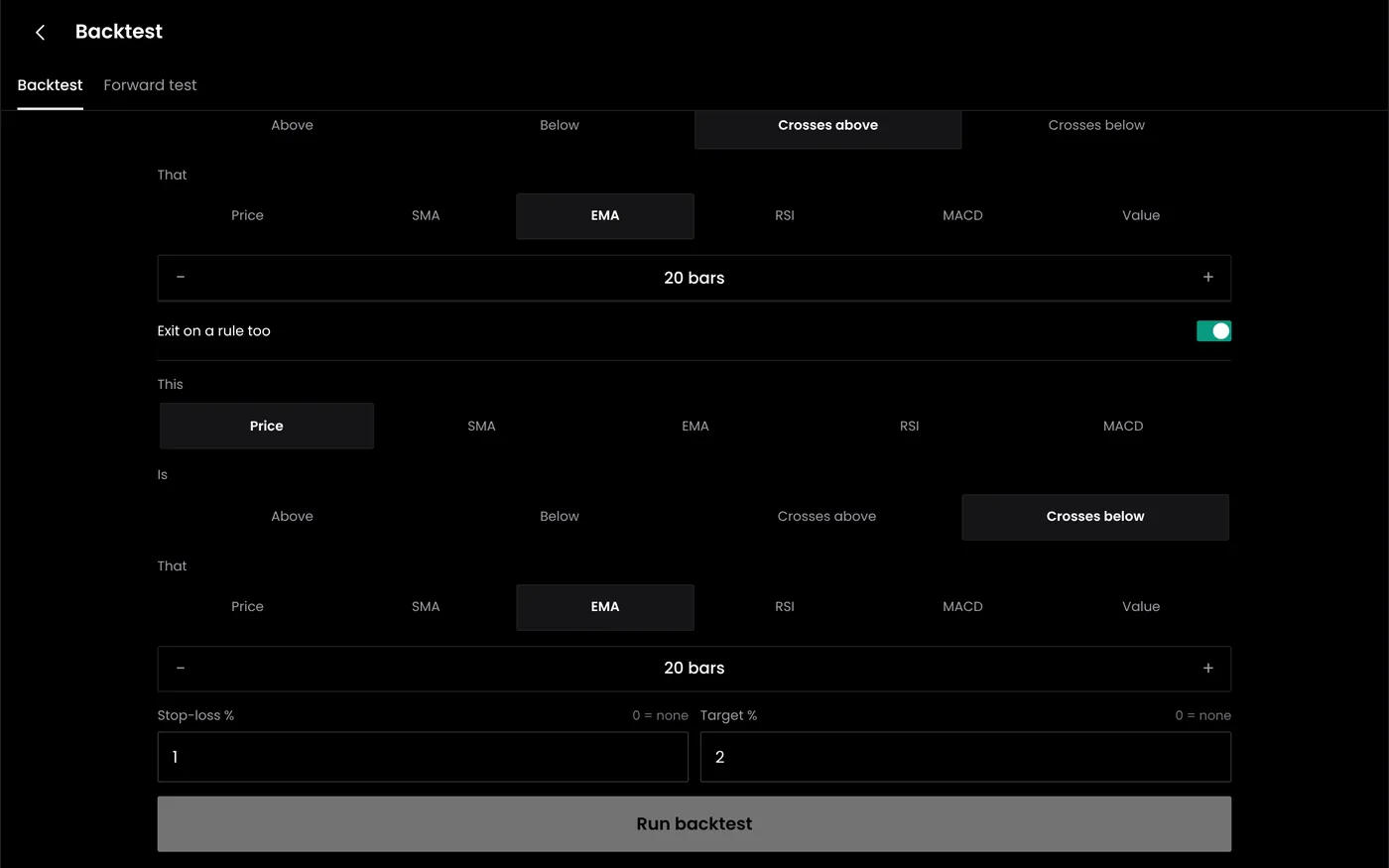
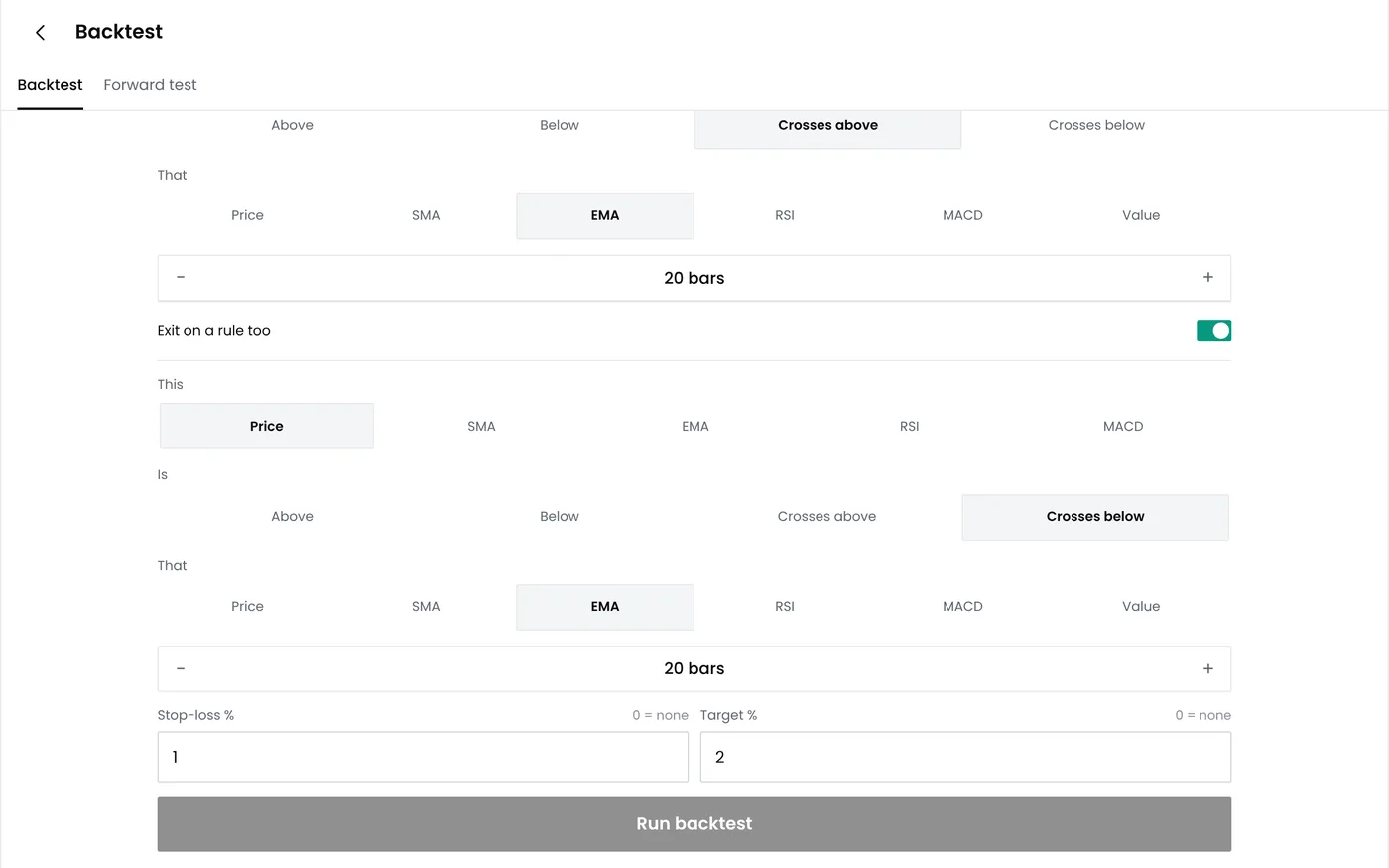
In the option strategy builder, choose Nifty weekly options, add the EMA cross on 1-minute candles as the entry condition, then the VWAP filter and the entry windows.
Step 2. Set the exits and limits
Set the 8-point target, the 5-point stop, the exit signal, the 3:10 pm time exit, the number of re-entries and the strategy stop loss.
Step 3. Backtest it
Run the rules over past months with slippage and costs on, then change one setting at a time: the target, the stop, the windows.
Step 4. Paper trade it
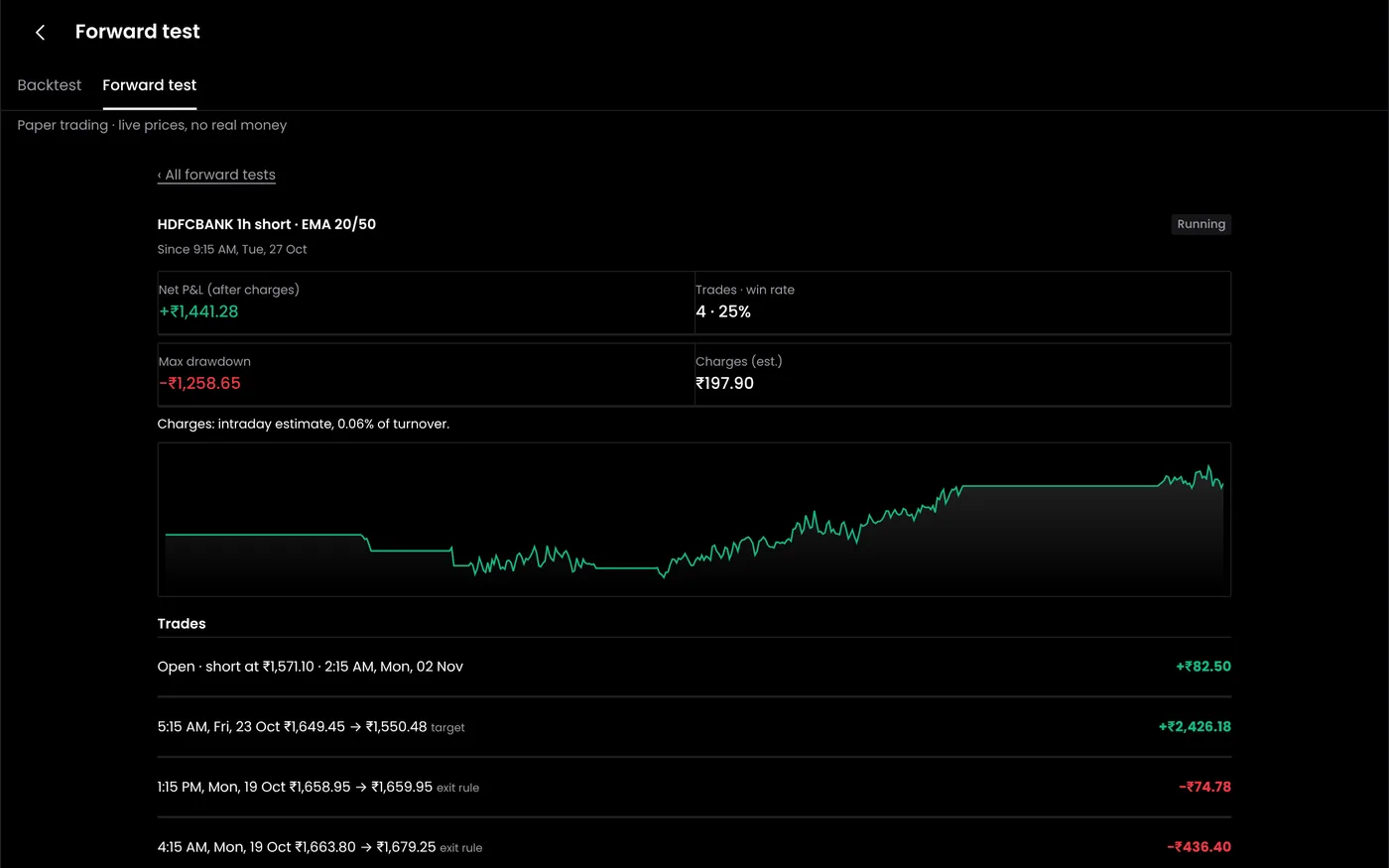
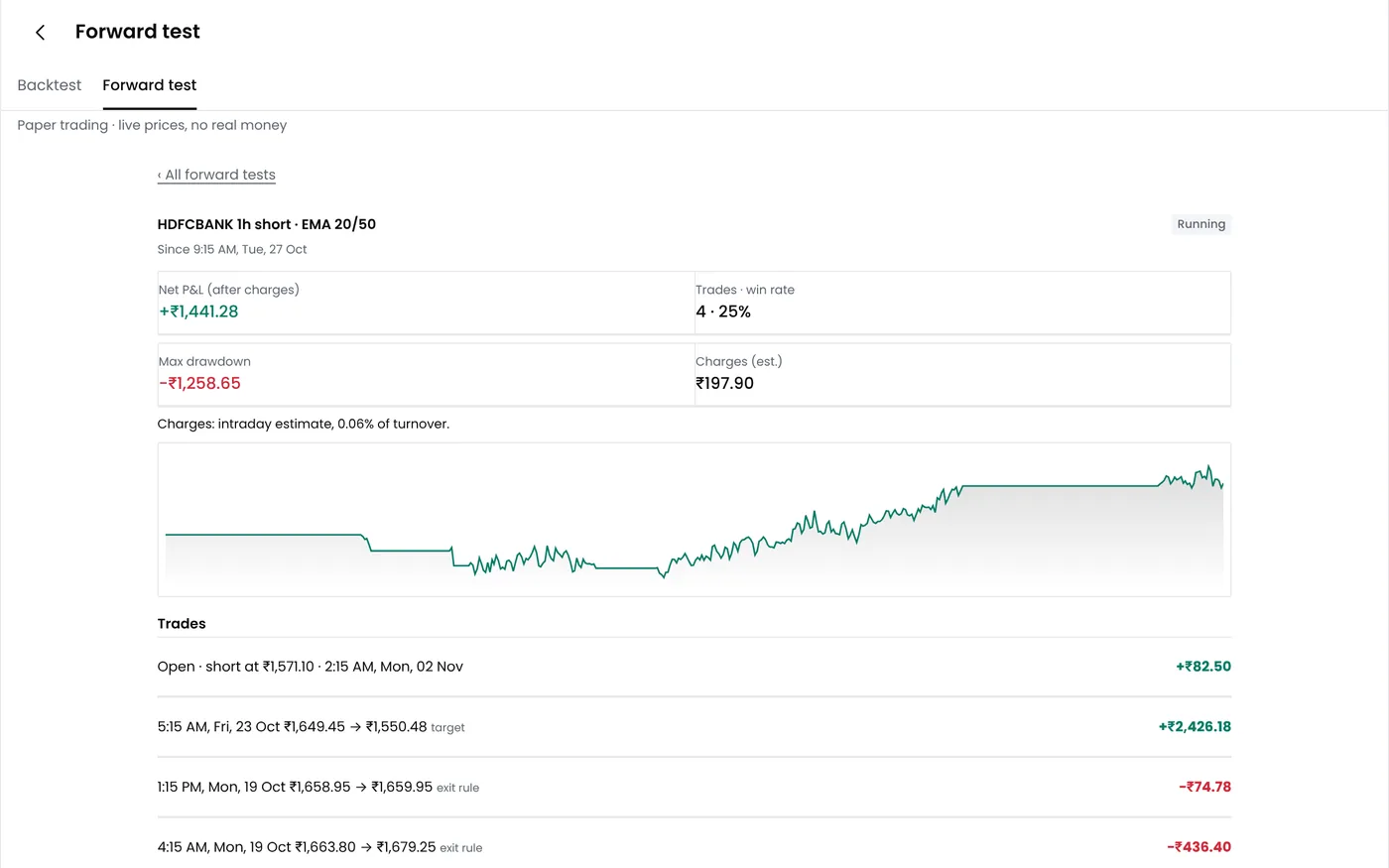
Run the strategy on live prices with virtual money for at least a few weeks, and compare each fill with the price the backtest assumed. For a scalping strategy this is the most important test.
Step 5. Set the account limit
Set the daily MTM loss limit in the risk settings before going live. It squares off every position when it is hit, including positions from other strategies.
Step 6. Deploy the bot
Connect your broker, choose the strategy and the number of lots, confirm the limits and deploy. The bot places the target and the stop as soon as each entry fills.
Step 7. Monitor and pause
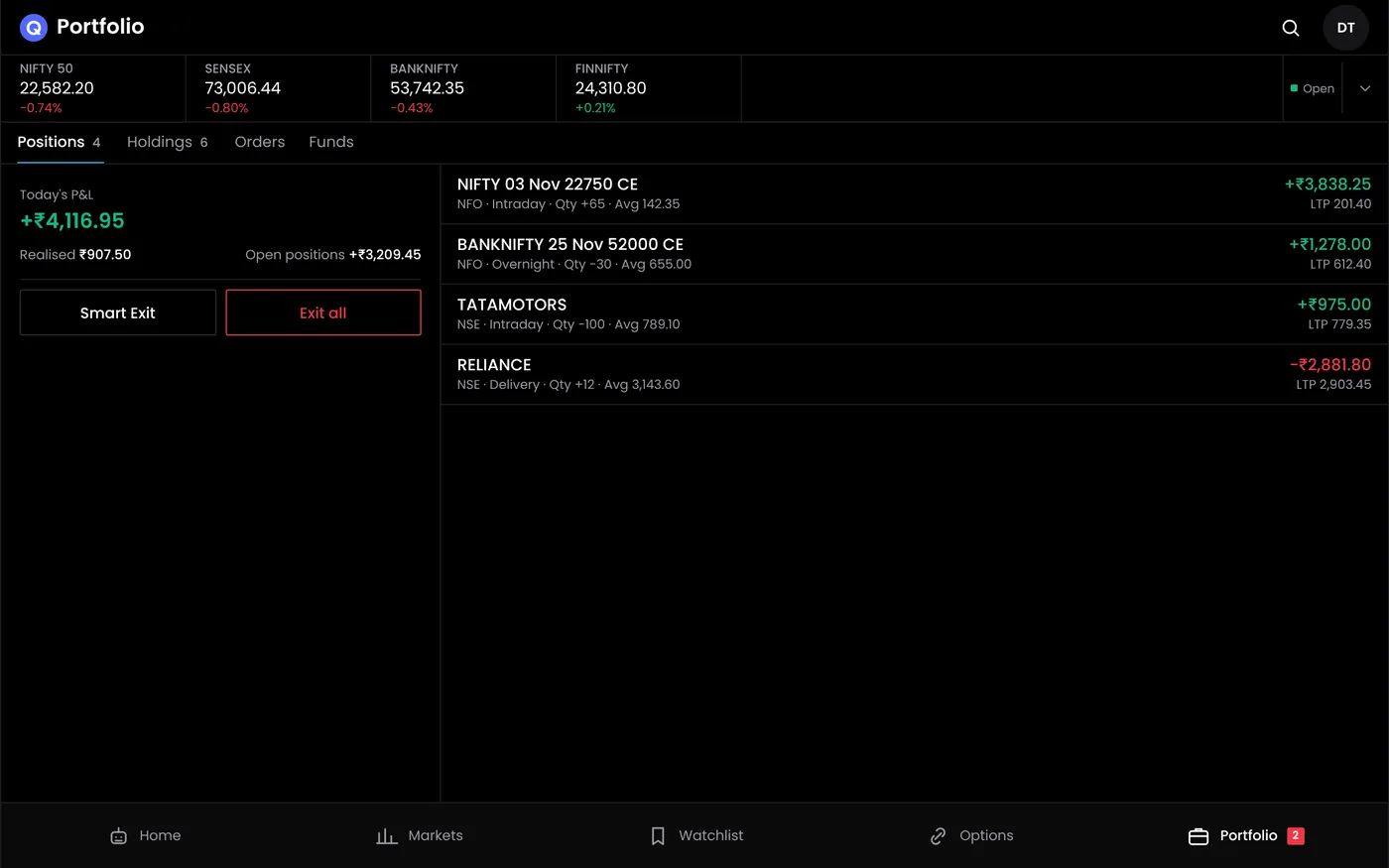
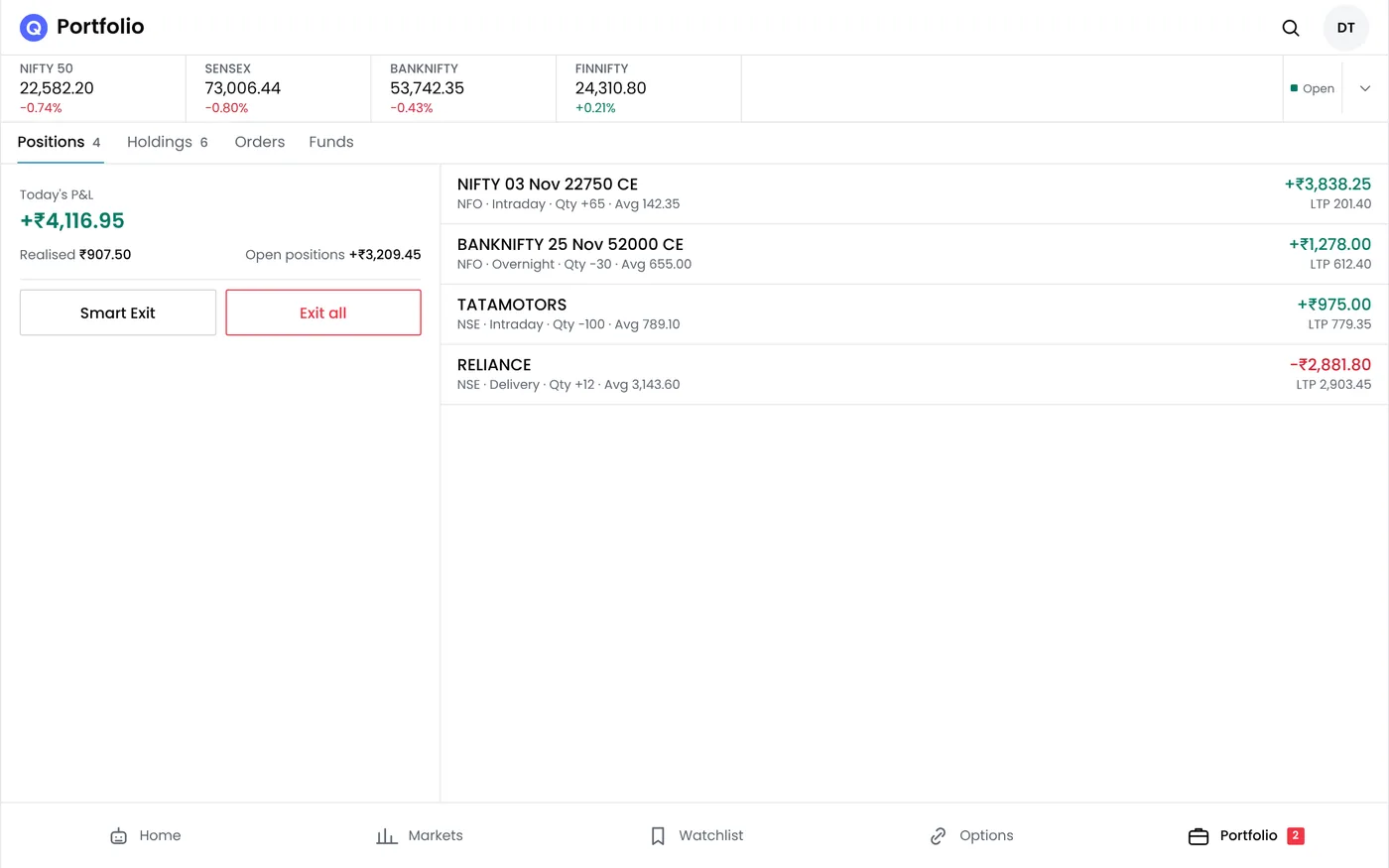
Watch the first live sessions closely: the fills, any rejected orders and the re-entries used. Use Pause all to stop every bot at once. The bot runs on your own account with a broker connection verified for your release, through the broker's API.
Measuring a scalping strategy
| Measure | What to look for |
|---|---|
| Net result per trade | Positive after every charge, the spread and slippage |
| Costs as a share of gross profit | Above half means the strategy works mostly for the broker and the exchange |
| Win rate against the break-even rate | The gap is the edge: with an 8-point target and a 5-point stop, it has to stay above 52% |
| Average slippage on stops | Compared with the backtest's assumption |
| Trades per day | How often the cap is reached; frequent caps suggest overtrading |
| Worst day and longest losing run | Compared with the daily limit |
A trade journal helps track these week by week.
Common mistakes
- Targets too small for the costs, such as 2- or 3-point scalps on one lot.
- Market orders in the first minutes after the open, when spreads are widest.
- Moving or removing the stop after a few losses.
- Revenge trading: more trades and more lots after a loss.
- Averaging down a losing option.
- Ignoring IV, for example buying calls after a sharp rally, when IV is high and likely to ease.
- Scalping through scheduled news.
- Holding past 3:15 pm on expiry day, when the index stops moving with trades.
- Judging the strategy on a few good days rather than on hundreds of trades.
Pre-trade checklist
- The spread on your strike is at its usual width.
- No scheduled news falls in the next hour, or the bot skips it.
- The target, the stop and the exit signal are set, and the target is large enough for the costs.
- The trade cap, the strategy stop loss and the account MTM limit are set.
- The broker session is live and the bot shows no rejected orders.
- The strategy has run in paper trading with fills close to the backtest.
- You know whether today is an expiry day and whether the bot trades it.
Start your free trial
Connect your broker, build a strategy and test it on paper before a single live order goes out.
Frequently asked questions
Is scalping in option trading profitable?
For most traders it is not, once costs are counted. A round trip on one lot of a Nifty option costs about ₹75 in charges plus the spread and slippage, so small targets need win rates of 60% to 75% just to break even. Scalping can work with targets larger than stops, strict limits and consistent execution, but test it with every cost before trading. We do not publish returns for any strategy, and nothing here is a performance claim.
What is the best time for option scalping?
Liquidity is usually best after the first 15 minutes and through the late morning, with another active spell in the afternoon. Spreads are often wider in the first minutes and around news. On expiry day, many scalpers stop well before 3:15 pm, when the closing auction in the index stocks begins.
Which options are best for scalping?
At-the-money or one strike in-the-money options on the nearest expiry: Nifty weekly options on NSE, Sensex weekly options on BSE and Bank Nifty monthly options. They have the tightest spreads and a delta near 0.5. Deep out-of-the-money options are cheaper but move less and lose more to the spread.
What is the best chart setup for scalping?
A 1-minute chart for the trigger, a 5-minute chart for the direction, VWAP and two short moving averages such as the 9- and 21-period EMAs on the futures, plus market depth for the strike you trade. Keep the layout the same every day so you read it the same way.
What is the best indicator for Bank Nifty scalping?
No indicator works on its own. VWAP for direction, a short EMA cross or the opening range for the trigger, and a volume check on the futures are the common choices. Bank Nifty's options are monthly and priced higher, so scale targets and stops to its premiums and test the rules with costs.
Which broker is best for scalping?
Look at the cost per order, the order types allowed in options, the API rate limits and how stable the platform is at the open and on expiry day. At eight trades a day, brokerage alone is ₹320 a day at ₹20 per order. Compare brokers with the brokerage calculator.
Is scalping futures better than scalping options?
Since 1 April 2026, STT on futures is 0.05% of the sale value, about ₹813 on one lot of Nifty. A futures round trip now costs about 15 index points in charges, against the equivalent of about 2 points for an at-the-money option. Futures have no time decay or IV risk, but for very short trades options are much cheaper.
Can I scalp on expiry day?
Yes, with care. In the model, the at-the-money call loses about 0.25 points a minute in the last hour, five times the rate five days earlier, and moves much faster with the index. Trade fewer lots, scale the target and the stop, and stop before 3:15 pm. See hero zero option trading.
Do I need an algo to scalp?
Not strictly, but manual scalping is limited by reaction time and discipline. A bot places the target and the stop the moment an entry fills, keeps to the trade cap and stops at the daily limit. Follow the applicable broker and exchange requirements; this strategy example is not a claim of approval.
Related guides and terms
- Option buying strategies and hero zero option trading
- VWAP indicator for option trading and opening range breakout strategy
- Moving average crossover strategy and momentum breakout strategy
- Order types and iceberg orders
- Option greeks and implied volatility crush
- Brokerage calculator, slippage calculator and trade journal
- Glossary: Bid ask spread meaning, market depth meaning, delta meaning, gamma meaning, vega meaning, VWAP meaning, square off meaning
- Intraday trading
Sources
- SEBI circular on safer participation of retail investors in algorithmic trading, 4 Feb 2025, and the implementation timeline to 1 April 2026
- SEBI, Profitability of Individual Traders in the Equity Derivatives Segment (FY25–FY26), PR No. 50/2026, 20 August 2026
- NSE circular NSE/FAOP/49677: SL-M orders discontinued in index and stock options from 27 September 2021
- NSE circular of 30 May 2026: equity derivatives close moved to 3:40 pm from 3 August 2026, alongside the Closing Auction Session in the cash market
- SEBI circular SEBI/HO/MRD/TPD-1/P/CIR/2024/132, 1 Oct 2024: additional 2% ELM on short index options on expiry day from 20 Nov 2024
- Finance Act, 2026: STT of 0.05% on the sale of futures and 0.15% on the sale of options from 1 April 2026
- NSE: Equity derivatives contract specifications (lot sizes and expiry days)