
This guide covers how Bank Nifty options work today, the numbers on one lot for the main strategies, the Greeks and margin, how the monthly cycle changes straddles, strangles, condors and momentum trades, a worked month, and how to automate Bank Nifty strategies with clear risk limits.
Bank Nifty options at a glance
| Bank Nifty options | |
|---|---|
| Underlying | Nifty Bank index |
| Exchange | NSE |
| Lot size | 30 units, from the January 2026 series |
| Expiries | Monthly only, on the last Tuesday of the month, since November 2024 |
| Strike interval | 100 points |
| Style | European: exercised only at expiry |
| Settlement | Cash |
| Contract value, one lot at 56,000 | About ₹16.8 lakh |
Bank Nifty weekly options were discontinued when SEBI limited each exchange to one benchmark index with weekly expiries. NSE kept weekly options on Nifty 50 only. When the last Tuesday is a holiday, the contract expires on the previous trading day; the Nifty expiry date calendar lists every date. Check NSE's contract specifications for the current lot size.
Key takeaways
- At an illustrative Bank Nifty level of 56,000 with 15 days to expiry and 16% IV, the at-the-money straddle is worth about ₹1,452 a unit, or ₹43,566 a lot. The model one standard deviation move to expiry is about ±1,816 points, and about ±469 points in a single day.
- One lot of Bank Nifty and one lot of Nifty are similar in contract value, about ₹16 to 17 lakh, but Bank Nifty moves more in points and usually in percentage terms. Strike distances, stops and wings must be wider.
- Monthly expiry means most days are far from expiry. An at-the-money straddle with 15 days left earns about ₹1,483 a day in decay but loses about ₹2,705 for each point of IV, so volatility matters as much as time.
- Defined-risk positions suit the monthly cycle: an iron condor 55,000 / 55,500 / 56,500 / 57,000 collects ₹10,192 with a maximum loss of ₹4,808 a lot.
- RBI policy, bank results and bond yields move the index. Most systematic Bank Nifty strategies skip or hedge those days.
What monthly expiries change
With weekly options, a Bank Nifty trader could sell an at-the-money straddle a few days before expiry and capture the fast final decay every week. With monthly options, most trading days are far from expiry, where options decay more slowly and carry more vega.
Model values with Bank Nifty at an illustrative 56,000, IV of 16% and a lot of 30:
| Days to expiry | ATM straddle value per unit | Per lot | One standard deviation move to expiry |
|---|---|---|---|
| 30 | ₹2,058 | ₹61,733 | About 2,569 points |
| 15 | ₹1,452 | ₹43,566 | About 1,816 points |
| 12 | ₹1,298 | ₹38,950 | About 1,625 points |
| 5 | ₹837 | ₹25,119 | About 1,049 points |
At 30 days, the at-the-money straddle decays by about ₹1,046 a day per lot. That is meaningful, but a typical day's move of several hundred points can easily outweigh it. Decay speeds up through the cycle and is fastest in the final week.
The numbers on one lot
Model values for the main strategies, with Bank Nifty at 56,000, 15 days to the monthly expiry, IV of 16% and a lot of 30. The last two rows use three days to expiry and IV of 15%, as in an expiry-week trade.
| Strategy (one lot) | Strikes | Credit or debit | Maximum profit | Maximum loss | Breakevens | Model chance of profit | Theta a day | Vega per IV point |
|---|---|---|---|---|---|---|---|---|
| Short straddle | 56,000 | Credit ₹43,566 | ₹43,566 | Unlimited | 54,548 and 57,452 | About 58% | +₹1,483 | −₹2,705 |
| Short strangle | 55,500 / 56,500 | Credit ₹30,234 | ₹30,234 | Unlimited | 54,492 and 57,508 | About 59% | +₹1,429 | −₹2,611 |
| Iron condor | 55,000 / 55,500 / 56,500 / 57,000 | Credit ₹10,192 | ₹10,192 | ₹4,808 | 55,160 and 56,840 | About 35% | +₹155 | −₹263 |
| Bull call spread | 56,000 / 56,500 | Debit ₹7,058 | ₹7,943 | ₹7,058 | 56,235 | About 47% | −₹41 | +₹13 |
| Bear put spread | 56,000 / 55,500 | Debit ₹6,275 | ₹8,726 | ₹6,275 | 55,791 | About 43% | −₹14 | +₹81 |
| Long straddle | 56,000 | Debit ₹43,566 | Unlimited | ₹43,566 | 54,548 and 57,452 | About 42% | −₹1,483 | +₹2,705 |
| Short straddle, 3 days out | 56,000 | Credit ₹18,237 | ₹18,237 | Unlimited | 55,392 and 56,608 | About 57% | +₹3,349 | −₹1,214 |
| Iron fly, 3 days out | 55,400 / 56,000 / 56,600 | Credit ₹12,614 | ₹12,614 | ₹5,387 | 55,580 and 56,420 | About 42% | +₹1,053 | −₹306 |
These are Black–Scholes model values at an illustrative level, not live prices. They show the trade-offs that matter on Bank Nifty: naked selling earns large decay with unlimited risk; spreads and condors cap the loss and earn far less each day; buying a straddle needs a move of about 1,450 points just to break even.
Interactive payoff chart: change the spot, IV, lot size and days to expiry to see the curve, breakevens and Greeks.
Bank Nifty straddles and strangles
Intraday straddles
Intraday sellers still sell Bank Nifty straddles in the morning and exit before the close. Early in the monthly cycle, each session decays only a small part of the premium, so the strategy depends heavily on tight stops and on quiet days. Many traders reduce the size of Bank Nifty intraday straddles compared with the weekly era, or restrict them to the last week of the cycle, when a day's decay is several times larger.
Positional straddles and strangles
Selling a strangle two or three weeks before the monthly expiry collects more premium and gives more time for decay. It also carries overnight gap risk and is exposed to events such as RBI policy announcements and bank results. A two-point rise in IV costs the 55,500 / 56,500 strangle about ₹5,200 a lot, more than three days of decay.
Defined-risk sellers: condors and flies
Iron condors and iron flies cap the loss with wings and need a fraction of the margin of naked selling. On Bank Nifty the wings need to be wider than on Nifty for the same protection: 500 points is a common minimum for a monthly condor.
Expiry-week strategies
The final days before the monthly expiry carry the fastest decay and the highest gamma. With three days left, the at-the-money straddle earns about ₹3,349 a day in decay, but a 600-point move wipes out the whole premium. Many Bank Nifty sellers concentrate their selling into that week, with smaller size, wings and tight exits. Our guide to hero zero option trading explains the risks of the final session.
Bank Nifty momentum strategies
Bank Nifty's larger moves suit momentum strategies on futures or options:
- Opening range breakout. Trade the break of the first 15 or 30 minutes' range, with a stop at the other side of the range.
- VWAP trend filters. Buy only above VWAP and sell only below it, with exits when price crosses back.
- Supertrend and moving averages. Trend filters on 5- or 15-minute charts.
- Option buying on breakouts. Buy calls or puts when a breakout confirms, with a quick exit if it fails.
Because monthly options carry more time value than weekly ones did, buying them costs more per point of delta, but they also lose value more slowly while you wait for the move.
The Greeks on Bank Nifty
- Theta is slow early in the cycle and fast in the last week. With 15 days left the at-the-money straddle decays about ₹1,483 a lot a day; with three days left, about ₹3,349.
- Vega is large while expiry is far away. A one-point rise in IV moves the 15-day straddle by about ₹2,705 a lot. Bank Nifty IV usually runs several points above Nifty's and jumps around RBI policy and bank results.
- Gamma grows through the cycle. In the final week a 300-point move, routine for Bank Nifty, swings a short straddle by tens of thousands of rupees a lot.
- Delta of the at-the-money options starts near 0.5. A Bank Nifty future has a delta of one lot: ₹30 for every point.

Margin on Bank Nifty
One lot of Bank Nifty at 56,000 has a contract value of about ₹16.8 lakh, close to one lot of Nifty at 25,000 (about ₹16.25 lakh). Margins per lot are therefore of a similar order to Nifty's for the same position, but depend on Bank Nifty's own volatility in the exchange's SPAN file. Our F&O margin calculator shows typical figures and how they are built.
- Naked short options need the most margin. Wings cut it to a fraction.
- Expiry day: short index options carry an extra 2% extreme loss margin on the day they expire, which falls on Bank Nifty's last Tuesday of the month.
- Size by risk: a ±469-point daily standard deviation is about ±₹14,000 a lot on futures. Size by the loss you can accept on a large day, not by the margin.
What moves Bank Nifty
Bank Nifty reacts strongly to:
- RBI policy decisions on interest rates and liquidity.
- Bank results, especially from the largest index constituents.
- Credit and liquidity news, such as changes in bond yields or regulations affecting lenders.
- Broad market moves, since banks make up a large part of Nifty 50 as well.
Strategies that sell Bank Nifty options often skip RBI policy days and the days around major bank results.
When to enter
Where you are in the cycle
- Early in the cycle: options carry the most time value and vega, and decay slowly. Positional, defined-risk selling such as iron condors suits this stage, with room for the index to move.
- Middle of the cycle: decay picks up. Many traders take profits on positions that have captured half their credit, or roll them.
- Final week: gamma rises sharply and moves hurt quickly. Traders reduce size, close positions or switch to strategies built for the last days.
Volatility
Sell when IV is high relative to its own recent range and likely to fall, for example after an RBI decision has passed. Buy when IV is low and a move is likely. Compare Bank Nifty's IV with its own history, not with Nifty's, because it usually runs higher.
Time of day
The first 15 minutes have the widest spreads on Bank Nifty options. Most systematic entries wait until 9:30 am, and opening range strategies wait for the range to form.
Exits
- Profit target: for sellers, often 40% to 60% of the credit, which captures most of the reward before the riskiest days.
- Stop loss: a combined stop for spreads and condors, inside the maximum loss; per-leg stops for intraday straddles and strangles.
- Time exit: close positional short options before the final session, or set a fixed intraday exit time.
- Rolling: close a position that has captured half its credit, or a set number of days before expiry, and open a similar one in the next month's contract.
- Daily MTM limit: an account-level MTM stop loss squares off everything when the day's loss reaches your limit.
A worked month, week by week
A model example, not a record of results. A positional Bank Nifty iron condor opened 15 days before the monthly expiry, with a 50% profit target, a combined stop at 1.5 times the credit and a time exit the day before expiry.
- Day 1, 9:40 amBank Nifty 56,000, 15 days to expiry, IV 16%. Buy the 55,000 put at ₹284.95 and the 57,000 call at ₹383.10, then sell the 55,500 put at ₹442.25 and the 56,500 call at ₹565.55. Net credit ₹339.75, or ₹10,192. Maximum loss (500 − 339.75) × 30 = ₹4,808.
- Day 3Bank Nifty 56,200, 13 days left. The condor is worth ₹331.13. P&L +₹259.
- Day 6Banks rally after strong results and the index reaches 56,650, above the short call. IV rises to 17%. With 10 days left the condor is worth ₹334.25: still a small profit of ₹165, because the 500-point wings and the time left absorb the move. The stop at ₹509.63 is far away.
- Day 8The index settles at 56,400 and IV returns to 16%, with eight days left. The condor is worth ₹298.06. P&L +₹1,251.
- Day 11Bank Nifty 56,100, five days left, IV 15.5%. The condor is worth ₹234.45. P&L +₹3,159.
- Day 13With three days left and the index near 56,050, the condor's value falls through ₹169.88, half the credit. The bot buys back the short legs and sells the wings at a net ₹169.00. Profit (339.75 − 169.00) × 30 = ₹5,123 before charges, about ₹4,880 after them.
The rally on Day 6 tested the short call early in the cycle, when time value still cushions the position. The same move with two days left would have cost close to the maximum loss.
Intraday momentum on Bank Nifty futures
A hypothetical opening range breakout on Bank Nifty futures, with a lot of 30:
- The first 15 minutes trade between 55,880 and 56,030, a 150-point range.
- A 5-minute candle closes at 56,045, above the range. The algo buys one lot at the next price, 56,050.
- The stop is at the range low, 55,880, a risk of 170 × 30 = ₹5,100 a lot.
- The target is 1.5 times the range above the high, 56,255, a gain of 205 × 30 = ₹6,150 if reached.
Bank Nifty's larger point moves mean wider ranges and stops than Nifty's, so check that the risk per lot fits your limit before each trade.
Buying Bank Nifty options on monthly contracts
Monthly options carry more time value than weekly ones did, so each point of delta costs more, but they lose value more slowly while you wait for a move. Buyers often choose the at-the-money strike or one strike in the money, use a time stop of a few days rather than hours, and exit before the final week, when decay accelerates. A bull call spread or bear put spread cuts the cost: the 56,000 / 56,500 bull call spread costs ₹7,058 a lot against ₹24,024 for the 56,000 call alone.
Bank Nifty compared with Nifty
| Bank Nifty | Nifty 50 | |
|---|---|---|
| Lot size, from the January 2026 series | 30 | 65 |
| Option expiries | Monthly only | Weekly on Tuesdays, plus monthly |
| Strike interval | 100 points | 50 points |
| Index | Large banking stocks | 50 large companies across sectors |
| ATM straddle, 30 days, per lot (model) | About ₹61,733 at an illustrative 56,000 and 16% IV | About ₹52,357 at 25,000 and 14% IV |
| One standard deviation move over 30 days (model) | About 2,569 points | About 1,003 points |
In rupee terms per lot, Bank Nifty and Nifty positions are similar in size, but Bank Nifty's moves are larger in points and usually in percentage terms.
Choosing strikes on monthly options
With weeks to expiry, strikes need more room than weekly Nifty strikes:
- By delta: sell or buy strikes by delta, such as 0.15 to 0.25 for strangles and condors, so the distance adapts to volatility.
- By expected move: at the illustrative 16% IV, one standard deviation over 15 days is about 1,816 points. Short strikes inside half of that are likely to be tested.
- Wings: defined-risk positions need wider wings on Bank Nifty than on Nifty for the same protection in percentage terms.
Hedging with Nifty
Because banks are a large part of Nifty 50, Bank Nifty and Nifty usually move in the same direction. Some traders hedge part of a Bank Nifty position with Nifty options or futures, or the reverse. The hedge is never exact, because the indices do not move one for one, but it can reduce the effect of broad market moves. Running the same short position on both indices doubles the same risk rather than spreading it.
Costs, slippage and tax
- Brokerage: ₹20 an order at most discount brokers: ₹40 for a two-leg round trip on futures or one option, ₹160 for a four-leg condor.
- Statutory charges: STT of 0.15% on the premium of options sold and 0.05% on futures sold, plus exchange charges, the SEBI fee, stamp duty and GST.
- Slippage: far out-of-the-money monthly strikes can have wide spreads. Use limit orders where possible and include slippage in every backtest.
The brokerage calculator and slippage calculator work out the figures. F&O profits are generally taxed as non-speculative business income.
Backtesting after the 2024 changes
Bank Nifty's contract has changed a lot. Weekly options were discontinued in November 2024, and the lot size has changed more than once. When you test a strategy:
- Test on the monthly contract, because that is what you can trade now.
- Use the lot size in force on each date for rupee results.
- Do not judge a monthly strategy by weekly-era results. The decay and gamma profile is different.
- Include costs and slippage on every leg, and test across calm, trending and event-heavy months.
- Keep part of the data aside for an out-of-sample check, as in walk-forward testing.
Setting up a Bank Nifty strategy in QuantPower
A sample positional rule set for a monthly iron condor:
| Rule | Example setting |
|---|---|
| Instrument | Bank Nifty, current monthly expiry |
| Entry | 9:40 am, 12 to 20 days before expiry, only if IV is above your chosen level |
| Legs | Sell the call and put near a 0.20 delta, buy wings 500 points further out |
| Order of legs | Wings first, then the short legs |
| Profit target | 50% of the credit |
| Stop loss | Combined premium reaches 1.5 times the credit, or the index touches a short strike |
| Time exit | Close before the final session |
| Filters | Skip entries in the week of an RBI policy decision |
| Daily limit | Your MTM loss limit for the account |
Step 1. Build the strategy
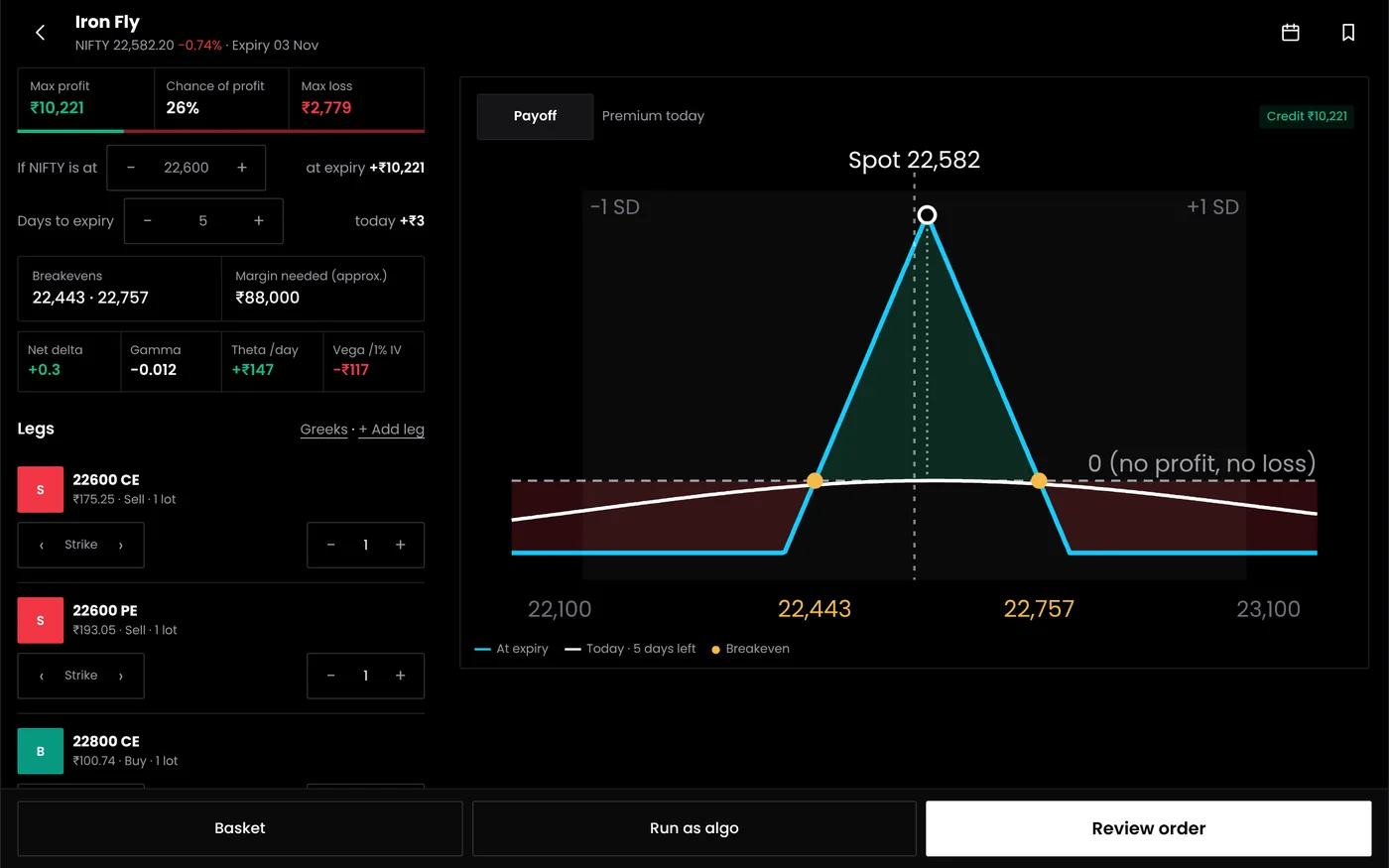
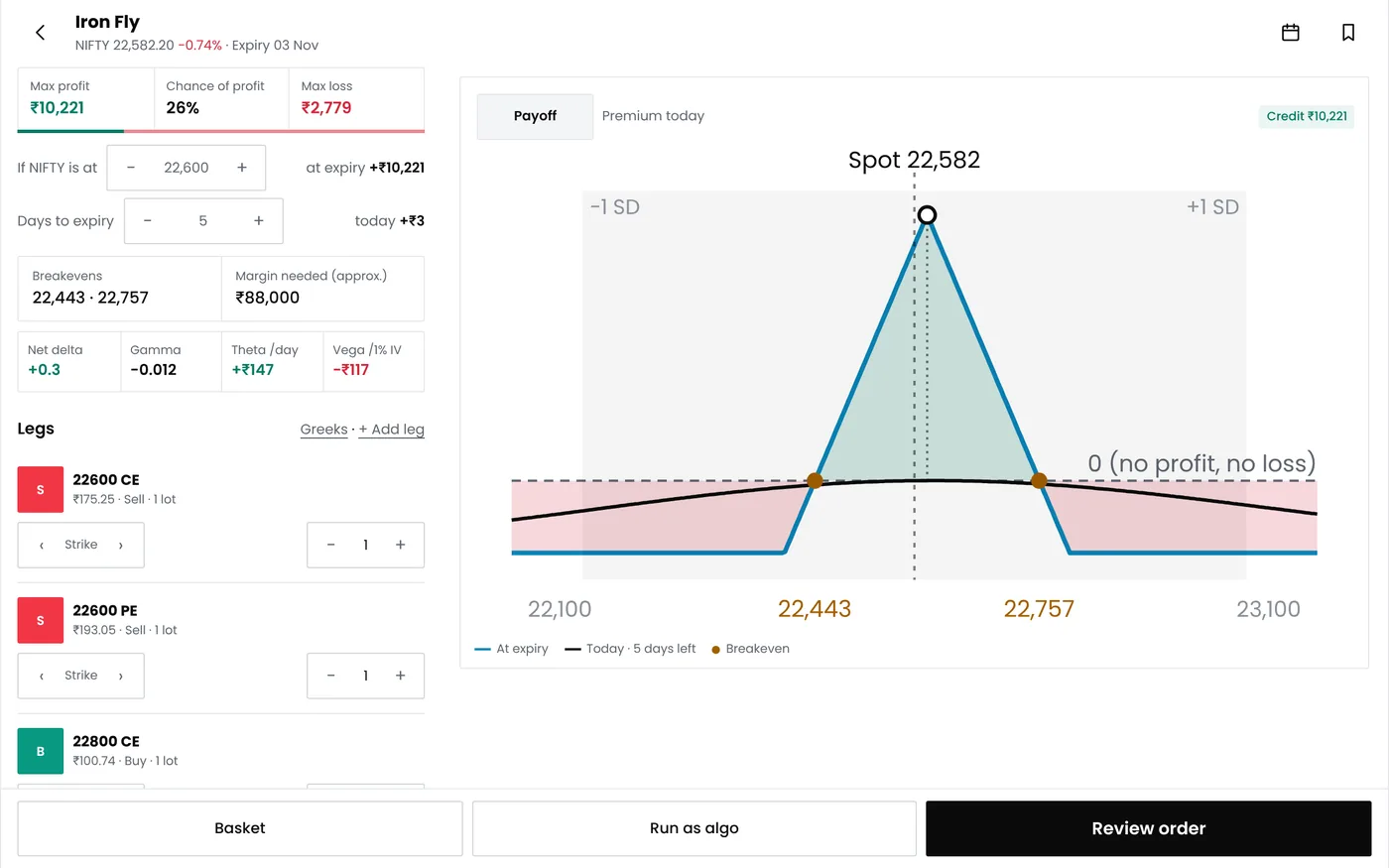
In the strategy builder, choose the iron condor preset, set the index to Bank Nifty and the expiry to the current month, and set lots to 1.
Step 2. Set the exits and filters
Enter the target, the stop, the time exit and the event filter.
Step 3. Backtest on monthly expiries
Run the rules over past monthly expiries in the backtesting engine, with costs and slippage on. Leave out the weekly era for this strategy.
Step 4. Paper trade a full cycle
Run it on live prices with virtual money for at least one full monthly cycle, including an RBI week.
Step 5. Set the account limit
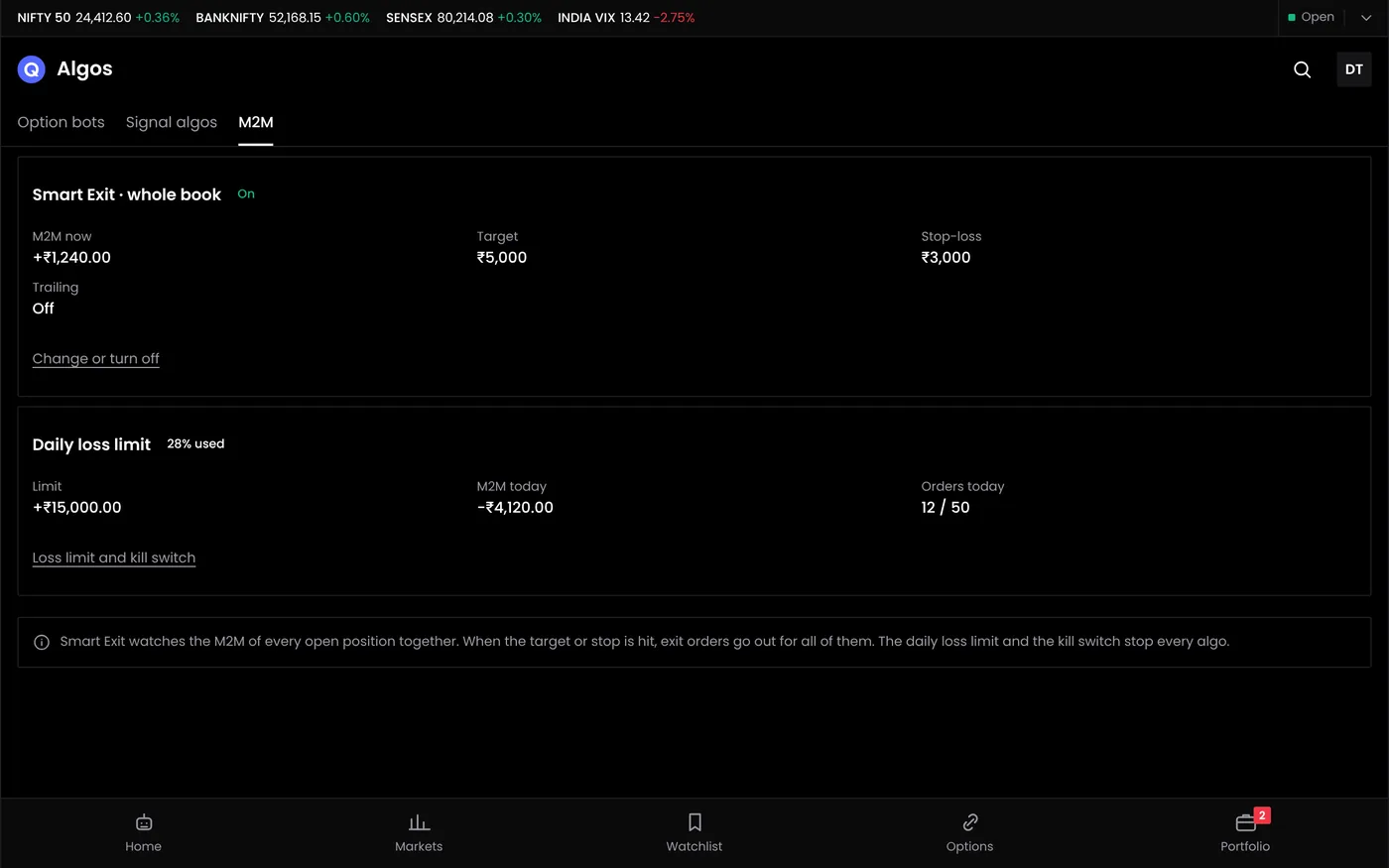
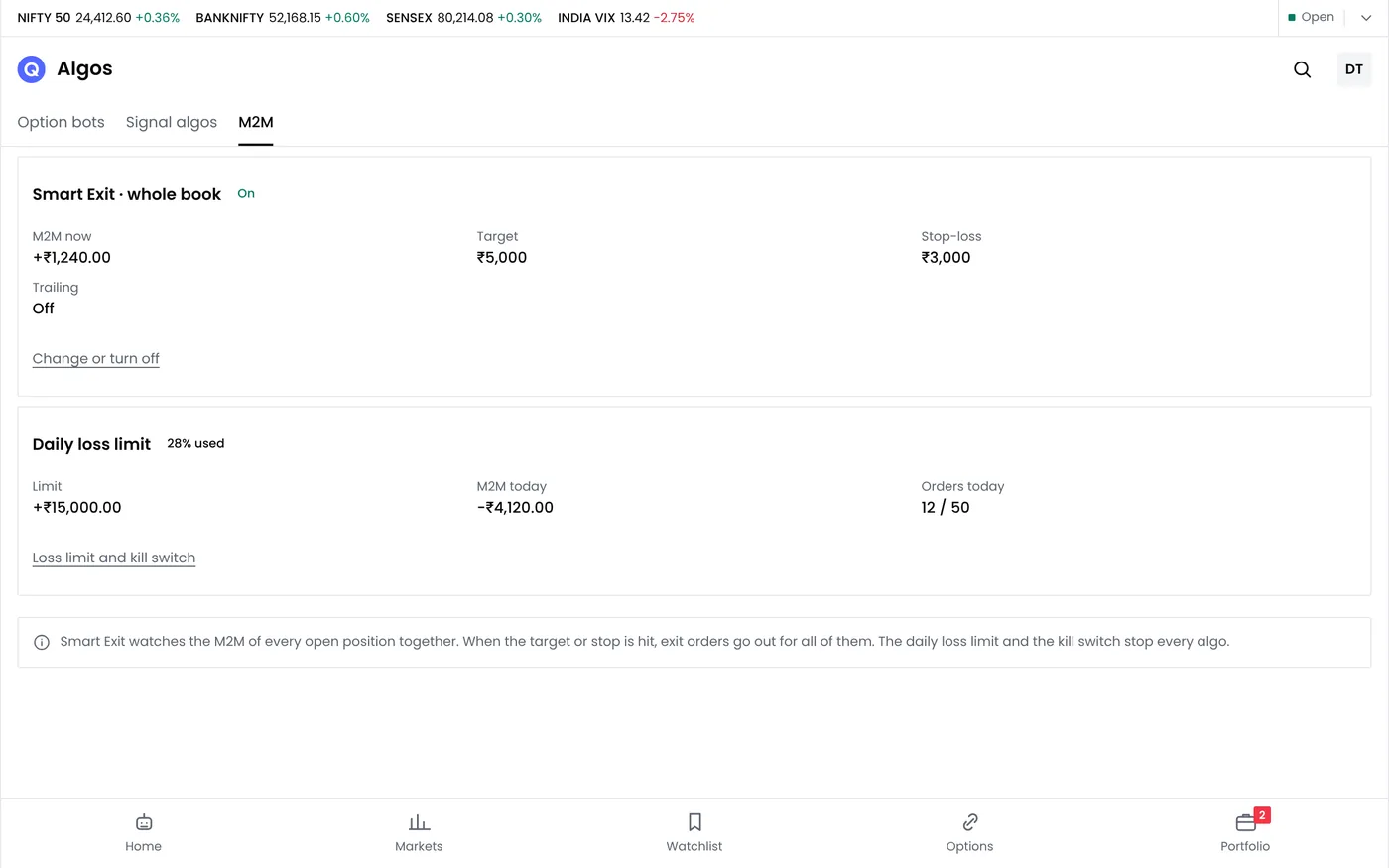
Set the daily MTM loss limit in the risk settings before going live.
Step 6. Deploy the bot
Connect your broker, choose the strategy and lots, confirm the limits and deploy.
Step 7. Monitor and pause
Watch the position through the cycle and use Pause all if you need to stop every bot at once. Orders run on your own broker account within SEBI's retail algo framework, through the broker's API.
Managing risk on Bank Nifty
- Size for larger moves. A one standard deviation move in Bank Nifty is larger in points, and usually in percentage terms, than in Nifty.
- Watch liquidity on far strikes. Out-of-the-money monthly options can have wider spreads than Nifty weeklies.
- Respect event days. RBI policy and bank results can gap the index.
- Add up exposure. Banks are a large part of Nifty 50, so Bank Nifty and Nifty positions are closely related.
- Use an account limit. An MTM stop loss protects the account when several strategies lose together.
Common Bank Nifty mistakes
- Using Nifty-sized strike distances on an index that moves more.
- Treating a monthly straddle like a weekly one, expecting fast decay that no longer happens early in the cycle.
- Ignoring vega on positions far from expiry.
- Ignoring RBI policy days and major bank results.
- Running the same short position on Bank Nifty and Nifty and treating them as separate risks.
- Backtesting on weekly-era data for a strategy that can only trade monthly options now.
Pre-trade checklist
- The expiry is the current monthly contract, and you know where you are in the cycle.
- Strikes and wings are set for Bank Nifty's range, not Nifty's.
- No RBI policy decision or major bank result falls before your planned exit, or the position is hedged for it.
- The target, the stop and the time exit are entered.
- The daily MTM limit is set for the account.
- The position size is based on a large daily move, not on the margin.
- The strategy has been backtested on monthly expiries with costs and paper traded.
Frequently asked questions
Does Bank Nifty still have weekly expiry?
No. Since November 2024, Bank Nifty options have monthly expiries only, on the last Tuesday of the month. NSE's only weekly index options are on Nifty 50.
What is the Bank Nifty lot size?
30 units from the January 2026 series. Check NSE's contract specifications for the current size.
Is Bank Nifty more volatile than Nifty?
Historically, Bank Nifty has moved more than Nifty 50 in percentage terms, partly because it is concentrated in one sector. Its implied volatility usually runs several points higher.
What is the best Bank Nifty strategy?
There is no single best one. Defined-risk selling such as iron condors suits the monthly cycle for range views; spreads suit directional views; opening range breakouts suit intraday momentum. The right choice depends on your view, your risk limit and how the rules test over past monthly expiries.
Can I still trade intraday straddles on Bank Nifty?
Yes, on the monthly contract. Each session decays less of the premium than weekly options did near expiry, so the strategy relies more on quiet days and tight stops.
How much margin does a Bank Nifty position need?
A lot of Bank Nifty has a contract value of about ₹16.8 lakh at 56,000, so margins are of a similar order to a lot of Nifty for the same position. Hedged positions need far less, and short options need more on expiry day. Check your broker's calculator.
When does Bank Nifty expire if the last Tuesday is a holiday?
On the previous trading day. The Nifty expiry date shows the moved dates.
Can I automate Bank Nifty strategies?
Yes. Strategies built in QuantPower run as bots on your own broker account within SEBI's retail algo framework, which has applied in full since 1 April 2026. Orders carry an exchange-assigned Algo ID.
Related guides and terms
- Nifty option trading, FinNifty option trading and Sensex option trading
- Iron condor strategy, iron fly strategy, short strangle strategy and short straddle strategy
- Opening range breakout strategy and option buying strategies
- Bank Nifty option chain and the Nifty expiry date
- Options risk management and how to place stop loss order
- Terms: Lot size meaning, expiry meaning, vega meaning, theta meaning, what is margin in trading
- Hero zero option trading
Start your free trial
Connect your broker, build a strategy and test it on paper before a single live order goes out.
Sources
- NSE: Equity derivatives contract specifications (lot size, strike interval, expiry day)
- SEBI circular SEBI/HO/MRD/TPD-1/P/CIR/2024/132: Measures to strengthen the equity index derivatives framework, 1 Oct 2024 (one weekly expiry per exchange, expiry-day extreme loss margin)
- SEBI circular on safer participation of retail investors in algorithmic trading, 4 Feb 2025, and the implementation timeline to 1 April 2026
- NSE trading holiday list for 2026
- Black, F. and Scholes, M. (1973). The Pricing of Options and Corporate Liabilities. Journal of Political Economy, 81(3), 637–654